Environment · 6 min read
Understanding indoor air quality
Understand sources, ventilation, filtration, moisture, and the hazards that need their own tests—not a single air-quality score.
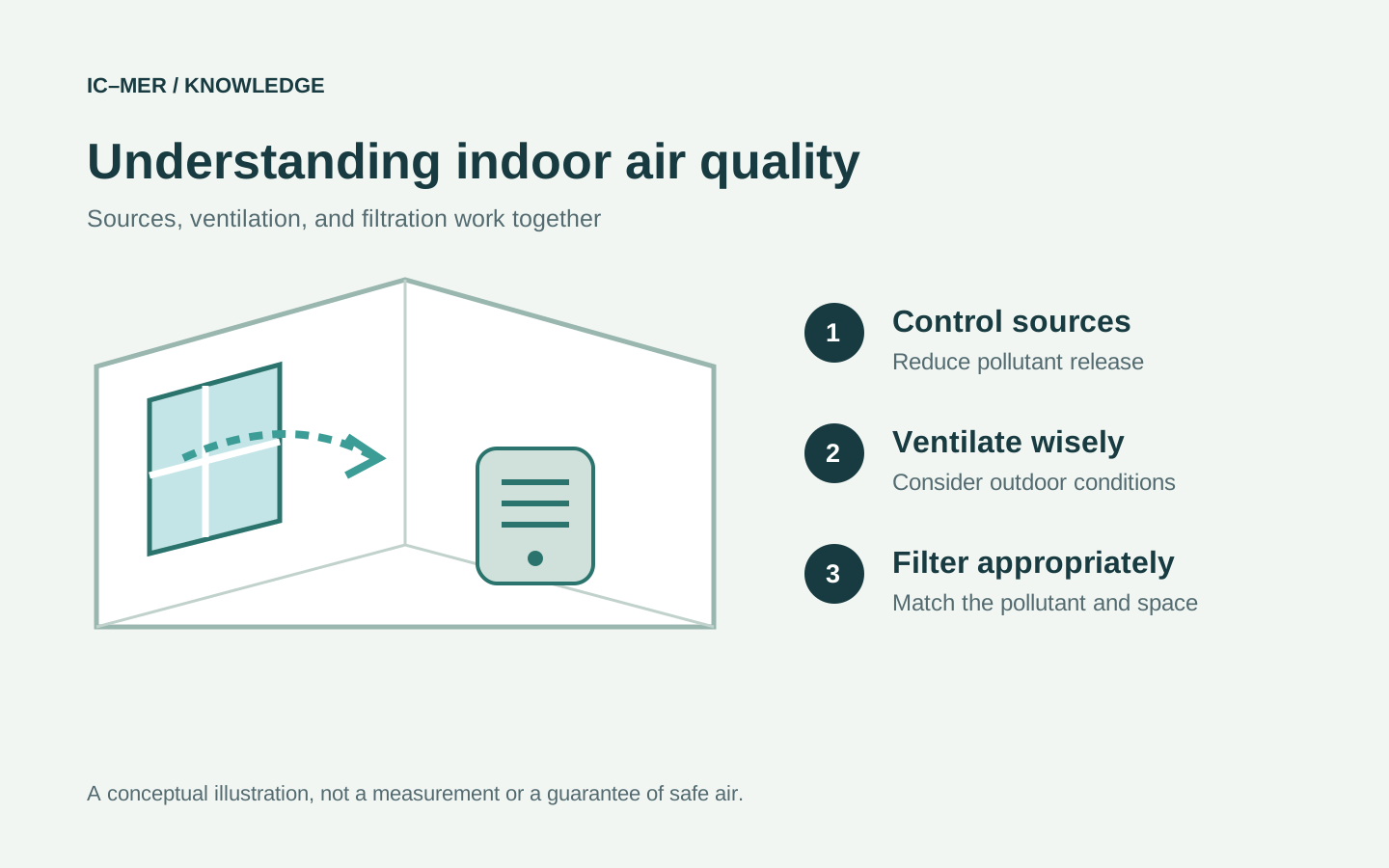
General educational information, not personal medical advice or a building safety certification. Seek qualified help for hazards or individual health concerns.
Information may contain errors, omissions or outdated guidance. This article is general education, not individual medical or other professional advice. Verify important information before acting and consult an appropriately qualified professional. Never disregard medical advice, delay care or change treatment because of this article. See our accuracy disclaimer and terms.
Begin with a question, not a device
“Is the air good?” sounds like one question, but a useful investigation separates several possibilities. Is there a source of particles? Is moisture accumulating? Could combustion exhaust be entering the space? Is a particular activity associated with the concern? What would an appropriate test actually tell us?
For a homeowner or small organization, the first useful product is often a written description of the problem. Note the room, the time, what was happening, whether heating or cooling was running, and what changed recently. This does not diagnose illness or prove causation. It helps avoid buying equipment to solve a problem that has not yet been identified.
The approach below draws on U.S. environmental and public-health guidance. It is intended for general education. Specialized workplaces, laboratories, and healthcare facilities may require assessments and ventilation arrangements beyond the scope of a household guide.
Understand the three main control approaches
EPA’s air-cleaner guide describes three complementary approaches: reduce pollutant sources, ventilate with clean outdoor air, and filter selected pollutants. A filter is a supplement; it does not remove every contaminant or correct every source.
For example, a recurring concern during a particular cleaning task should prompt a review of the products and how they are used, rather than an automatic assumption that the building needs a larger purifier. Product instructions matter. “Clean outdoor air” is an important condition: an outdoor smoke problem changes the ventilation question.
Assign the next question to someone who can answer it. A resident can describe an activity, while a building manager may need to establish where an exhaust duct terminates or how the ventilation system operates. Avoid equating the sensation of moving air with verified pollutant removal.
Sources: [1]
Know what filtration can and cannot do
HEPA filters capture particles; gas removal needs suitable gas-filtering media. For portable particle cleaners, the clean air delivery rate, or CADR, helps match capacity to room size. Lower fan settings clean less air, so check the setting you intend to use.
Choose an HVAC filter the system can accommodate, replace filters as directed, and keep portable-cleaner airflow unobstructed. Avoid devices that intentionally generate ozone, a lung irritant.
When comparing products, make a small comparison sheet: intended pollutant, room served, operating setting, noise, replacement-filter cost, and placement. Ask who will maintain the unit and how the team will know whether its intended purpose is being achieved. This turns a purchase into an accountable task. An equipment receipt should not be treated as the final answer to a recurring building concern.
Sources: [1]
Treat dampness as a building problem
EPA identifies moisture control as central to preventing indoor mold growth. Cleaning a patch without fixing the water source allows the problem to recur. Its guidance recommends keeping relative humidity below 60 percent and, where feasible, around 30–50 percent. These are general prevention recommendations, not proof that every surface in a room is dry.
Inspect the history of leaks, condensation, and water damage. Prompt drying matters: EPA advises drying water-damaged areas and items within 24–48 hours to help prevent mold growth. Large areas, contaminated water, suspected hidden damage, or a potentially affected HVAC system can require professional assessment. People with health concerns should discuss those concerns with a clinician.
A practical record might include a dated photograph of a stain, when it first appeared, the repair requested, who is responsible, and whether dampness returns after rain. This is a maintenance record, not a claim that a photograph identifies a mold species. Keep the goal clear: find and correct the moisture pathway, then verify the repair.
Sources: [2]
Recognize carbon monoxide as an urgent hazard
Carbon monoxide, or CO, is a poisonous gas that cannot be reliably detected by sight or smell. CDC’s National Institute for Occupational Safety and Health warns that gasoline-powered engines and tools can produce dangerous concentrations in enclosed or partly enclosed areas. An open door does not make an indoor engine safe.
Use appropriate CO alarms and follow their instructions. If a CO alarm sounds or exposure is suspected, get everyone outside to fresh air and call emergency services from outside; in the United States, call 911. Do this even if no one feels ill. Headache, dizziness, confusion, or nausea require prompt medical attention when CO exposure is possible. Do not reenter until emergency responders permit it, or attempt an unsafe rescue.
For a workplace using fuel-powered equipment, prevention includes identifying exhaust sources and keeping exhaust away from building openings and air intakes. This needs a specific safety plan. A consumer particle reading, a pleasant odor, or a history of using the same equipment without trouble does not establish that CO is absent.
Test for radon rather than guessing
Radon is a radioactive gas associated with lung-cancer risk. EPA’s guidance explains that testing is the way to determine a home’s radon level; the condition cannot be inferred from appearance. Homes can have a problem regardless of whether they are new, old, or have a basement.
EPA recommends corrective action at or above 4 picocuries per liter (pCi/L), and explains that lower levels are not risk-free. Follow the appropriate testing instructions and interpretation process, including follow-up where required. A qualified radon professional can help interpret the situation and plan mitigation; a generic air purifier is not a substitute for a radon assessment.
Keep the test date, device information, location, duration, result, and any mitigation records together. When moving into a property, ask for actual documentation rather than relying on “the air was tested.” The useful follow-up question is: tested for what, by which method, and under which conditions?
Sources: [4]
Use monitors as evidence with limits
Low-cost monitors measure particular pollutants or conditions, such as particles, carbon dioxide, temperature, or humidity. In a controlled study published in 2021, researchers found that consumer monitors varied in how closely they agreed with reference measurements. Detecting a pollution event did not necessarily mean measuring its concentration accurately. That study assessed selected devices, not every product available today.
Before purchasing a monitor, identify the question it is supposed to answer. If the concern is a recurring particle spike, look for evidence about particle-measurement performance. If the concern is dampness, a humidity measurement answers a different question. Confirm what the unit measures directly and what it estimates, and read its placement and maintenance instructions. A combined “air quality” score cannot establish that all possible hazards are absent.
A fictional office might note that a monitor reading changes during a scheduled activity. That observation can guide further investigation, but does not by itself prove which substance was present, where it came from, or whether it caused a person’s symptoms. Preserve the raw observations and the uncertainty rather than translating one colored indicator into “safe” or “unsafe.”
Sources: [5]
Turn observations into an accountable plan
Make a short action log with four columns: observation, next check, responsible person, and review date. A musty storage room, a suspected exhaust problem, and an occasional particle reading should not all receive the same response. Prioritize urgent hazards first; then distinguish maintenance work from questions needing specialized measurement or professional assessment.
For a rented or shared building, provide the manager with a precise description and ask for a documented response. For a small organization, identify who receives complaints and who can authorize repairs. Do not require occupants to prove a medical diagnosis before recording and investigating a building concern.
After any intervention, ask whether the original problem was addressed and how that conclusion was reached. A new device receipt is evidence of a purchase, not evidence of a resolved problem. The strongest record connects the observation, the corrective work, the follow-up check, and any remaining uncertainty. That makes the next decision easier and helps prevent the same issue from being repeatedly rediscovered.
Sources & further reading
- Guide to Air Cleaners in the Home, second editionChecked 2026-10-20
- A Brief Guide to Mold, Moisture, and Your HomeChecked 2026-10-20
- Carbon Monoxide Hazards at WorkChecked 2026-10-20
- Home Buyer's and Seller's Guide to Radon, March 2024Checked 2026-10-20
- Performance assessment of low-cost environmental monitors and single sensors under variable indoor air quality and thermal conditions (2021; author-hosted abstract)Checked 2026-10-20
- Carbon Monoxide Fact SheetChecked 2026-10-20
About this article
Prepared with AI assistance and an AI fact-checking pass against the sources listed above. No human clinical review is claimed. Evidence may change; consult appropriate qualified professionals for decisions about your circumstances.
Spotted a problem? Suggest a correction.