Environment · 4 min read
Air quality index: using outdoor air information wisely
Use the U.S. air quality index to plan outdoor activity while recognizing forecast limits, sensitive groups and the limitations of low-cost sensors.
General environmental-health education about the U.S. AQI, not a real-time local air-quality report or personal medical advice. Follow current official local alerts and individual clinical advice. Prepared with AI assistance; the activity scenario is hypothetical.
Information may contain errors, omissions or outdated guidance. This article is general education, not individual medical or other professional advice. Verify important information before acting and consult an appropriately qualified professional. Never disregard medical advice, delay care or change treatment because of this article. See our accuracy disclaimer and terms.
Know which index you are reading
The U.S. Air Quality Index, or AQI, communicates outdoor air pollution and related health concern. Higher numbers indicate greater concern. It is an index, not a percentage of polluted air, a personal dose or a medical test. Other countries may use different scales, so check the country and system before comparing numbers across travel destinations.
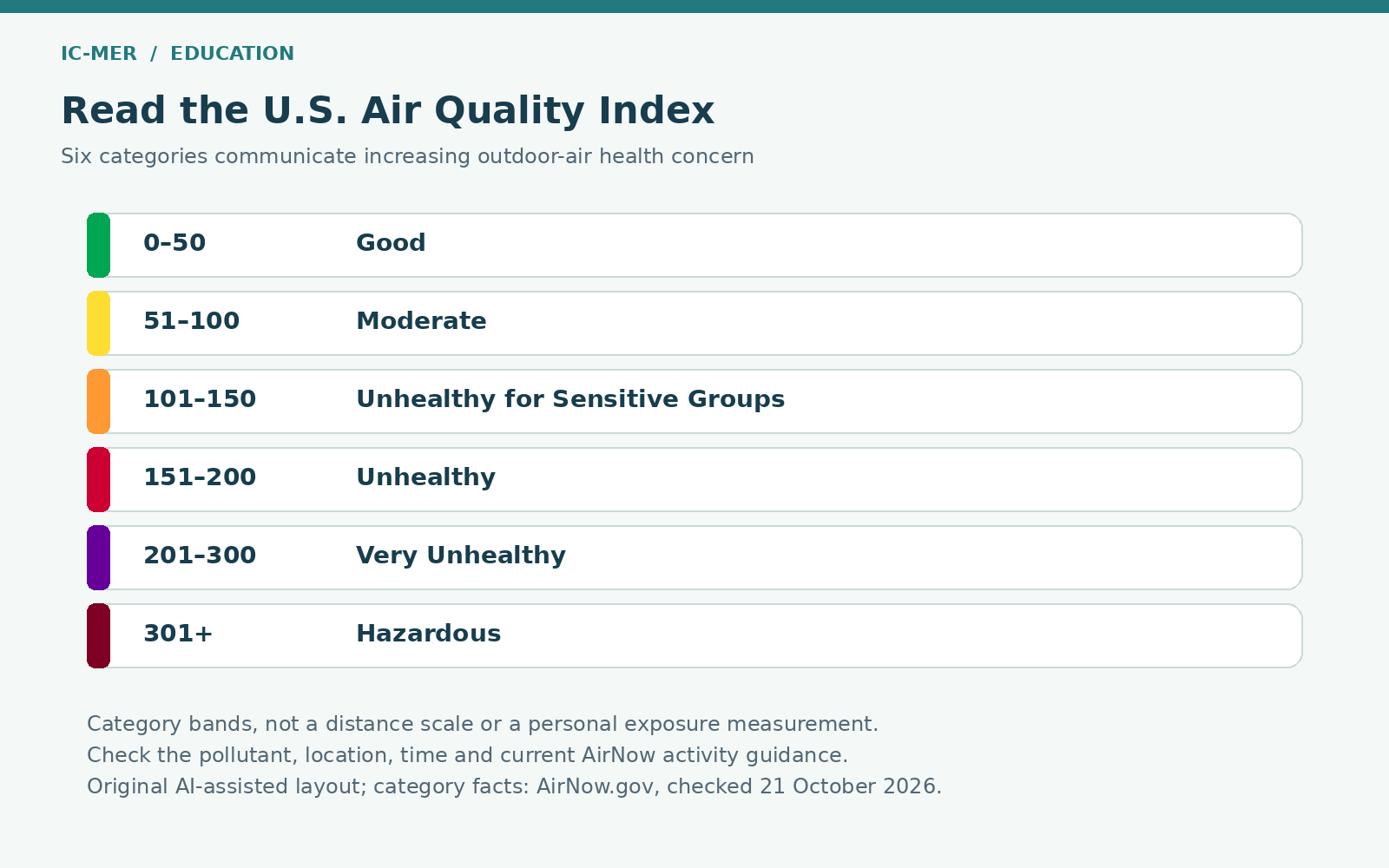
The U.S. categories are Good at 0–50, Moderate at 51–100, Unhealthy for Sensitive Groups at 101–150, Unhealthy at 151–200, Very Unhealthy at 201–300 and Hazardous at 301 or higher. Their colors run from green through yellow, orange, red, purple and maroon. Use the category name as well as the color, especially when sharing information with someone who may not distinguish all colors.
The index covers ozone, particle pollution, carbon monoxide, sulfur dioxide and nitrogen dioxide. A displayed number does not describe every possible airborne hazard. Read which pollutant is driving the report and the associated health message. AirNow’s current maps and readings focus on ozone and particle pollution; not every location reports every AQI pollutant.
Separate a completed day, a forecast and a current estimate
AirNow distinguishes the daily AQI, forecasts and the NowCast. Time periods differ by pollutant: its guide describes ozone’s daily index as based on eight hours and particle pollution’s as based on twenty-four hours. A forecast predicts conditions; it is not a measurement of the air you are breathing at that moment.
The NowCast relates recent monitor readings to the AQI scale using multiple hours of data. It is designed to respond to changing conditions while retaining information from preceding hours. Check the timestamp, location and whether the display says forecast or current. Two numbers can differ because they represent different times or products, rather than because one must be wrong.
Before an outing, review the forecast for planning and refresh current information nearer departure. During rapidly changing smoke or weather conditions, an old screenshot can be misleading. Share the source and observation time along with a number.
Sources: [2]
Turn information into an activity plan
AirNow’s categories distinguish concern for sensitive groups from broader population risk. Moderate air quality can still matter to unusually sensitive people. As categories worsen, health concerns extend more widely. The relevant sensitive groups and recommended actions depend on the pollutant, so read the specific guidance rather than treating every orange day as an identical situation.
For an original planning example, imagine a community group preparing an outdoor walking event. Its organizer could assign someone to check the official local report, identify an indoor alternative, and communicate any change before participants travel. The organizer should consider the duration and intensity of activity and whether participants have individual clinical plans. This example is a planning framework, not a universal cancellation threshold.
A clinician’s individualized advice and local emergency instructions take priority over a generic planning example. Do not use a favorable AQI value to dismiss symptoms or assume that every participant has the same tolerance.
A regional number is not your personal exposure
A report describes conditions represented by its monitoring and reporting system. Your experience also depends on where you are, how long you stay and what is happening nearby. For practical planning, write down the actual location of an activity instead of relying on a remembered number for an entire metropolitan area. Check local advisories when smoke, fires or unusual releases are relevant.
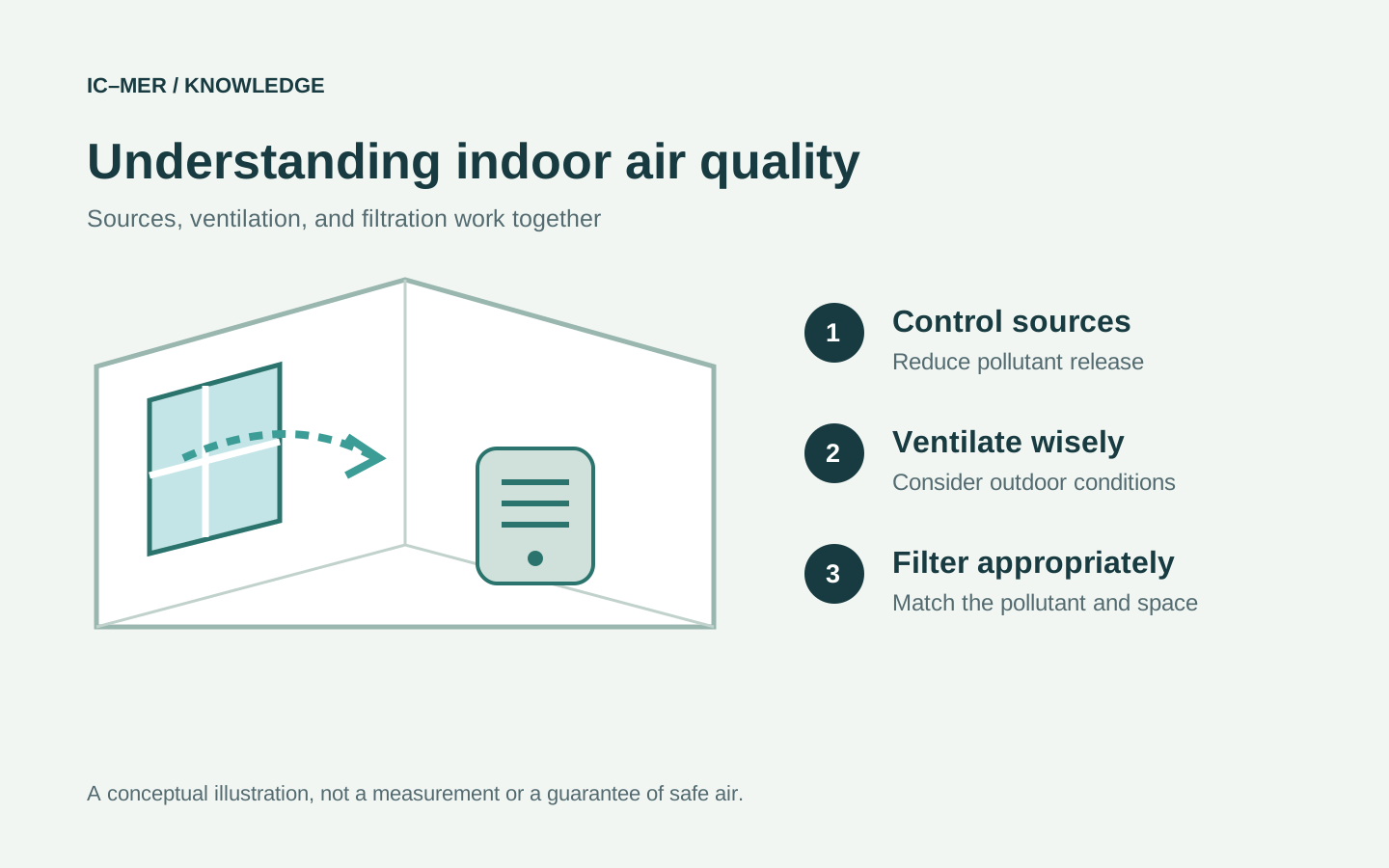
Outdoor AQI also does not establish indoor air quality. A building can have its own pollutant sources and ventilation conditions. Moving an activity indoors therefore requires thought about the available space, not an assumption that any room is automatically suitable. See IC-MER’s indoor-air guide for the separate questions of sources, ventilation and filtration.
When information is missing, say that it is missing. A blank map area or unavailable monitor reading is not a measurement of clean air. For a group plan, record the fallback source you will check and who will make the decision if updates are delayed.
Use low-cost sensors as additional information
EPA notes that air sensors vary in the pollutants they measure and may produce biased or questionable readings. Temperature, humidity, calibration and other operating conditions can affect accuracy. A consumer device should not be treated as a complete detector of every hazard simply because it displays one reassuring score.
If you use a sensor, identify the pollutant, units, averaging period and maintenance requirements. Compare like with like: a raw particle concentration and an AQI number are different quantities. Investigate an unexpected spike by checking the device and surrounding conditions, while following official alerts and health guidance. Do not erase a concerning result solely because it is inconvenient, or treat one unverified reading as proof of a regional emergency.
A useful final checklist is short: right location, right time, named pollutant, official category, relevant health message and a practical alternative activity. The AQI is most useful when it supports a timely decision with its limitations visible.
Sources: [3]
Sources & further reading
- AirNow: Air Quality Index BasicsChecked 2026-10-21
- AirNow: Using the Air Quality IndexChecked 2026-10-21
- EPA: Frequent Questions About Air SensorsChecked 2026-10-21
- EPA: Introduction to Indoor Air QualityChecked 2026-10-21
- AirNow: Activity GuidesChecked 2026-10-21
- AirNow: About the DataChecked 2026-10-21
About this article
Prepared with AI assistance and an AI fact-checking pass against the sources listed above. No human clinical review is claimed. Evidence may change; consult appropriate qualified professionals for decisions about your circumstances.
Spotted a problem? Suggest a correction.