Medicine · 7 min read
Healthy eating on a budget: practical shopping and cooking habits
Spend on food you can use: compare prices fairly, plan flexible meals and make leftovers part of the plan.
General nutrition education for adults, not an individualized diet or treatment plan. Discuss medical dietary restrictions with a qualified clinician or registered dietitian.
Information may contain errors, omissions or outdated guidance. This article is general education, not individual medical or other professional advice. Verify important information before acting and consult an appropriately qualified professional. Never disregard medical advice, delay care or change treatment because of this article. See our accuracy disclaimer and terms.
Budget for meals that will actually happen
A low grocery bill is useful only if the food becomes meals. A bargain that spoils, a recipe that requires equipment you do not own or a large pack you cannot carry may cost more in practice than a smaller convenient option. Start with the money, time, transport, refrigeration and cooking equipment available to you. A realistic plan respects all of those limits.
Rather than planning an ideal month, choose a few days you can see clearly. Note which meals will be eaten at home, which need to travel and when there will be time to cook. Then check the cupboard, refrigerator and freezer before making a list. The sample prices below are invented to explain arithmetic; they are not current store prices or a promise of savings.
Choose versatile foods before choosing recipes
The current U.S. dietary guidance supports a pattern built around nutrient-dense foods and recognizes frozen and canned produce with little or no added sugar as useful options. You do not need specialty products to begin planning varied meals. Look for ordinary ingredients that can work in several dishes and that your household enjoys.
A possible short list might include oats or another grain, beans or lentils, eggs or tofu, a vegetable that stores well and fruit you expect to eat. These are examples, not a nutritionally complete shopping prescription. Prices and suitability differ by location, season, dietary restrictions and what is already at home. Replace an ingredient when another provides a better practical fit.
Try assigning each perishable item to two meals before buying it. A cabbage might be used in a cooked vegetable dish and a slaw; cooked beans could accompany rice and later become part of a soup. If you cannot name a use, consider leaving the item out of this trip. A discount sticker should support the plan rather than write it.
Sources: [1]
Compare equal amounts, then check the cash cost
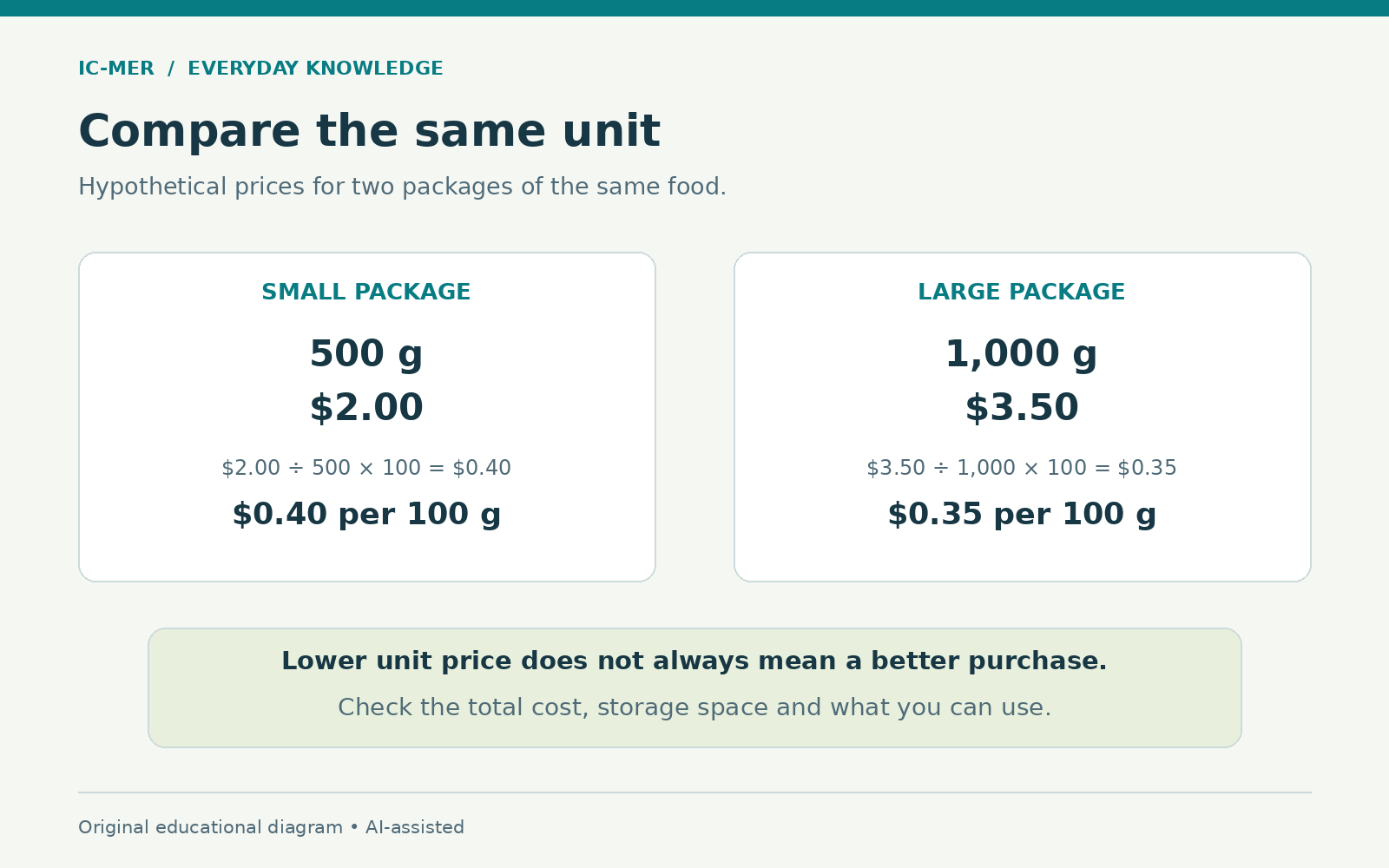
Unit price means price for a standard quantity. Compare the same units, such as dollars per 100 grams, rather than the package price alone. In a hypothetical comparison of the same food, a 500-gram package costing $2.00 is $0.40 per 100 grams. A 1,000-gram package costing $3.50 is $0.35 per 100 grams. The second has a lower unit price but requires $1.50 more at checkout.
The larger purchase is useful only if you can afford, store and use it. If you need just 500 grams and the rest will be discarded, the first package may be the better decision. Do not assume that a large package or a sale is always cheaper. Check that the comparison concerns the same form of food: dried beans and ready-to-eat beans, for example, differ in preparation and water content.
When shelf labels use different units, calculate one common unit on your phone or compare matching package sizes. Include a membership fee, delivery charge or extra trip if it changes your real cost. A small saving on a product can disappear if obtaining it creates another expense. Choose a comparison simple enough to repeat on an ordinary shopping day.
Make a short flexible menu
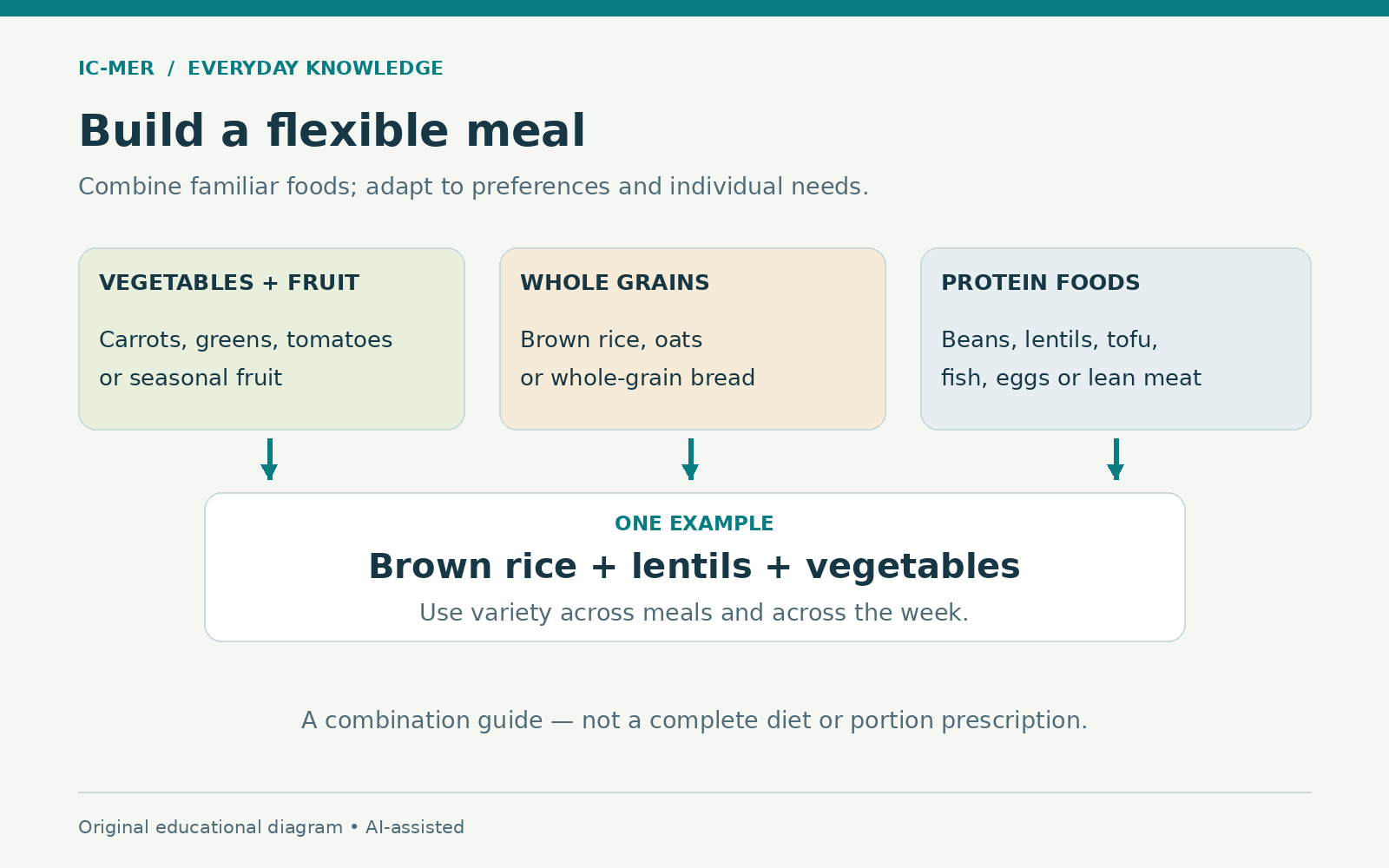
Here is an original planning example, not a prescribed diet. On the first evening, a household cooks rice, beans and vegetables. The next day, safely stored components can be served in a different combination, perhaps with an egg or another suitable ingredient. On a busy evening, a shelf-stable food plus a frozen vegetable may complete a quick meal. The goal is to reduce unused ingredients, not to eat the same thing indefinitely.
Write the menu in terms of functions rather than exact brands: a protein food, a vegetable, a grain or staple and any additional item that completes the meal. This makes substitutions easier when a favorite product is unavailable or expensive. If you have a medical meal plan, keep its requirements when substituting instead of assuming all foods in a category are interchangeable.
Leave one flexible slot for food remaining at the end of the plan. Check what needs using soon before deciding what to cook. A clear shelf or container marked for the next meal can make food easier to notice. Avoid relying on memory for when cooked food was prepared; a date label is more useful.
Use labels without paying for health slogans
FDA’s Nutrition Facts guidance can help compare the amounts of nutrients in equivalent servings. A product described as fashionable, natural or high in something is not automatically the best use of your budget. Compare the information relevant to your needs, then consider taste, portion size and price.
For instance, when choosing among similar canned foods, look at sodium amounts on the same serving basis. When comparing breakfast products, consider added sugars and fiber as well as the price of the package. These are comparison examples, not a claim that one label number determines the quality of your whole diet. An item that is inexpensive and works in your meals may be a sensible choice without prominent wellness advertising.
If a recipe calls for several costly specialty ingredients, ask whether you can make a simpler version using familiar foods. Do not replace foods needed for a diagnosed allergy or other medical restriction solely to reduce cost. In that situation, a dietitian or the relevant care team may help identify suitable lower-cost options.
Sources: [2]
Count time and energy as real constraints
Cooking dried ingredients may reduce the purchase price, but it can require time, fuel, water and suitable storage. A ready-to-use alternative may fit better on a day when those resources are limited. Compare the whole task, not just the price of the raw food. No single shopping style is cheapest for every household.
If you cook a larger batch, choose an amount you can cool, store and use safely. Preparing a double quantity is not automatically helpful when the refrigerator is crowded or the household dislikes leftovers. You might instead prepare one component, such as chopped vegetables, for two different meals. A small amount of preparation that gets used is more valuable than an ambitious system abandoned after a week.
Keep an easy option for low-energy days. It could be an assembled cold meal, a microwave-friendly dish or another combination suited to the equipment available. Convenience is not a failure. A plan that anticipates fatigue may work better than one that assumes cooking from scratch every evening.
Protect the value of leftovers with safe storage
FoodSafety.gov advises refrigerating perishable food within two hours, or within one hour when temperatures are above 90°F (32°C). Keep the refrigerator at 40°F (4°C) or below. Use shallow containers so leftovers cool promptly. The official cold-storage chart lists many cooked leftovers, including cooked meat or poultry and soups, for three to four refrigerated days; check the entry for the actual food.
Do not plan to keep all of a week’s cooked meals in the refrigerator. Freeze suitable portions you will not use within the recommended time. Label them with the contents and date, and leave space to keep food properly chilled. Reheat leftovers to 165°F (74°C), checked with a food thermometer. Freezing or reheating does not make food safe again after unsafe handling.
Budget pressure does not change these safety limits. If refrigeration fails or food has been left out too long, use current food-safety guidance rather than smell or appearance to decide. Build smaller batches when safe storage is uncertain. Avoid spending scarce money on a bulk purchase that depends on refrigeration you cannot rely on.
Review the plan without blaming yourself
At the end of a shopping cycle, notice three things: which foods became useful meals, which were wasted and which missing items led to extra spending. Make one adjustment. Perhaps the next trip needs a smaller bag, another frozen option or fewer recipes. Keep a brief price note for regularly purchased items if that helps you recognize a genuine saving.
Food costs and access are not fully under individual control. If there is not enough food, local food assistance may be more useful than another budgeting trick. Check official local services for current eligibility and availability. The purpose of this approach is to make available resources work better, not to imply that planning alone can solve every shortage.
Sources & further reading
- Dietary Guidelines for Americans, 2025–2030Checked 2026-10-22
- How to Understand and Use the Nutrition Facts LabelChecked 2026-10-22
- Four Steps to Food SafetyChecked 2026-10-22
- Cold Food Storage ChartChecked 2026-10-22
- Safe Minimum Internal TemperaturesChecked 2026-10-22
- Are You Storing Food Safely?Checked 2026-10-22
About this article
Prepared with AI assistance and an AI fact-checking pass against the sources listed above. No human clinical review is claimed. Evidence may change; consult appropriate qualified professionals for decisions about your circumstances.
Spotted a problem? Suggest a correction.