Environment · 10 min read
Private well water: testing and everyday household care
Build a practical private-well testing and care routine. Know when to seek extra testing, how to use a certified lab and what to do after suspected contamination.
General household well-water education, not a safety certification or repair instruction. Follow current local health-department guidance and use qualified well professionals for suspected contamination, flood damage or treatment decisions.
Information may contain errors, omissions or outdated guidance. This article is general education, not individual medical or other professional advice. Verify important information before acting and consult an appropriately qualified professional. Never disregard medical advice, delay care or change treatment because of this article. See our accuracy disclaimer and terms.
Know where the water reaching your tap begins
A private well can be easy to forget when water arrives reliably at the kitchen sink. Unlike a public water customer, however, a household using its own drinking-water well needs a plan for testing and upkeep. Start by confirming the source: does the home use a private well for drinking, a public supply, a shared system, or a well used only for irrigation? The answer determines which guidance applies.
Do not assume that an irrigation well supplies water suitable for drinking, or that a public utility’s annual water report describes a separate household well. If you are buying or renting a property, ask for the actual source, recent testing records and the person responsible for maintenance. A description in a listing is not a substitute for a result tied to the correct well.
This guide focuses on ordinary household drinking-water wells in the United States, with a Florida testing resource included. It does not certify any well, provide a construction design or replace local instructions after a flood or contamination event. Shared systems, rental arrangements and particular uses can raise additional requirements.
Make testing a routine, not a reaction to taste
CDC recommends testing well water at least yearly for total coliform bacteria, nitrate, total dissolved solids and pH, with additional testing for local concerns. Its guidance explains that federal rules protecting public drinking-water systems do not apply in the same way to privately owned wells. State and local requirements still need checking for the actual property and use.
A clear glass of water does not provide a complete account of what is in it. Changes in taste, odor or appearance can be reasons to investigate, but the absence of a change does not replace testing. The task is to get suitable laboratory information and understand what was tested, rather than relying only on the household’s senses.
Make the annual step easy to remember. Put the last test date and the next planned review in one record, along with the laboratory’s contact information. This organizational suggestion is not a claim that one date makes water safe for the following year. An event that changes the risk can require action sooner.
Sources: [1]
Ask which tests fit the location
EPA advises additional testing when local conditions suggest other contaminants, and recommends contacting local health officials about groundwater concerns. Nearby land uses, plumbing, known contamination and changes around the property can affect the questions worth asking. A standard package does not test for every possible substance.
Before ordering, describe the well’s location and known history to the health department or qualified laboratory. Ask whether there are local recommendations beyond the routine panel. If the household includes an infant, someone who is pregnant or someone with particular health vulnerabilities, say so when seeking advice. Do not assume that a neighbor’s test answers the question for your own water.
In Florida, the Department of Health recommends private-well testing for bacteria and nitrate at least once per year and provides links to testing services and certified laboratories. Its listed bacteriological service is not automatically a complete nitrate or chemical panel. Ask which analyses are included, what requires a separate order and where those samples must go.
A useful order description names the actual tests rather than simply saying water quality. If you are comparing laboratories or quotes, compare their scopes as well as their prices. Keep the advice you received with the order so you can understand later why particular tests were selected.
Arrange the sample before turning on the tap
Use a laboratory certified for the drinking-water testing needed. Obtain its collection kit and instructions before taking a sample. Different analyses can require different containers, collection methods, preservation and delivery times. A clean-looking jar from the kitchen is not an adequate substitute for the specified container.
Ask where the sample should be taken and whether the question concerns untreated well water, treated household water or a particular tap. Tell the laboratory about existing treatment equipment. A result from one location should not silently be presented as describing another. Record the collection point and relevant equipment status.
Florida’s public health laboratory instructions illustrate why logistics matter: they specify a supplied kit, same-day delivery and temperature conditions for the service described. Other tests may have different requirements. Follow the instructions for your actual order rather than copying a generic procedure from a website.
Plan transport and receiving hours in advance. Taking a sample late on a day when the laboratory cannot accept it may create an unusable result and another fee. If you are unsure about a step, ask before collecting. An invalid sample is a reason to repeat the process correctly, not evidence that the water passed.
Sources: [3]
Read the report with help when needed
Keep the entire laboratory report, including the date, sample identity, units, methods or notes and the substances tested. A statement about one organism or chemical does not establish that all other hazards are absent. If a result is difficult to interpret, contact the laboratory and local health department.
For example, a household might receive a report for bacteria only and assume that the word satisfactory also covers nitrate. That conclusion does not follow from the test scope. Another household might compare numbers from different units or sampling points. Before drawing a trend, ask whether the two results can reasonably be compared. These are illustrative mistakes, not claims about a specific laboratory.
CDC explains that water-quality indicators help identify possible problems; they are not a complete inventory of every pathogen or chemical. A positive indicator requires appropriate follow-up, while a reassuring result still has the limits of what was sampled. Ask what the result means for immediate use and what next step is recommended.
Write the answer in ordinary language: what was found, what uses are affected, what action is needed, who will do it and when another sample is required. If someone else shares the household’s water, make sure they understand the instruction too. Do not reduce a complicated result to an unexplained green check mark.
Sources: [1]
Know the events that should interrupt the calendar
EPA identifies flooding, significant changes near the well, repairs and changes in water quality as reasons for additional testing. A yearly appointment is not a reason to wait after a new concern. Contact local health or environmental officials promptly when circumstances change.
Keep an event note alongside routine records. For instance, record when work was done on the pump, when water first appeared cloudy, or when floodwater reached the property. Include what you know and distinguish it from guesses. A short factual timeline is more useful to the professional assessing the system than a confident but unsupported explanation.
If illness seems connected with water use, seek medical advice as appropriate and tell the clinician about the suspected exposure. A laboratory water result cannot diagnose a person, and several household members becoming unwell should not be dismissed because the water tasted normal. Use official guidance about alternate water while the concern is assessed.
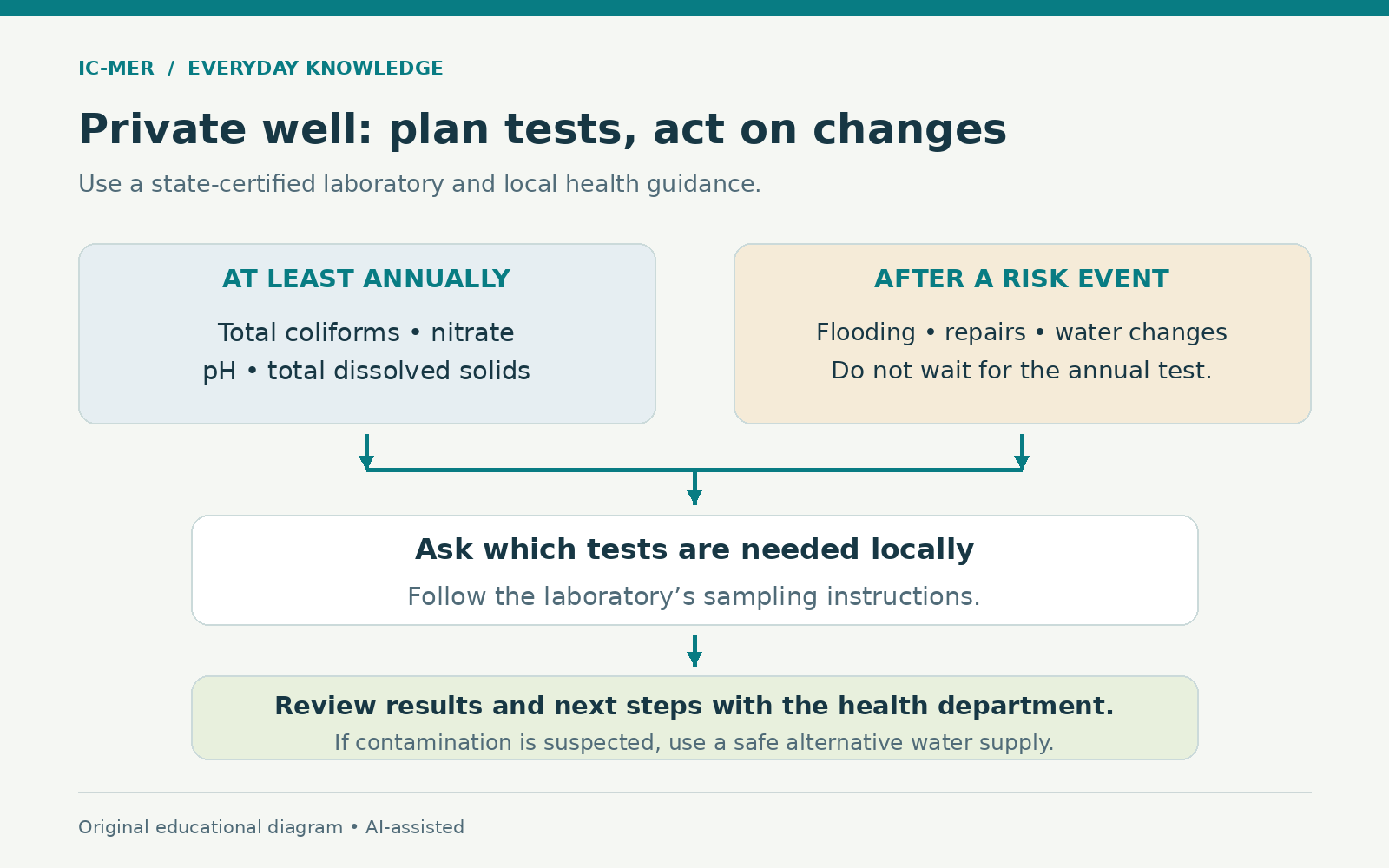
The diagram summarizes two routes into review: routine testing and a new risk event. Both lead to suitable testing and interpretation. It is a planning aid, not a statement that the same test panel or waiting period applies to every incident.
Sources: [2]
After flooding, protect people before restarting equipment
CDC advises using bottled water after a disaster until the supply is known to be free of contaminants and safe. If extensive flooding occurred or contamination is suspected, do not drink the well water. Well work after a disaster can involve electrical, structural and other hazards and should be handled by a well or pump contractor with local guidance.
Do not enter a well pit or reach into damaged equipment to investigate. Keep household members away from hazards and contact appropriate professionals. This article does not provide a bleach dose or a do-it-yourself disinfection sequence because the well, equipment and contamination circumstances need to be assessed.
If fuel or toxic chemicals may be involved, boiling or disinfecting the water will not make it safe. If water is contaminated with chemicals, do not drink or use it for any purpose until the contamination has been addressed and it is safe to use. Use a known safe alternative and contact local health officials about evaluation, treatment and clearance.
Before returning to normal use, obtain the recommended clearance information, including any required post-treatment tests and instructions. The end of flooding, the return of electricity or the disappearance of an odor is not by itself proof of water safety. Keep temporary instructions visible so a visitor does not accidentally use the wrong tap.
Match treatment to the problem that was found
CDC cautions that no single treatment method protects against every well-water problem. A filter, disinfection system or other device must be suitable for the contaminant of concern. Better taste alone does not demonstrate that a health-related contaminant has been removed. Get advice from the health department or a qualified well-water professional before buying a solution.
Ask the seller to identify the specific contaminant the system is designed to address, the conditions under which it works and the ongoing maintenance. Compare that answer with your laboratory findings. A broad claim such as purifies water is less useful than evidence relevant to the actual problem. Also ask whether a repair or another water source is needed.
Plan how performance will be checked after installation or corrective work. CDC recommends testing after treatment to confirm that it worked. The timing and sampling point should follow professional instructions. Keep both the untreated and follow-up reports where they can be compared accurately.
For an original example, a household could buy a device to improve taste while overlooking a separate laboratory finding that needs a different response. The problem is not that improving taste has no value; it is that the purchase did not answer the health question. Write down the question before choosing the equipment.
Sources: [5]
Keep a modest maintenance record
EPA recommends inspecting exposed well components for damage, maintaining the cap or sanitary seal, keeping potential pollutants away and using qualified contractors for well work. The area around the well should shed surface runoff away from it. Ask a professional about problems rather than altering the well casing or drainage based on a generic diagram.
A simple record can include the well location, construction information if available, test reports, treatment equipment, service dates and contact details. Add repairs and unusual events. When a contractor visits, ask what was changed and whether the work creates a need for follow-up testing. Keep the explanation with the invoice.
Separate observation from diagnosis. You can note a damaged cover, standing water or a new stain without deciding which contaminant is responsible. Photographs may help document what changed, but they do not establish the water’s chemical or microbiological condition. Let the appropriate testing and assessment answer that question.
Make sure another household member knows where the record is kept. A care routine that depends on one person remembering every detail can fail during illness, travel or an emergency. Keep essential contacts available in a form you can use when power or internet access is interrupted.
Sources: [2]
Leave yourself a clear next action
If the well’s history is unknown, begin by locating the latest complete test report and confirming the source serving the drinking-water taps. Contact the county health department or a certified laboratory to discuss an appropriate testing plan. Ask about scope, sample collection, delivery, cost and how results will be explained before purchasing a kit.
If a recent event suggests contamination, address that concern now rather than waiting for a routine appointment. Use the safe-water instructions given for the situation and arrange professional evaluation. Do not improvise a treatment because a similar-looking problem was discussed online.
The goal is an understandable household routine: know the source, order the right tests, collect the sample correctly, interpret the result, act on problems and retain the record. Those steps do not remove every uncertainty, but they make responsibility visible and give you a concrete next move when the water supply needs attention.
Sources & further reading
- Guidelines for Testing Well WaterChecked 2026-10-22
- Protect Your Home’s WaterChecked 2026-10-22
- Well Water Testing — Florida Department of HealthChecked 2026-10-22
- How to Disinfect Wells After an EmergencyChecked 2026-10-22
- Guidelines for Treating Well WaterChecked 2026-10-22
About this article
Prepared with AI assistance and an AI fact-checking pass against the sources listed above. No human clinical review is claimed. Evidence may change; consult appropriate qualified professionals for decisions about your circumstances.
Spotted a problem? Suggest a correction.