Environment · 8 min read
Drinking-water quality: understanding a consumer confidence report
A water-quality report is a starting point for informed questions about your supply, its monitoring results and the water at your own tap.
AI-assisted U.S. environmental-health education, not a test of a particular water supply, a building-safety certification or individual medical advice. Follow current local advisories and consult the utility, health authority or clinician about specific concerns.
Information may contain errors, omissions or outdated guidance. This article is general education, not individual medical or other professional advice. Verify important information before acting and consult an appropriately qualified professional. Never disregard medical advice, delay care or change treatment because of this article. See our accuracy disclaimer and terms.
Find the report that actually serves your address
A Consumer Confidence Report, often called a CCR or annual water-quality report, is a summary from a U.S. community water system. EPA says these systems provide reports each year by July 1. The report describes the source of the water, detected regulated contaminants, relevant health information and contact details.
Start by matching the report to your supplier and service address. A nearby city name is not enough if several utilities or distribution systems serve the region. If water is included in your rent or condominium charges, ask the manager or utility for the correct report. Private wells have different testing responsibilities and do not receive this community-system report.
Save the report with its year and system name. Record where it came from, especially if a search engine found an older PDF. This guide explains how to read the document; it does not assess any particular utility or establish the safety of water at a specific property.
Distinguish the reporting year from today's conditions
CDC describes the CCR as reporting water-quality results and violations from the past year. Look at the reporting period and the sample dates inside the tables, rather than assuming the date you downloaded the file is the date the water was tested.
A practical reading note might say “Report received in 2026; summarizes 2025; individual sample dates checked.” This is an illustrative format, not a claim about a real water system. If a row uses an older sampling date or a different reporting interval, ask the supplier what that row represents and why that schedule applies.
Keep current utility notices alongside the annual report. A past report cannot establish that a newly reported problem has resolved. If an active advisory gives instructions, follow that notice and seek clarification from the issuing authority rather than using a previous annual summary as reassurance.
Sources: [2]
Decode the main regulatory terms
An MCL, or maximum contaminant level, is an enforceable limit. An MCLG is a non-enforceable health goal that includes a margin of safety. They are related but are not interchangeable. A TT, or treatment technique, is a required process intended to control a contaminant. An MRDL is a maximum residual disinfectant level.
EPA's national standards explain that feasible treatment technology and cost enter into setting MCLs as close as feasible to health goals. A regulatory limit therefore should not be described as a promise of zero risk for every individual and circumstance. Likewise, a health goal is not automatically the limit used to determine compliance.
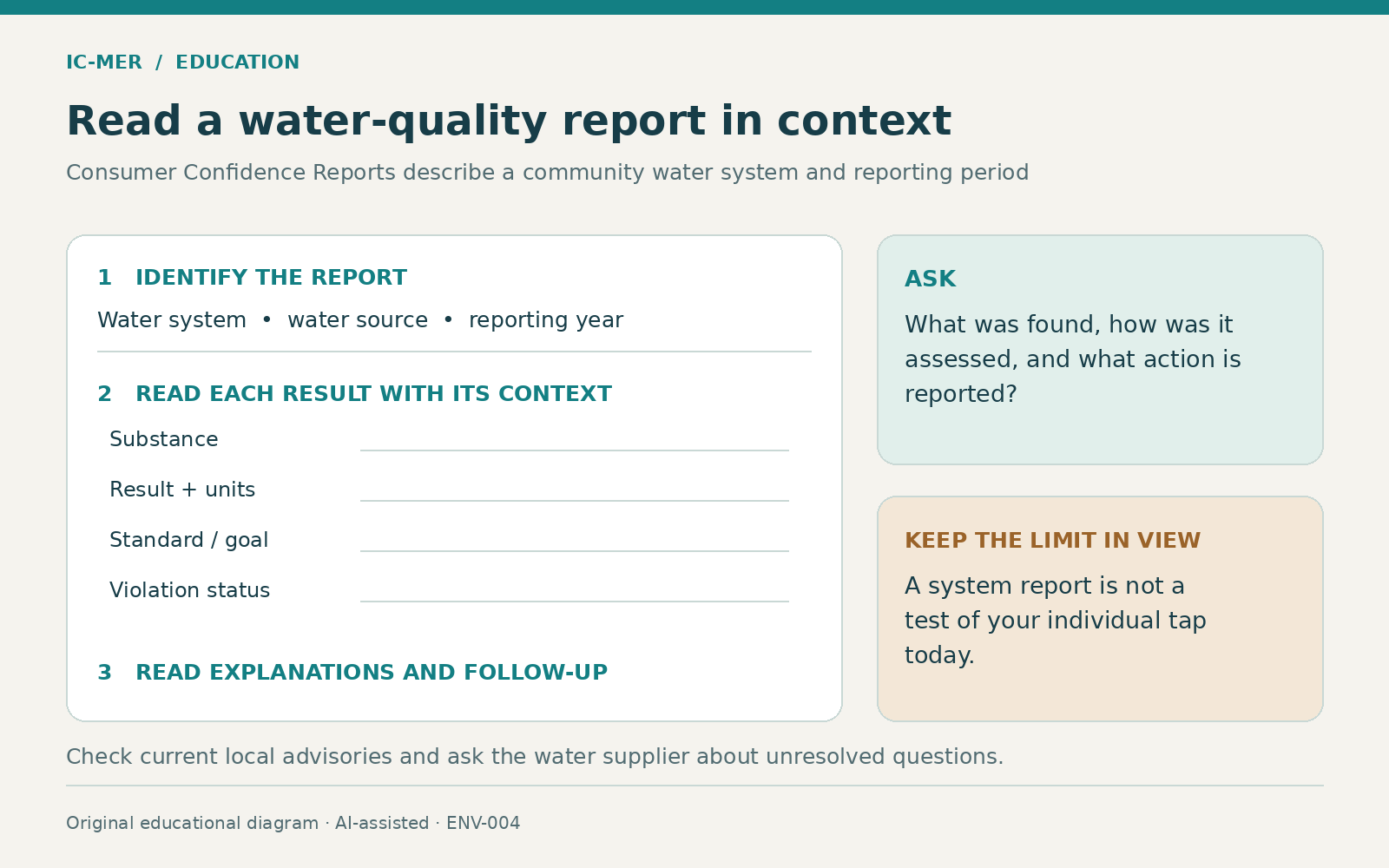
Read a table one row at a time: substance, units, reported measurement, applicable standard, sample date and explanatory notes. If the table includes an average, maximum, range or percentile, retain that label when you summarize the result. Comparing unlike statistics can produce a confident but incorrect conclusion.
Sources: [3]
Separate detection, compliance and an individual exposure
Finding a substance listed in the report does not automatically mean a violation occurred. CDC notes that the report can include substances such as disinfectants added for a useful purpose and educational health information that does not necessarily indicate the named substance was detected.
Look for the actual violation entry and the explanation of what happened, when it happened and what the system did about it. A failure to follow a monitoring or reporting requirement is not identical to a measured concentration exceeding a health standard, although both deserve a clear explanation. Ask which type of problem the report describes.
Even a clear system summary does not measure everything an individual household drank. Use precise language: “the report states no violation for this row during this period” says something narrower than “every glass from my tap is guaranteed safe.” The narrower statement keeps the evidence and its limits connected.
Sources: [2]
Practice reading a hypothetical row
Imagine a fictional report showing Substance Q at 3 micrograms per liter, with an applicable limit of 10 micrograms per liter, a detected range of 1–4, and no listed violation. The reported number is below the stated limit. Before interpreting further, check what “3” represents, which sampling period applies and whether the footnotes specify a compliance calculation.
Now suppose a different row is reported in milligrams per liter. One milligram per liter equals 1,000 micrograms per liter, so 0.003 mg/L equals 3 micrograms per liter. A smaller printed decimal is not necessarily a smaller concentration. This unit example is arithmetic, not a measurement from an actual water system.
Do not rank health risk by comparing bare numbers from different substances. “Four” for one contaminant and “three” for another do not establish which is more concerning. The substance, units, standard, exposure information and relevant health context all matter. If a label is unclear, ask the utility to explain the row using its exact wording.
Understand what the report cannot settle about plumbing
EPA explains that lead can enter water from corrosion of service lines, faucets and other plumbing materials. This means conditions at an individual property can require questions beyond the system-wide report. Appearance, taste and smell cannot reliably tell you whether dissolved lead is present.
Ask the utility what is known about the service line, whether testing is recommended and how samples should be collected. Where testing is needed, use the appropriate laboratory and sampling instructions. An improvised sample may not answer the question being investigated.
EPA advises cold water for drinking and cooking and states that boiling does not remove lead. If using a filter for lead, choose one certified for that purpose and follow cartridge-replacement instructions. Ask the utility about appropriate flushing instructions for the property rather than applying an arbitrary universal duration. These steps do not replace investigation of a lead source.
Sources: [4]
Choose treatment only after identifying the problem
CDC explains that home-treatment methods remove different contaminants. Identify the relevant chemical or germ first, then check the specific product's treatment claims. A unit that improves taste should not automatically be assumed to remove lead, every chemical or every microorganism.
Before purchasing, prepare a comparison sheet with the target contaminant, evidence supporting the need for treatment, relevant certification or verified performance claim, installation requirements, cartridge or servicing schedule and ongoing cost. Decide who will maintain it. A purchase does not complete the task if the unit is later used outside its intended conditions.
If there is a current water advisory, ask the supplier whether the proposed treatment is appropriate for that advisory. Do not assume a familiar household filter makes all restricted uses acceptable. The decision should follow the actual notice and the hazard it identifies.
Sources: [5]
Use health information to ask focused questions
Reports contain information for people who may be more vulnerable to waterborne illness and may discuss substances such as lead, nitrate or arsenic where relevant. EPA's consumer guidance identifies these educational elements, but a household still needs advice appropriate to its own circumstances.
Someone with a condition or treatment affecting immune function can bring the report and any current notice to their healthcare team. A parent concerned about infant feeding can ask the pediatric clinician and water authority about the specific issue. The useful question names the concern and the actual source of water rather than asking whether all tap water is “good” or “bad.”
Keep health symptoms separate from proof of cause. If someone is ill, seek medical advice; a water-report entry alone does not establish that the water caused the illness. Conversely, absence of a visible problem in the annual report should not be used to dismiss a current symptom or a new utility warning.
Sources: [1]
Know that reporting requirements are changing
EPA finalized CCR revisions in 2024, with updated report requirements beginning in 2027. The changes address readability, access and information about lead. As of this article's October 22, 2026 source check, the new reporting cycle should not be described as already operating everywhere.
EPA's comparison factsheet specifies that community systems serving 10,000 or more people must distribute reports twice yearly under the revised rule, with deliveries by July 1 and December 31. Systems below that population continue annual delivery by July 1. The second delivery is not necessarily a completely new year's dataset; check the period and any required updates.
When looking at reports across years, allow for changes in format and requirements. Ask whether an apparent difference reflects new information, a different presentation or an actual change in water quality. Retain the original documents so the comparison can be checked.
Make your follow-up specific
End your reading with three short lists: what the report establishes, what remains unclear, and what you will do next. For each open question, copy the table heading or paragraph that prompted it and identify the right contact: utility, building manager, health department, laboratory or clinician.
A useful inquiry might ask for the meaning of a particular sample statistic, an explanation of a violation's resolution, or the correct route to assess a home's service line. Record the date and response. If an issue remains unresolved, ask the relevant drinking-water authority how it should be escalated.
The purpose of the report is to support informed action. You do not need to memorize every abbreviation to use it well. You do need the correct report, the relevant dates, an accurate reading of the rows and a clear next question when the document cannot settle a household concern.
Sources & further reading
- CCR Information for ConsumersChecked 2026-10-22
- How to Read Drinking Water Quality ReportsChecked 2026-10-22
- National Primary Drinking Water RegulationsChecked 2026-10-22
- Basic Information about Lead in Drinking WaterChecked 2026-10-22
- About Home Water Treatment SystemsChecked 2026-10-22
- Consumer Confidence Report Rule RevisionsChecked 2026-10-22
- Consumer Confidence Report Rule Revisions Comparison FactsheetChecked 2026-10-22
About this article
Prepared with AI assistance and an AI fact-checking pass against the sources listed above. No human clinical review is claimed. Evidence may change; consult appropriate qualified professionals for decisions about your circumstances.
Spotted a problem? Suggest a correction.