Environment · 10 min read
Staying safer during extreme heat at home and outdoors
A heat plan needs more than a water bottle: know where you can cool down, how to get there, and who will check in.
General U.S. environmental-health education prepared with AI assistance and independently checked by an AI reviewer. It is not a live weather alert, a verified cooling-center listing or individualized medical advice. For suspected heat stroke, call 911 and begin cooling immediately.
Information may contain errors, omissions or outdated guidance. This article is general education, not individual medical or other professional advice. Verify important information before acting and consult an appropriately qualified professional. Never disregard medical advice, delay care or change treatment because of this article. See our accuracy disclaimer and terms.
Plan before the home or outing becomes too hot
Extreme heat can disrupt an ordinary day at home as well as an outdoor event. A room without effective cooling, a long wait for transport or an activity that runs later than planned can leave a person with fewer options than expected. A useful plan starts before someone becomes unwell: where can you cool down, how will you get there and who knows the arrangement?
CDC emphasizes staying cool, staying hydrated and recognizing symptoms. Heat can affect anyone, with additional concerns for older adults, young children, pregnant people and people with certain chronic conditions. Having a plan does not make a person immune to heat illness; it gives them practical options to use sooner.
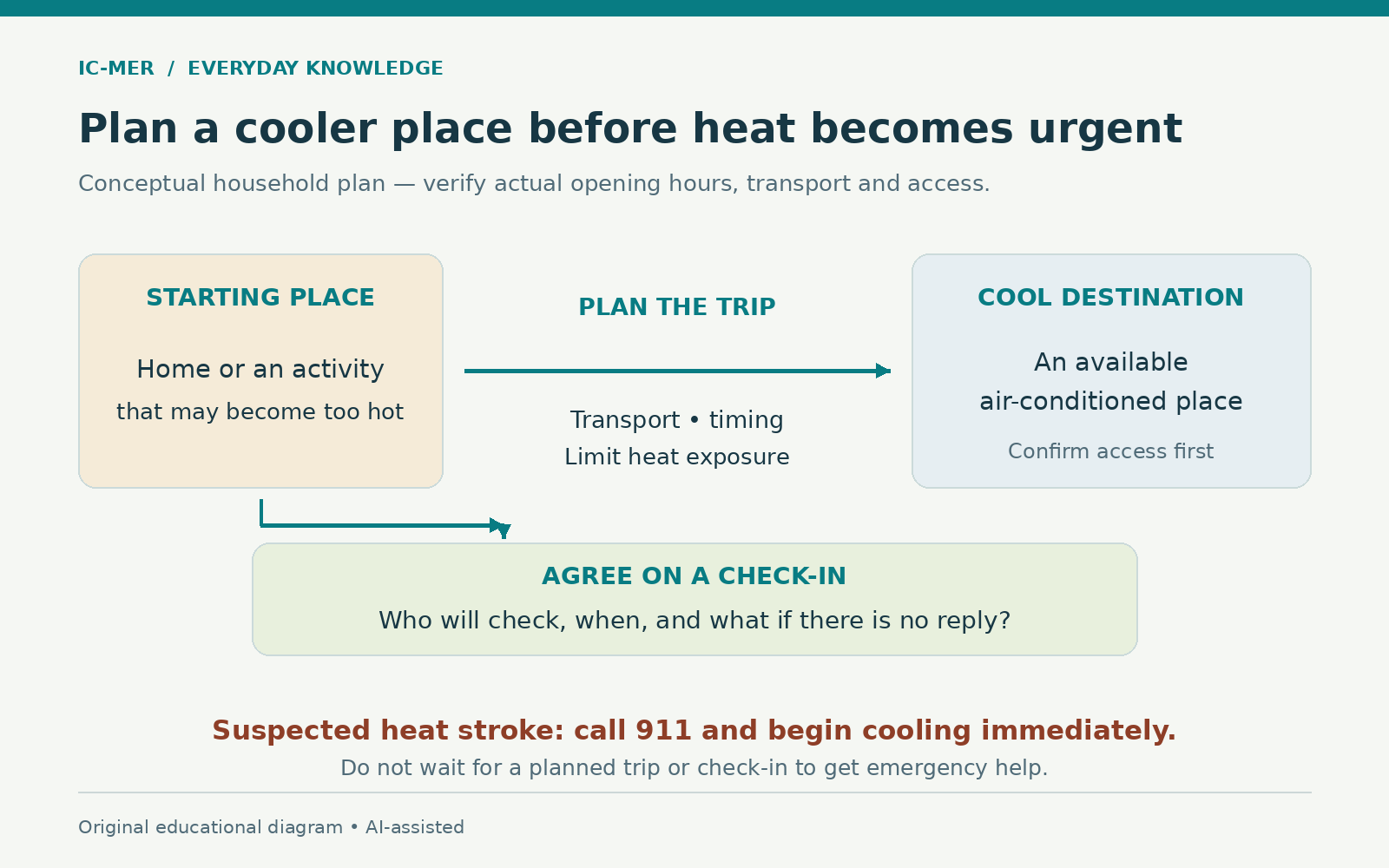
This article is a planning guide, not a forecast for St. Petersburg or a claim that a particular cooling center is open. Check current local weather and official community information before acting. The illustration separates a cooler destination, a route and a check-in, while making clear that a suspected heat emergency requires immediate help rather than waiting for the plan's next step.
Sources: [1]
Look beyond the day's high temperature
The National Weather Service uses several tools to describe heat. The heat index combines air temperature and humidity and assumes shaded, light-wind conditions; direct sun can make exposure more severe. HeatRisk also considers factors such as unusual local heat and its duration, including warm nights. These tools add context, but they do not measure an individual person's health or indoor conditions.
Use the local forecast to make decisions about the actual day. An afternoon appointment may involve a hot walk from a stop even if the appointment itself is indoors. An evening activity may still need a backup if conditions remain uncomfortable. Look at the whole journey rather than only the time you expect to be at the destination.
Choose a reliable way to receive updates, and check again if plans change. A forecast read several days earlier should not be treated as a fixed promise. Share relevant changes with anyone depending on your arrangements. If you organize an activity, make it clear who decides to shorten, move or cancel it so that the decision is not delayed by uncertainty.
Sources: [2]
Identify a place that actually offers cooling
CDC recommends air conditioning and suggests contacting local health or emergency-management services for information about cooler locations. It cautions that fans should be used only when indoor temperatures are below 90°F; above that level they can increase body temperature. Do not rely on a fan as a substitute for an adequately cooled place during dangerous indoor heat.
Identify a primary destination and check its practical details. Is it open when you would need it? Can you enter and remain there? Is it accessible for the person using it? What are the arrangements for a companion, service animal or pet? A building that looks suitable on a map is not a confirmed option until the relevant details have been checked.
Record a backup if feasible. It might be another confirmed location or an agreed arrangement with someone you know. Do not assume that a friend will be home or that a public building operates as a cooling center. The purpose of the list is to replace guesses with usable information while there is time to make calls or check official notices.
Sources: [1]
Make the journey part of the cooling plan
A destination is useful only if you can reach it. Write down the transport arrangement and the point at which you will use it. If another person is providing a ride, agree how they will be contacted and what happens if they are unavailable. If you rely on public transport, check the current route and consider the wait and walk at both ends.
For someone with limited mobility, include the details that can make a trip fail: stairs, a long distance from the entrance or a need for assistance with a device. Ask the person what they need rather than assuming. A plan that works for an able-bodied visitor may be unsuitable for someone who cannot stand outside while waiting.
Avoid treating a planned trip as a response to serious symptoms. If someone becomes confused, collapses or otherwise shows signs of an emergency, call emergency services and begin appropriate cooling. Do not spend the next several minutes comparing bus routes or waiting for the person who agreed to drive later. The preventive plan and the emergency response serve different purposes.
Prepare a small, useful departure list
A departure list can reduce the work of leaving an overheated home. Consider keys, a phone and charger, relevant contact information, necessary personal items and any medicines or equipment you are responsible for. Follow the person's established care and storage instructions. Keep the list short enough to use without delaying departure when conditions are worsening.
Decide who handles each task if more than one person is involved. One person might confirm the destination while another arranges transport. A caregiver can check the items needed by the person receiving support. These are organizational suggestions, not a requirement to assemble a particular emergency kit or buy new equipment before taking sensible action.
Rehearse the awkward parts on a normal day. Can you locate the phone numbers without internet access? Is the agreed contact reachable? Does a needed mobility aid fit the transport? A brief check may uncover a problem while it is easy to fix. Keep any written personal information secure and share only what the people assisting actually need.
Give outdoor activities a clear alternative
NWS heat guidance includes shade, changes to work timing, rest schedules and limits on strenuous work. For a personal outing, translate that into a concrete alternative: a shorter route, an indoor activity or another day. Carrying water is useful, but it does not remove the need to change exposure when conditions are unsafe.
Before starting, agree where a break can happen and how to stop early. A circular route with no convenient exit may be a poor choice when someone is unsure about managing the conditions. A destination that requires crossing a large unshaded area may need a different arrival plan. Think about the least flexible part of the outing and address it first.
Do not make the alternative feel like failure. If the purpose is seeing a friend, the meeting may work indoors. If the purpose is completing an errand, it may be possible to postpone it or ask for assistance. Separating the purpose from the original location makes it easier to change plans without feeling that the entire day has been lost.
Sources: [2]
Check in with a specific agreement
A vague promise to keep an eye on someone can leave both people assuming the other will make contact. Agree on a time, a method and what to do if there is no answer. Ask whether a call, a message or an in-person visit is most useful. Make sure the plan respects the person's preferences and does not rely on a device they cannot use easily.
For example, two neighbors might agree to speak at a particular point in the day and share the contact details of someone who can assist if needed. This is a fictional planning example, not a universal check-in interval. The appropriate arrangement depends on the person's situation and care needs. Serious symptoms require action immediately, not at the next planned call.
When checking in, ask practical questions: is the cooling working, can you reach the place you planned, and do you need help arranging transport? An answer to a message alone does not verify that the home is safe. If you have concerns, respond to them rather than treating a completed check-in as a guarantee that nothing else is needed.
Include medicines, devices and individual advice
CDC notes that some medicines can contribute to dehydration or overheating and that heat or power outages can affect storage and medical devices. It advises discussing a heat action plan with a clinician and not stopping or changing medicines independently. A general article cannot decide which adjustment, if any, is right for you.
Before a period of hot weather, ask specific questions about your circumstances. What should happen if the power fails? Who can advise about a medicine that may have become too warm? What is the plan for equipment that requires electricity? Keep the answers with your existing care information rather than relying on memory when a disruption occurs.
If you have a fluid restriction or another medical plan, do not replace it with blanket advice to drink large amounts. Ask your healthcare professional how hot weather changes the actions you should take. For family helpers, make sure the plan is understood consistently; several well-meaning but conflicting instructions can make a difficult day harder to manage.
Sources: [1]
Keep children and pets out of parked-car danger
NOAA warns against leaving children, older people or pets in a car during hot weather. A brief errand is not a reason to leave a dependent person or animal in a parked vehicle. Build the shopping or appointment plan around bringing them safely with you or arranging appropriate care elsewhere.
Check the destination's arrangements before departure. If a building cannot accommodate a pet, waiting in the car is not a suitable workaround. If a child needs supervision while an adult completes a task, decide who is responsible before arriving. Avoid an informal handoff where each adult assumes the other has taken charge.
For any trip involving dependents, include a deliberate check that everyone has left the vehicle. This is a practical reminder, not a claim that one habit eliminates every risk. If a person or animal appears to be in immediate danger, seek emergency assistance promptly and follow local emergency guidance rather than waiting for the planned errand to finish.
Sources: [3]
Recognize heat illness and act promptly
Headache, nausea, dizziness, weakness and heavy sweating can occur with heat exhaustion. Stop the activity, move to a cool place and seek medical evaluation; NIOSH recommends evaluation for affected workers. Stay with the person and use cool wet cloths. Small sips of water may be appropriate if they are fully alert and able to swallow; do not give drinks to someone confused or unconscious.
Confusion, slurred speech, collapse or seizures in a hot setting can indicate heat stroke. Skin can be dry or very sweaty. Call 911 in the United States and cool immediately while help is coming. Wet the skin or apply cold wet cloths and stay with the person. NOAA says not to give fluids for heat stroke. Follow dispatcher instructions; do not wait for a temperature reading or a scheduled ride.
You do not have to settle every diagnostic question before asking for help. Tell emergency services what happened, the symptoms you can observe and the exact location. If another person is present, assign a clear task, such as meeting responders at an entrance, while someone stays with the ill person. Avoid leaving them alone to sort out nonessential belongings.
Turn the plan into a page you can use
Write a short household note with the cooler destination, its confirmed arrangements, transport, the check-in contact and the emergency number. Add any essential individual care instructions in a form agreed with the person concerned. Keep it somewhere accessible to the people who need it, while protecting private health information.
Review the plan after a real outing or a hot day. Was the destination convenient? Did the transport work? Was someone unsure who should make a call? Update those practical details. A plan is useful because it reflects current arrangements, not because it has an impressive title or an exhaustive list of things nobody has checked.
When conditions change, simplify the day around what matters most: effective cooling, appropriate care and prompt help for symptoms. Postponing an optional task can be a sound decision. The aim is to make safer choices easier for you and the people relying on you, with enough preparation that an uncomfortable situation does not become a scramble for basic information.
Sources & further reading
- About Heat and Your HealthChecked 2026-10-23
- Heat Forecast ToolsChecked 2026-10-23
- Heat exhaustion or heat stroke? Know the signs of heat illnessChecked 2026-10-23
- Heat-related IllnessesChecked 2026-10-23
About this article
Prepared with AI assistance and an AI fact-checking pass against the sources listed above. No human clinical review is claimed. Evidence may change; consult appropriate qualified professionals for decisions about your circumstances.
Spotted a problem? Suggest a correction.