Medicine · 6 min read
Strength training for beginners and healthy aging
A practical introduction to strength training: choosing suitable instruction, covering major muscle groups, allowing recovery and building a manageable routine.
General health education, prepared with AI assistance and independent AI factual review; not human clinical review, rehabilitation or an individualized exercise prescription. A qualified healthcare professional or instructor can help adapt activity to your circumstances. Call 911 in the United States for a suspected medical emergency.
Information may contain errors, omissions or outdated guidance. This article is general education, not individual medical or other professional advice. Verify important information before acting and consult an appropriately qualified professional. Never disregard medical advice, delay care or change treatment because of this article. See our accuracy disclaimer and terms.
Begin with an everyday purpose
Strength training can sound like a separate world of machines, numbers and gym language. A more approachable starting point is an ordinary task you care about: getting up from a chair, carrying shopping or managing a flight of stairs. That task gives you a reason to learn, without turning your first session into a performance test.
This guide explains how to organize a beginner routine and what to ask an instructor. It does not prescribe exercises, loads or movements for an individual medical condition. Your first useful step may be a suitable class, an equipment orientation or a conversation about adapting activity, rather than buying weights.
Consider what would make the setting workable. You may want a quiet room, a daytime class, clear spoken instructions or space for a mobility aid. These are practical requirements worth stating. A program that is accessible and understandable is a better starting place than one selected because someone else found it demanding.
Know where strengthening fits
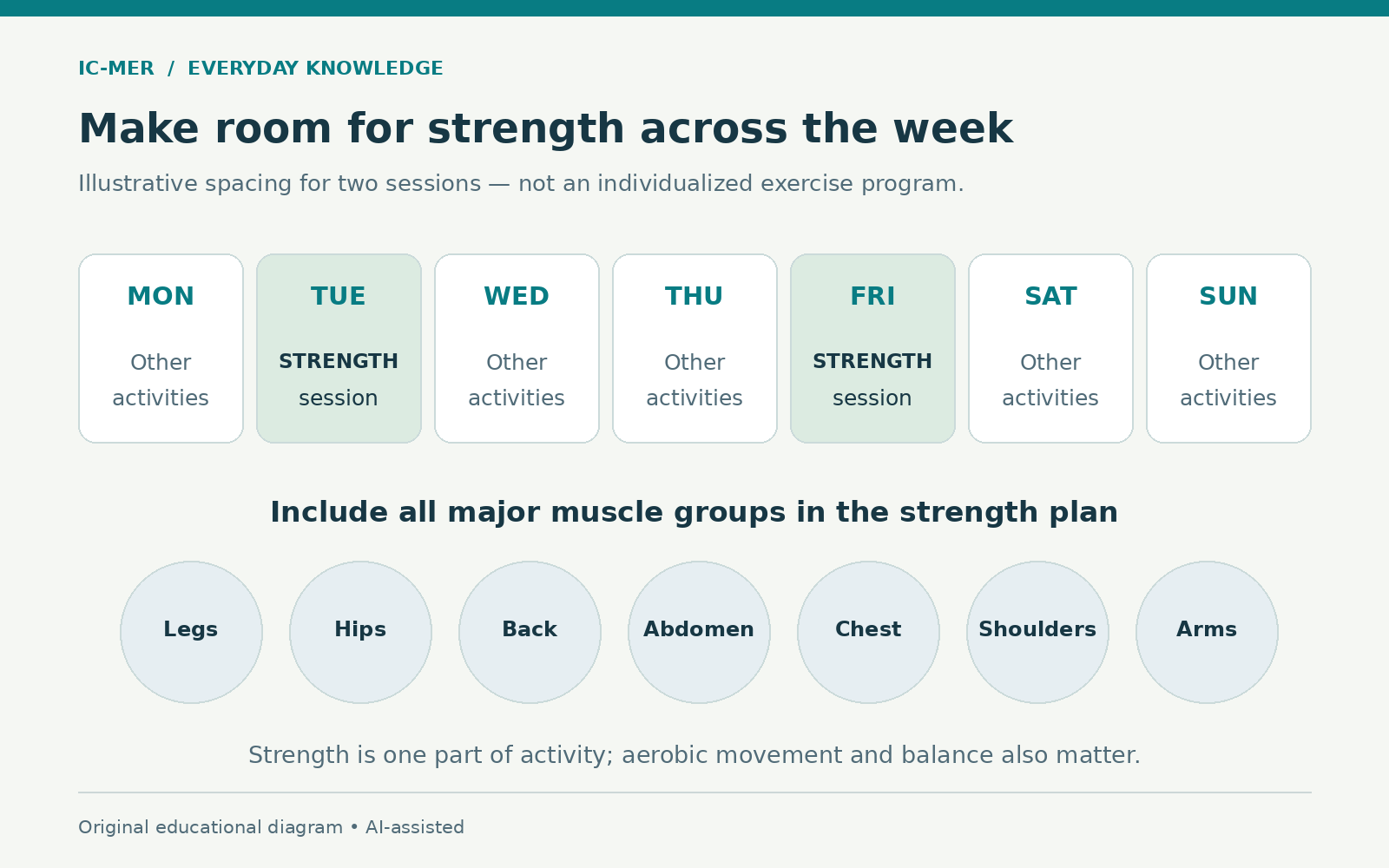
Adult physical activity recommendations include strengthening all major muscle groups on at least two days a week, alongside aerobic activity. CDC identifies the major groups as the legs, hips, back, abdomen, chest, shoulders and arms. A program focused only on the arms leaves much of that task unfinished.
For adults 65 and older, balance activities are also part of the recommendations. Older adults unable to meet the recommended amounts should be active within their abilities and conditions. Strengthening is part of a broader activity pattern, not a replacement for every other kind of movement.
Use these categories to ask questions about a class or plan. Which groups does it cover? Where does aerobic activity fit elsewhere in the week? Is there suitable balance work when needed? You do not need to identify every muscle by name. You do need to know that the plan has a purpose beyond making one exercise harder.
Understand the basic terms
A repetition is one complete movement; a set is a group of repetitions. CDC describes eight to twelve repetitions as a set for its general strengthening guidance and notes that weights, resistance bands and body-weight exercises can all be options. A particular exercise still needs to match the person doing it.
Do not interpret a general repetition range as an instruction to force a movement, lift the largest available weight or ignore an individual adaptation. Ask the instructor how much resistance to use, how to recognize correct technique and what to do if the movement is uncomfortable.
Write the explanation in your own words. “Use this setting, move this way, stop for this problem, ask before changing this part” is easier to follow later than a list of unfamiliar exercise names. If you cannot explain the instructions back, ask for another demonstration before practicing alone.
Sources: [3]
Learn the movement before adding difficulty
Poor technique, unsuitable equipment and progressing too quickly can contribute to injury. Learning from a qualified instructor can help you understand the basics. If a health condition or injury affects exercise choices, involve a healthcare professional who can advise on appropriate activity.
At an introductory session, ask to see both the setup and the finish. How is the machine adjusted? Where do you place the equipment when done? What stable support is appropriate? A demonstration that starts with everything already arranged may leave a beginner unsure how to repeat it safely.
It is reasonable to ask for a simpler version or more practice time. A busy class is not always the right setting for individual troubleshooting. If the teacher cannot answer a question relevant to your limitations, seek a more suitable source of instruction. There is no need to demonstrate readiness by attempting an unfamiliar exercise under pressure.
Sources: [4]
Use a setup that removes avoidable distractions
The CDC-linked Growing Stronger manual, published in 2002 by Tufts University with CDC collaborators, emphasizes regular breathing during exercise and storing weights where they will not become trip hazards. It is a detailed older resource; the current CDC activity pages provide the weekly recommendations used here.
Before a home session, clear the area and decide where each item will go between exercises. Keep equipment away from children and other people moving through the room. Use equipment as instructed, including any manufacturer requirements for resistance-band attachments. A convenient improvised anchor is not automatically an appropriate one.
Keep instructions nearby in a form you can read without balancing awkwardly or leaving equipment in the way. Ask the instructor how to coordinate breathing with the movement; do not hold your breath. If the setup seems complicated, practice arranging it with assistance before treating the routine as an independent home workout.
Sources: [5]
Give the week a workable shape
MedlinePlus advises leaving a day between sessions that work the major muscle groups. For an illustrative beginner calendar, Tuesday and Friday could be strength-training days. These days are an organizational example, not a prescription for every person or a complete weekly exercise program.
Choose two workable appointments and consider the time around them. Will you be rushing to another commitment? Is the class reachable? If you use a shared space, is the equipment available? A calendar that overlooks these details may need adjusting even when your motivation is strong.
Ask how to handle a missed session. Do not assume you should combine missed work into one demanding workout. If the schedule repeatedly breaks down, change the arrangement before blaming yourself. A different class time, simpler setup or smaller set of instructions may be the practical improvement you need.
Sources: [6]
Keep progress understandable
A simple session note can record the exercise taught, the equipment setting or resistance used, the amount completed and any question for the next visit. Do not enter a guessed setting because the page looks incomplete. An honest blank with a question is more useful than a false record.
Before changing the plan, ask what improvement would justify the change. An instructor may want to see consistent technique and appropriate tolerance. Make sure you know which variable is changing and which will stay the same. Increasing several things together makes your own record harder to interpret.
Keep the record focused on your experience. Someone else’s weight, repetition count or speed is not a starting prescription for you. If a group setting encourages comparison, return to your original purpose and the instructions you were given. Progress can also mean understanding the setup and feeling confident asking for help.
Separate effort from a reason to stop
Exercise should not require pushing through pain. Stop when pain occurs, and seek advice for persistent muscle or joint pain. New symptoms or recovery from illness may mean the plan needs reassessment rather than another increase in difficulty.
Chest discomfort, shortness of breath, faintness or pain spreading to the arms, jaw, neck or back can be heart attack symptoms. Call 911 immediately in the United States if you notice symptoms of a heart attack. Do not assume a concerning symptom is simply part of getting fitter.
Before starting, know how to get assistance in the setting you use. At a class, locate the person responsible for helping. At home, keep a means of contacting help available. An emergency plan is different from an exercise plan, and neither should depend on completing the next repetition.
Make the first appointment specific
You can prepare three questions: What beginner option fits my needs? Who will teach and check the movements? What should I do between sessions and before changing the plan? Bring relevant limitations or clinician instructions, rather than expecting the teacher to infer them from your age or appearance.
After the first session, decide whether the instructions and setting worked for you. Keep what was clear, ask about what was confusing and arrange the next appropriate step. A useful beginning is one you can explain and repeat safely, with room for adjustments as your needs change.
Sources & further reading
- CDC — Adult Activity: An OverviewChecked 2026-10-23
- CDC — Older Adults: Adding Activity RecommendationsChecked 2026-10-23
- CDC — What Counts as Physical Activity for AdultsChecked 2026-10-23
- MedlinePlus — How to avoid exercise injuriesChecked 2026-10-23
- CDC and Tufts University — Growing Stronger: Strength Training for Older Adults (2002)Checked 2026-10-23
- MedlinePlus — Outdoor fitness routineChecked 2026-10-23
- CDC — About Heart Attack Symptoms, Risk, and RecoveryChecked 2026-10-23
About this article
Prepared with AI assistance and an AI fact-checking pass against the sources listed above. No human clinical review is claimed. Evidence may change; consult appropriate qualified professionals for decisions about your circumstances.
Spotted a problem? Suggest a correction.