Medicine · 7 min read
Understanding clinical research phases
Learn what each clinical-trial phase can establish, what remains uncertain, and which questions to ask before interpreting a result or considering participation.
For general education only; not personal medical advice. Discuss individual care and research participation with a qualified healthcare professional.
Information may contain errors, omissions or outdated guidance. This article is general education, not individual medical or other professional advice. Verify important information before acting and consult an appropriately qualified professional. Never disregard medical advice, delay care or change treatment because of this article. See our accuracy disclaimer and terms.
Start with the question the trial is asking
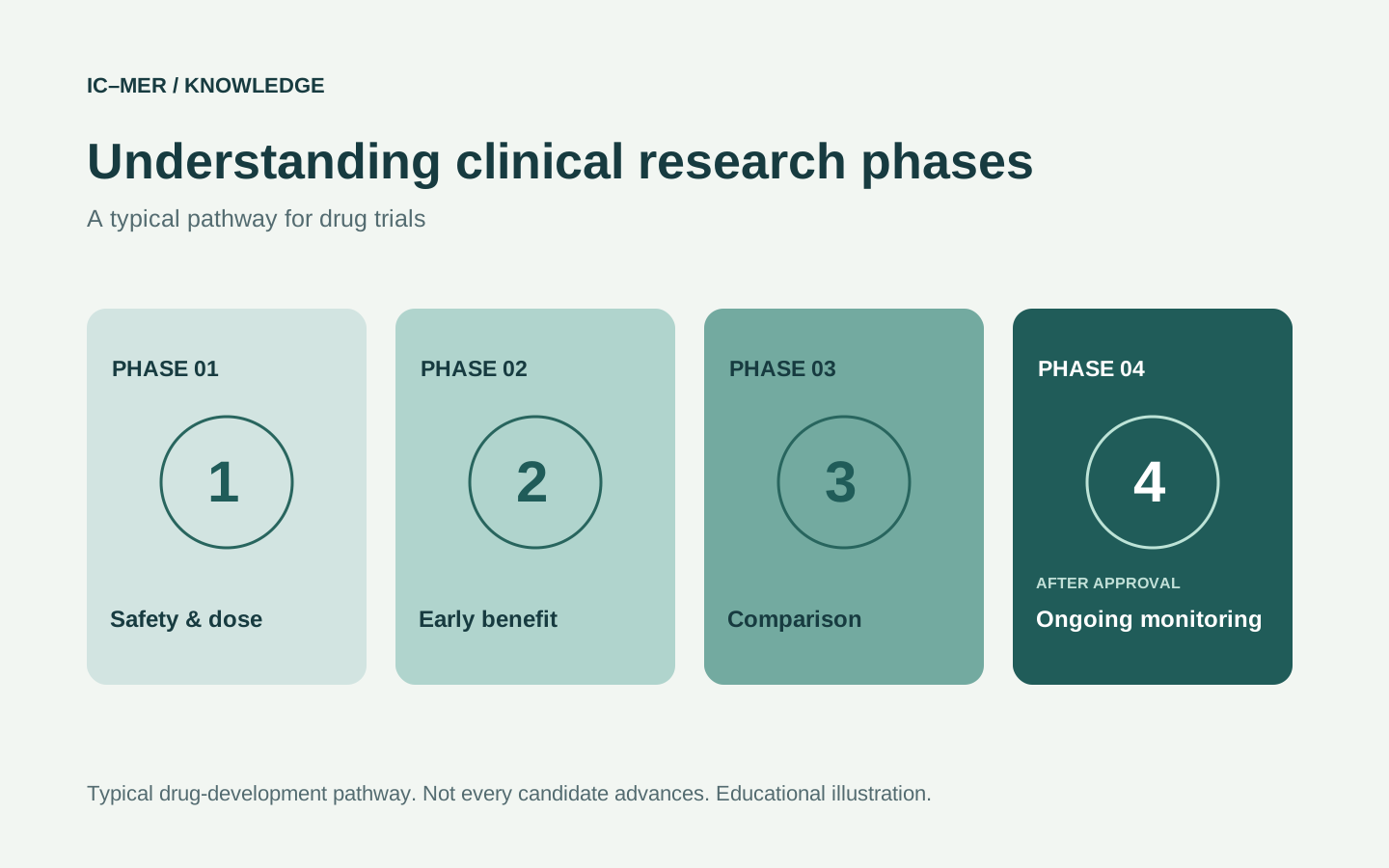
A headline that announces a successful clinical trial is the beginning of an evidence question, not the end. Was the study designed to explore a dose, look for an initial signal of benefit, or compare a treatment with an established option? Its phase helps orient the reader, but the protocol—the study plan—defines what researchers actually set out to learn. The FDA describes protocols as specifying eligibility, treatment, assessments, duration, and analysis.
This guide focuses on the familiar drug-development pathway in the United States. Its phase labels help explain that pathway; they are not a complete classification of every study involving people. Read the phase alongside the specific protocol and the applicable regulatory context.
Sources: [1]
Phase 1: learning about exposure, safety, and dose
Early human studies examine how an investigational drug behaves in the body and what adverse effects appear at the doses being studied. Researchers use that information to guide further testing. Participants may be healthy volunteers or people with the relevant condition; cancer drug trials commonly involve patients with cancer. Safety assessment continues in later phases as well.
The useful interpretation is limited: tolerability in an early study supports further investigation under the conditions tested. It does not establish that every dose is safe, exclude uncommon harms, or prove that a treatment improves patients’ lives. A favorable early report should prompt a practical question: what uncertainty is the next study intended to resolve?
Sources: [1]
Phase 2: asking whether benefit is plausible
Phase 2 studies assess whether a treatment appears to help people with the target condition while gathering additional safety information. In cancer research, for example, investigators may examine whether tumors shrink or their growth slows. These findings can support a decision to conduct further research, but their meaning depends on what was measured and how the study was designed.
Imagine a fictional phase 2 study of a new treatment for a recurring symptom. Participants report fewer episodes during treatment. Before interpreting that as proof, ask whether there was a comparison group, how episodes were counted, and whether follow-up lasted long enough to address the study’s stated question. These are reading questions, not claims about an actual therapy.
Sources: [3]
Phase 3: strengthening the comparison
Later trials seek stronger evidence about treatment benefit and harms in the intended population. In many phase 3 cancer trials, participants are randomly assigned to the new intervention or the current standard treatment. Random assignment helps prevent treatment groups from being formed by the preferences of participants or clinicians. Researchers then compare the prespecified outcomes.
Consider a fictional trial comparing Treatment A with Treatment B over twelve months. A result about fewer hospital admissions would answer a different question from a result about a laboratory measurement. Ask for the outcome in ordinary language before deciding how important the finding seems. Also ask whether the report describes all participants or only a selected subgroup.
Sources: [3]
Approval is a separate regulatory assessment
A phase 3 result is not itself permission to market a drug. In the United States, the FDA evaluates an application containing clinical and other evidence, proposed labeling, and information relevant to intended use. The agency may approve the application, require questions to be resolved, or determine that additional studies are needed.
Approval relates to an intended use and its supporting evidence. When reading a claim that a product is approved, identify the actual condition, population, and formulation being discussed. A headline can omit these distinctions. The practical reading task is to match the claim to the current prescribing information, rather than treating the word approved as a universal endorsement.
The usual sequence is not an inflexible ladder. For certain serious conditions with an unmet medical need, accelerated approval may rely on an effect on a surrogate or intermediate endpoint reasonably likely to predict clinical benefit. Required confirmatory studies then assess that benefit. This makes it especially important to read the approval basis and outstanding evidence requirements, rather than infer them from a phase number.
Phase 4 and safety learning after approval
Phase 4 research takes place after approval. Wider use and longer observation can reveal information that was not available during earlier studies. Postmarket safety monitoring is broader than any one trial: the FDA also reviews reports of problems and can revise warnings or take other action.
An approved medicine therefore has an evolving evidence record. A newly identified risk does not mean that every earlier observation was false; it may answer a question that limited follow-up or smaller exposure could not settle. Conversely, approval should not be presented as a guarantee that serious adverse effects are impossible.
Sources: [5]
The phase is only one line in your evidence notes
Build a short reading record for any study that interests you: the research question, who was included, what each group received, the main outcome, the observation period, and what remains uncertain. Write these before recording a promotional phrase such as breakthrough. This is a practical way to keep your interpretation tied to the question being investigated.
For a hypothetical news report, your notes might say: adults with Condition X; A versus usual care; symptom episodes over twelve months; fewer episodes reported; longer-term outcomes unresolved. That summary is more informative than simply writing phase 3 positive. It also gives a clinician or researcher a clear starting point for discussing what the result does and does not mean.
A worked exercise: separate what is known from what is hoped
Imagine that a fictional research summary says 24 participants received an investigational drug and the study team selected a dose for further testing. A cautious reading record would say that a dosing decision was made after a small study. It would not say that the drug cures the condition. Now imagine the next report says a symptom score improved. Your next questions should address how that score was measured, what happened in the comparison group, and how much the change mattered to participants.
Finally, imagine a later report describes fewer hospital admissions but does not discuss quality of life or longer follow-up. You can record the admission result while leaving those other questions open. The exercise is useful because it separates three things that promotional writing sometimes compresses: what investigators directly observed, what they infer from the observation, and what they still intend to test. None of these fictional descriptions is an IC-MER study or a claim about an existing product.
Participation involves a separate personal decision
Informed consent is a continuing process of explanation and discussion, not merely a signature. The research team should describe the purpose, procedures, foreseeable risks, possible benefits, and contacts for questions. Participation is voluntary, and a participant may leave a study. Ask who reviewed the protocol and who oversees participant safety.
Potential access to an investigational treatment is not a promise of improvement. Ask how trial visits relate to ordinary care, which procedures are for research, what costs or travel may be involved, and whom to call if a problem occurs. Discuss suitability with the research team and your own healthcare professional; the phase number cannot make that decision for you.
Use registries to organize your questions
ClinicalTrials.gov can help locate a study’s purpose, eligibility information, locations, and contacts. NIH recommends using registry information together with professional advice. The listing is a starting point for a conversation, not a personalized recommendation to join.
When contacting a study team, keep your first inquiry focused: ask whether enrollment is open, which criteria they need to evaluate, and how the screening process works. Save the study identifier and the date you checked so that later conversations refer to the same record. Avoid treating an old article about a trial as proof that a site is still recruiting.
Sources: [6]
A practical way to read the next trial headline
Try rewriting the headline as three sentences: this study asked a particular question; it observed a particular result in a particular group; these important questions remain. If you cannot fill in those sentences, read the underlying report or ask for clarification before sharing a strong conclusion.
For example, a fictional announcement that a drug reached phase 2 can be restated as an advance to another stage of investigation. It says nothing by itself about the eventual result. If the announcement instead reports a completed comparison, examine the outcomes and limitations. Progress through development and proof of a specific benefit are different claims, and careful communication keeps them separate.
Sources & further reading
- Step 3: Clinical ResearchChecked 2026-10-20
- Are Clinical Trials Safe?Checked 2026-10-20
- How Do Clinical Trials Work?Checked 2026-10-20
- Step 4: FDA Drug ReviewChecked 2026-10-20
- Step 5: FDA Post-Market Drug Safety MonitoringChecked 2026-10-20
- Finding a Clinical TrialChecked 2026-10-20
- Understanding Informed Consent FormsChecked 2026-10-20
- Accelerated ApprovalChecked 2026-10-20
About this article
Prepared with AI assistance and an AI fact-checking pass against the sources listed above. No human clinical review is claimed. Evidence may change; consult appropriate qualified professionals for decisions about your circumstances.
Spotted a problem? Suggest a correction.