Medicine · 7 min read
Balance and mobility: staying steady and confident
Build a practical plan for steadier everyday movement, a safer home and useful conversations about falls, dizziness and balance.
General health education, not personal medical advice or an individualized balance program. AI-assisted editorial content and AI factual review are not human clinical review. Call 911 in the United States for possible stroke symptoms.
Information may contain errors, omissions or outdated guidance. This article is general education, not individual medical or other professional advice. Verify important information before acting and consult an appropriately qualified professional. Never disregard medical advice, delay care or change treatment because of this article. See our accuracy disclaimer and terms.
Start with the activities you want to keep doing
Getting out of a chair, turning in a narrow kitchen and stepping through a doorway are ordinary parts of the day. When they begin to feel uncertain, the goal is more useful than winning a balance challenge: keep doing important activities with appropriate support. A plan might focus on reaching the bathroom safely at night, visiting a friend or moving around a garden.
Choose one task that matters to you and describe what feels difficult. Is it starting to walk, turning, getting tired or seeing the edge of a step? This description gives a clinician or physical therapist a better starting point than simply saying that you are getting older. It is not a way to diagnose the cause at home.
Write down what you would like to regain or maintain, and what help would make the task manageable. The examples below are planning suggestions, not an exercise prescription or a guarantee that a fall will not happen.
Include balance in a broader movement plan
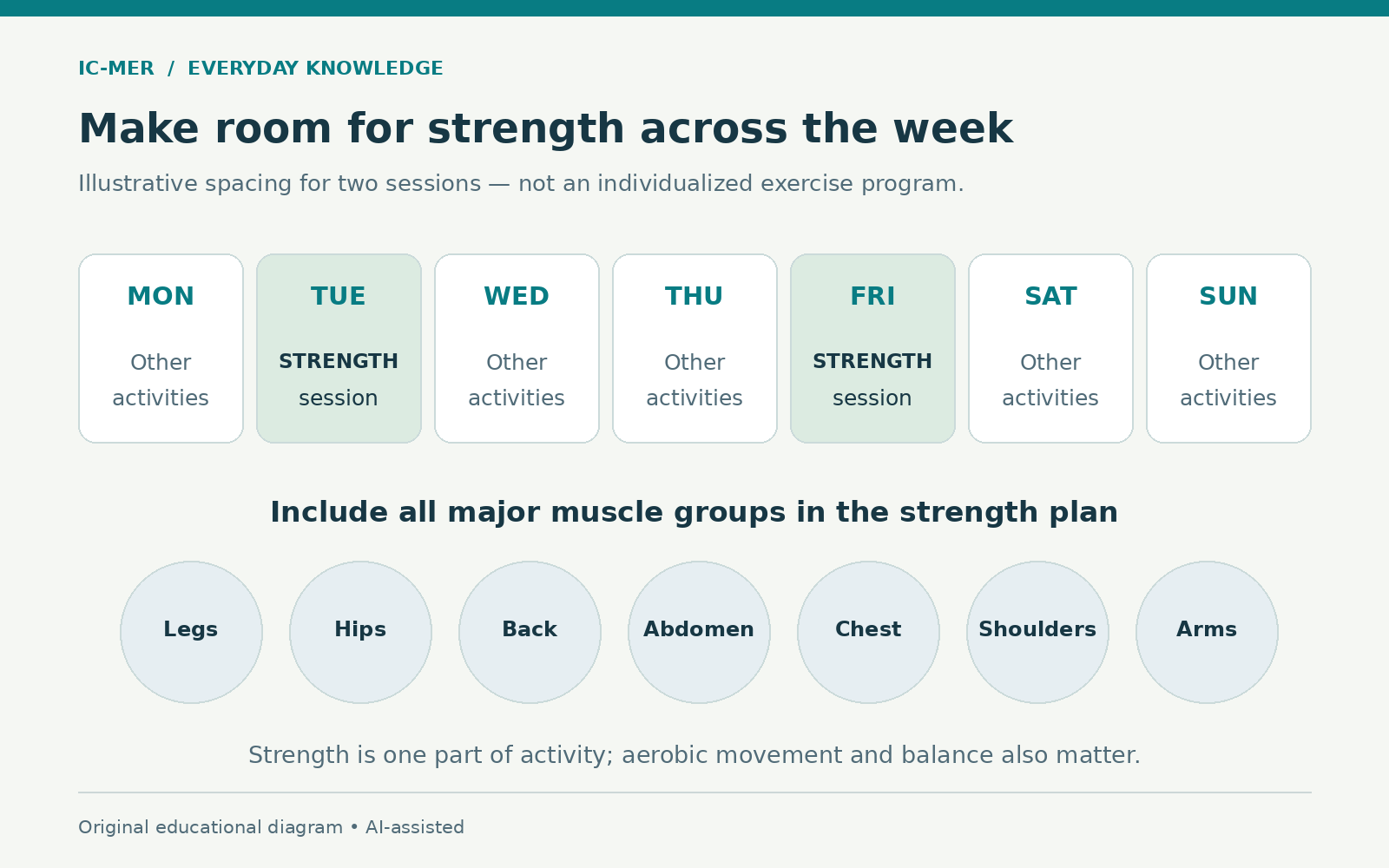
CDC recommends that adults aged 65 and older include aerobic activity, muscle strengthening and balance activities each week. Its general aerobic target is at least 150 minutes at moderate intensity, 75 minutes at vigorous intensity, or an equivalent combination, alongside muscle strengthening on at least two days. People unable to meet the targets should be active as their abilities and conditions allow.
A daily walk and balance practice serve overlapping but different purposes. Do not assume that completing a walk automatically covers every part of the recommendation. Ask how balance work and strength training could fit alongside activities you already enjoy.
You do not need to start with an ambitious weekly calendar. A useful first appointment can result in a short list of appropriate activities, the support to use and a clear explanation of when to stop. Keep that plan where you can find it, rather than improvising a harder version from an online video.
Sources: [1]
Choose instruction that meets your starting point
CDC identifies leg-strengthening and balance exercises, including tai chi, as useful fall-prevention approaches. The appropriate version depends on the person. A class described as suitable for older adults may still vary in pace, support and floor work.
Before joining, ask the instructor how they adapt activities for someone who uses a walking aid or feels unsteady. Ask whether a participant can stay near stable support, whether getting down to the floor is required and what happens if a movement is uncomfortable. A clear answer is more helpful than a promise that the class is suitable for everyone.
If you have fallen, feel unsteady or are unsure what is safe, ask your healthcare professional about assessment and appropriate instruction. Do not test yourself by closing your eyes, standing on an unstable object or removing a walking aid just to see what happens. A challenge that creates a fall is not useful practice.
Sources: [2]
Walk through the home as a problem solver
CDC’s home checklist emphasizes clear floors and stairs, secure rugs or their removal, accessible lighting, handrails and bathroom support. Look at the route you actually use, not just the room in daylight. A clear hallway can become difficult when a charging cord, laundry basket or pet toy is left across it.
Consider a fictional evening routine: the bedroom lamp is easy to reach, but the route to the bathroom becomes dark after the door closes. The useful change is a reliable lighting arrangement along that route, not a reminder to be more careful. Check the route with the household member who uses it.
For rails and grab bars, arrange appropriate installation. A towel rail should not be treated as a substitute. Keep frequently used items within easy reach rather than creating a need to climb. If you rent, describe the specific change to the property manager and keep a record of the request; the correct process depends on the property.
Sources: [3]
Bring medicines and symptoms into the conversation
Ask a doctor or pharmacist to review prescription and nonprescription medicines that could contribute to dizziness or sleepiness. Do not stop or change a medicine yourself. An up-to-date list is useful even when different clinicians prescribed the items.
CDC describes postural hypotension as a drop in blood pressure when changing position, such as rising from sitting or lying down. It can cause dizziness or lightheadedness and increase fall risk. Recurrent symptoms deserve assessment rather than being dismissed as clumsiness. Rise slowly and get stable before moving. Do not walk while you feel dizzy; ask for individual advice if symptoms occur.
Keep a brief note of when the problem happens, the position change and any fall or near fall. Tell the clinician about symptoms, rather than deciding in advance which medicine caused them. This article does not recommend changing fluid or salt intake, because those decisions can depend on other health conditions.
Make appointments answer everyday questions
A mobility appointment can become more useful when you bring a concrete question. For example: What support should I use for the steps at my entrance? Which activity could help me turn more confidently? How should I restart after being ill? Write down the answers and ask for a demonstration when instructions are unclear.
If you already use a cane or walker, discuss its fit and how you use it in the places that cause difficulty. Bring information about the route, such as the presence of a rail or a narrow doorway, rather than buying a different device based only on an advertisement.
A family member can help take notes if you want them there. Agree in advance on the goal of the visit so that your own priorities remain central. The desired outcome is a workable plan for your day, with follow-up for problems that the first visit cannot resolve.
Make room for interruptions without abandoning the plan
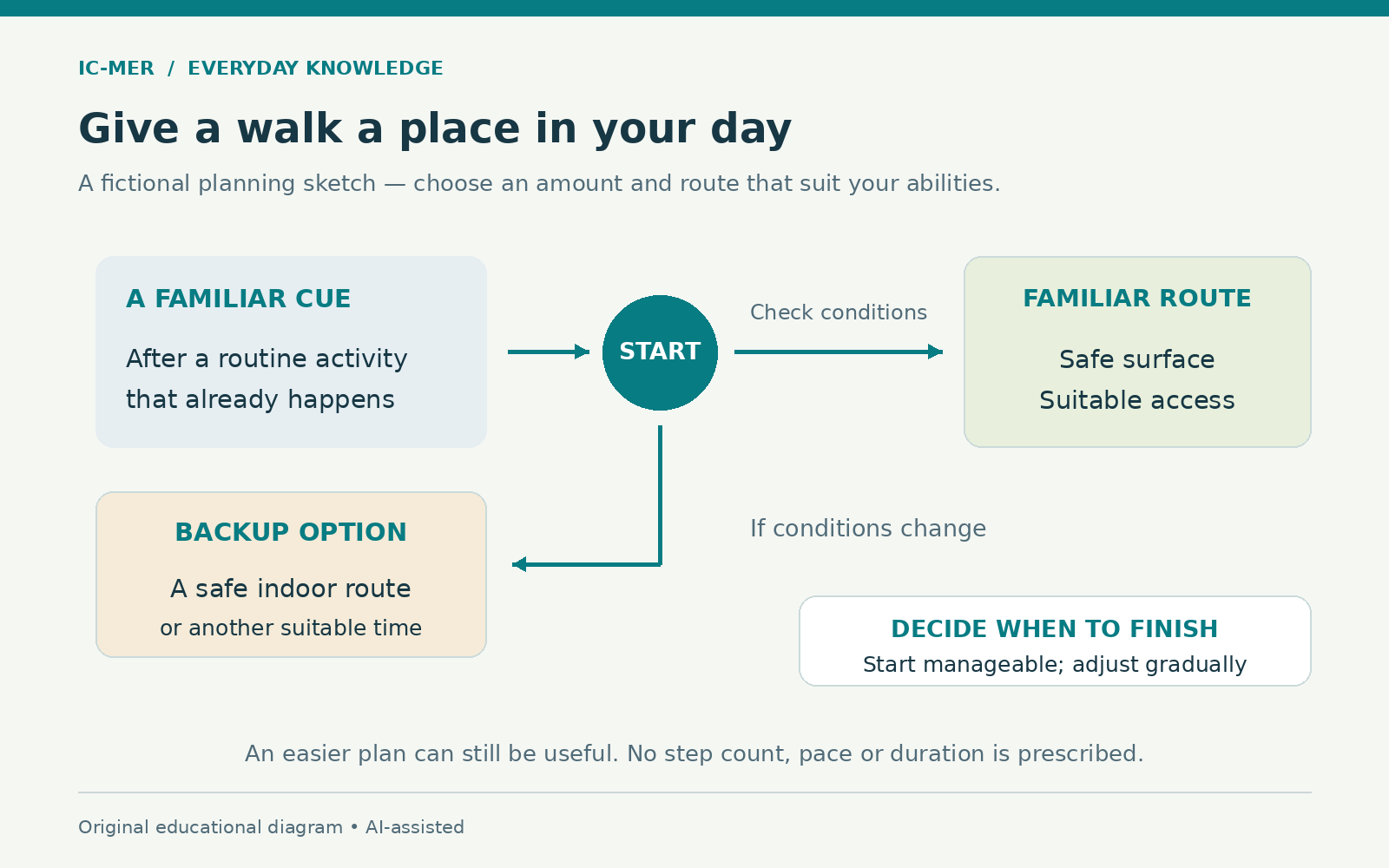
CDC advises restarting at a lower level after a break caused by illness or travel and gradually returning to the usual activity level. It also suggests indoor options when outdoor conditions are unsuitable. A changed week does not mean the whole routine has failed.
In a fictional plan, a person who normally attends a class keeps the instructor’s approved home alternative available for a week when transport is unavailable. The home option should match the person’s ability and available support; it is not an excuse to copy a difficult movement alone.
Before deciding that motivation is the problem, look for practical obstacles. Is the class accessible? Is the room too crowded? Is someone available to help with transport? Choose a smaller, realistic solution to the actual obstacle. Record what worked, not a score comparing yourself with someone else.
Sources: [5]
Know when balance trouble needs urgent help
Sudden trouble walking, dizziness, loss of balance or coordination can be a stroke symptom. Other warning signs include sudden one-sided weakness or numbness, vision trouble, trouble speaking or understanding speech, and a sudden severe headache without a known cause. In the United States, call 911 immediately for possible stroke symptoms, even if they improve. Do not drive yourself.
This is different from planning a routine exercise appointment. Do not try to walk off a sudden change or use a balance exercise as a test of whether something serious is happening. Note when symptoms began if possible without delaying the emergency call.
For ongoing concerns without those sudden warning signs, arrange a clinical assessment. Tell the clinician about falls and near falls even if you feel embarrassed. The information can guide prevention; it is not a judgment about independence.
Sources: [6]
Leave yourself a short, practical next step
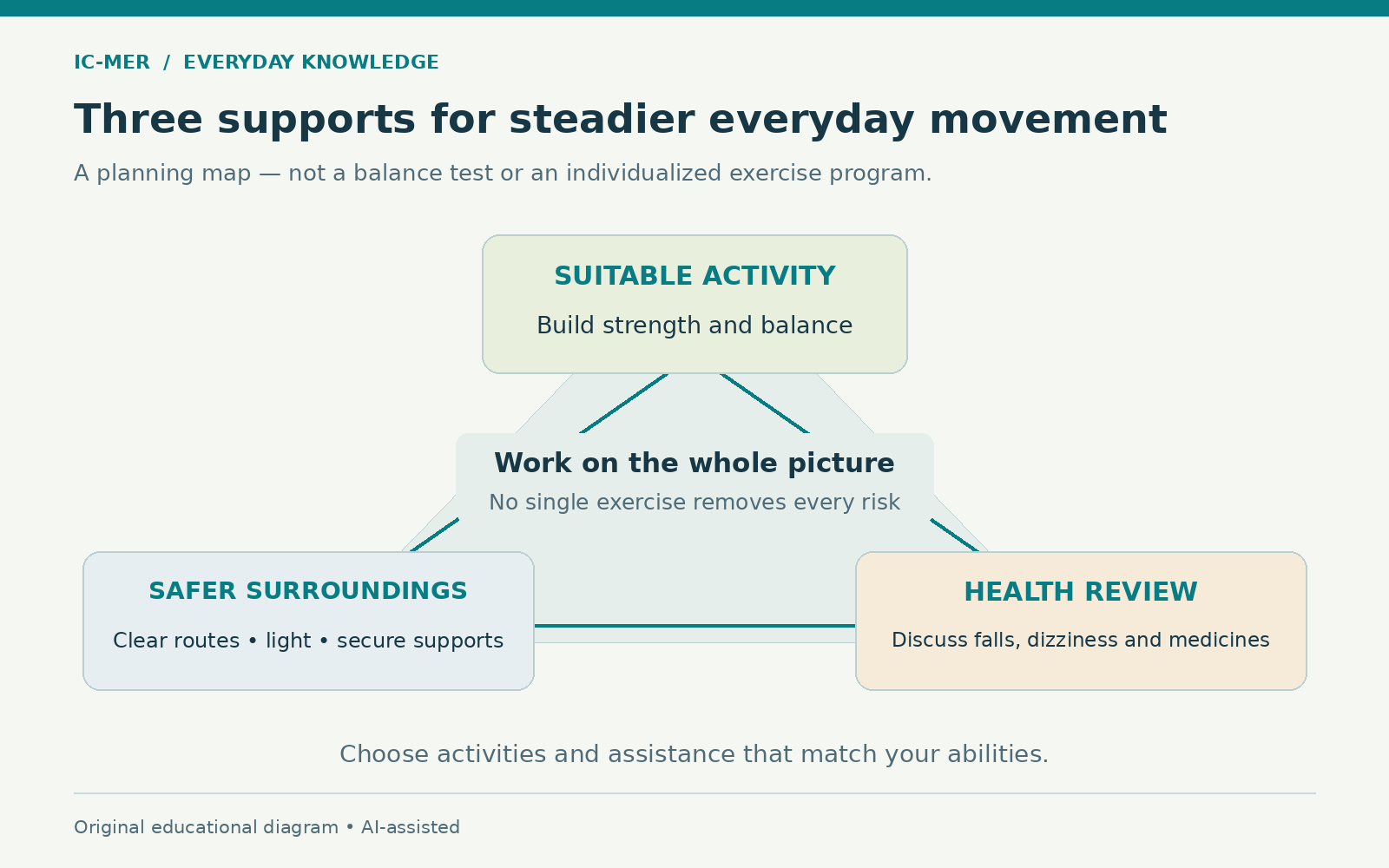
Pick one home obstacle to address, one question for your healthcare team and one suitable activity to discuss or continue. Keeping these three parts together avoids expecting a single exercise, product or piece of advice to solve every problem.
A useful note could read: improve the bathroom route lighting; ask about dizziness on rising; confirm a suitable balance class. Add who will help and when you will review progress. Those are organizational choices, not clinical targets.
Confidence can be built around preparation and appropriate support. The aim is to make valued activities more manageable while responding promptly to changes. If the current plan leaves you feeling unsafe, bring that information back to the professional helping you rather than silently pushing through.
Sources & further reading
- CDC: Older Adult Activity: An OverviewChecked 2026-10-23
- CDC: Preventing Falls and Hip FracturesChecked 2026-10-23
- CDC STEADI: Check for SafetyChecked 2026-10-23
- CDC STEADI: Postural HypotensionChecked 2026-10-23
- CDC: Older Adults: Adding Activity RecommendationsChecked 2026-10-23
- CDC: Signs and Symptoms of StrokeChecked 2026-10-23
About this article
Prepared with AI assistance and an AI fact-checking pass against the sources listed above. No human clinical review is claimed. Evidence may change; consult appropriate qualified professionals for decisions about your circumstances.
Spotted a problem? Suggest a correction.