Medicine · 6 min read
Blood pressure measurement: understanding the numbers and the process
A useful blood-pressure record includes how the measurement was taken, both readings, and a clear plan for follow-up.
AI-assisted general education for adults, not individual diagnosis or treatment advice. An independent AI source check is not human clinical review. Seek urgent medical help for concerning symptoms; pregnancy, postpartum care and childhood blood pressure need specific guidance.
Information may contain errors, omissions or outdated guidance. This article is general education, not individual medical or other professional advice. Verify important information before acting and consult an appropriately qualified professional. Never disregard medical advice, delay care or change treatment because of this article. See our accuracy disclaimer and terms.
A number is only part of the measurement
Imagine two notes brought to a clinic. One says “blood pressure high yesterday.” The other lists the date, time, both readings, the arm used, and whether the person had rested before measuring. The second note gives the clinician something more useful to investigate. Neither note alone establishes a diagnosis, but one preserves the context needed to interpret the observation.
This guide explains routine adult blood-pressure measurement using U.S. public-health and professional guidance checked on October 22, 2026. It is a preparation aid for conversations with a healthcare professional. Children and people who are pregnant or recently postpartum need guidance specific to their circumstances; the general adult categories and urgent thresholds below should not be substituted for their clinical plan.
The practical goal is a repeatable process. Before worrying about whether yesterday's result was a few points different from today's, establish that the cuff, posture, timing and recording method are suitable. Then agree with the care team how the results will be reviewed.
Understand systolic and diastolic pressure
Blood pressure is reported in millimeters of mercury, written mm Hg. The first, systolic number describes arterial pressure when the heart contracts; the second, diastolic number describes pressure between beats. A reading written as 128/78 therefore contains two measurements, not a score of 128 out of 78. Neither number should be discarded.
NHLBI explains that consistent systolic readings of at least 130 or diastolic readings of at least 80 are considered high in the usual U.S. adult framework. It also describes two patterns that complicate interpretation: readings higher in the clinic than outside it, called white-coat hypertension, and the reverse pattern, called masked hypertension. Comparing settings can help a clinician investigate these patterns.
Write down the units and both numbers when transferring a result from a monitor to a notebook. If an app also shows pulse, keep that separate: a pulse entry is not the lower blood-pressure number. Ask someone to demonstrate the display if its labels are unclear.
Sources: [3]
Select a device and check the cuff
The American Heart Association recommends a validated automatic upper-arm cuff monitor. The cuff must match the arm's circumference; a device being sold in a shop does not, by itself, establish suitability for every person. Ask a clinician or pharmacist to help check validation and sizing, especially for a child or during pregnancy.
Bring the monitor and cuff to an appointment so staff can observe your technique and compare readings with their equipment. Follow the manufacturer's maintenance instructions. Do not stop prescribed blood-pressure medicine because home numbers look better without discussing it with your prescriber.
Before buying, make a practical list: can you put the cuff on yourself, read the screen, and retrieve both readings later? If another person helps, can that person follow the same method? These usability questions do not certify accuracy, but they can prevent a technically suitable monitor from becoming unusable in everyday life.
Sources: [1]
Prepare the same way each time
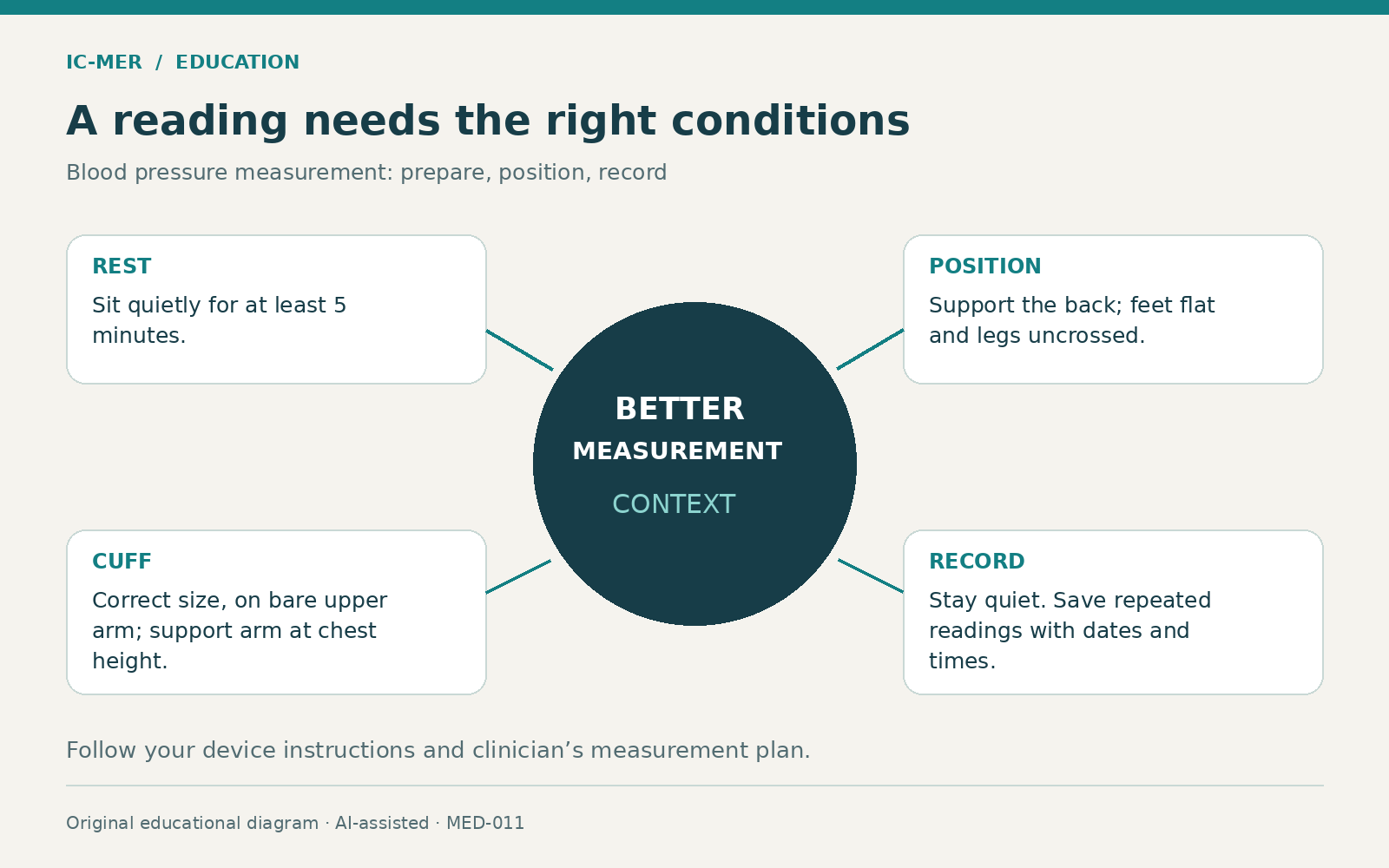
CDC advises sitting with back supported, feet flat and legs uncrossed after at least five minutes of rest. Empty your bladder beforehand. Put the cuff on bare skin and support the arm so the cuff is at chest or heart level. Stay quiet during the measurement. Recent smoking, caffeine or exercise can affect the result; avoid them during the preceding 30 minutes.
Choose a place where the setup can stay consistent. A chair beside a suitable table may be easier than the edge of a bed. Before pressing start, check the cuff position and that the arm is supported rather than held up by muscle effort. If you cannot use the recommended position, ask the care team for an adapted method and record it.
A small reminder card can contain just four prompts: rest, position, cuff, record. It is a memory aid rather than a replacement for the instructions provided with the monitor. Have someone observe a practice measurement if you are uncertain about any step.
Sources: [2]
Keep both readings and a useful log
AHA advises taking two readings one minute apart each time you measure. Agree with your clinician how often and at what times to measure, then keep that schedule. Home monitoring supplements clinical visits; it does not replace them.
A useful blank log has spaces for date, time, first reading, second reading, and a short context note. Include the arm if it might otherwise be unclear. Record an interruption, an error message or a missed session honestly. Do not repeatedly measure until you obtain a preferred result, then retain only that number.
For a fictional example, a person writes 136/84 and 132/82 at one session. The arithmetic mean is 134/83, calculated by averaging the upper numbers separately from the lower numbers. Preserve the original pair even if an average is requested. This example demonstrates recordkeeping; it does not establish a diagnosis, a treatment target or the number of days required for assessment.
Sources: [1]
Use categories as a discussion framework
AHA's current adult chart uses these categories: normal means systolic below 120 and diastolic below 80; elevated means systolic 120–129 with diastolic below 80; stage 1 means systolic 130–139 or diastolic 80–89; stage 2 means systolic at least 140 or diastolic at least 90. The word “or” matters: one elevated component is not cancelled by a lower other component.
These categories describe readings, while diagnosis and treatment decisions need professional interpretation. A colored symbol on a monitor cannot decide which medicine a person needs or whether an individual treatment target has been reached. Use the category to frame a question, not to make an unsupervised medication change.
For example, rather than asking only “Is this good?”, ask “What does the pattern mean in my circumstances, and what would make you change the plan?” Bring the record rather than relying on memory. This makes it easier to discuss apparently inconsistent results.
Sources: [4]
Separate routine follow-up from urgent symptoms
For a nonpregnant adult without concerning symptoms, AHA advises repeating a reading after at least one minute if systolic pressure is above 180 or diastolic is above 120. If it remains that high, contact a healthcare professional promptly. Do not simply file it away for the next routine visit.
If a reading in that range accompanies chest pain, breathlessness, back pain, weakness, numbness, vision changes or difficulty speaking, call 911 in the United States or the local emergency number elsewhere. Do not wait for the pressure to fall on its own. Serious new symptoms also warrant urgent assessment even if no reliable blood-pressure reading is available.
Ask your team to write down your own action plan, including whom to contact outside office hours. Pregnancy and the postpartum period can require urgent action at lower readings, so use obstetric instructions rather than this general adult threshold.
Leave the appointment with a measurement plan
Use five questions to close the loop: Is this device and cuff appropriate for me? Which arm and position should I use? When and for how many days should I measure? How should I share results? Which readings or symptoms require urgent action? Ask for a demonstration if any answer remains abstract.
Keep the plan with the log, including the date it was agreed and when it should be reviewed. If the plan changes, mark the change clearly rather than blending measurements taken under different instructions. A family helper should know the same plan and the same contact route.
The most valuable home record is not the longest one. It is a record the patient can obtain consistently and the clinical team can interpret. Treat unresolved measurement problems as questions to solve, rather than as a reason to assume every unusual reading is either harmless or dangerous.
Sources & further reading
- Home Blood Pressure MonitoringChecked 2026-10-22
- Measuring Your Blood PressureChecked 2026-10-22
- High Blood Pressure: DiagnosisChecked 2026-10-22
- Understanding Blood Pressure ReadingsChecked 2026-10-22
- When To Call 911 About High Blood PressureChecked 2026-10-22
- High Blood Pressure During PregnancyChecked 2026-10-22
About this article
Prepared with AI assistance and an AI fact-checking pass against the sources listed above. No human clinical review is claimed. Evidence may change; consult appropriate qualified professionals for decisions about your circumstances.
Spotted a problem? Suggest a correction.