Medicine · 7 min read
Prediabetes and type 2 diabetes: understanding the tests
Glucose tests look at different time windows. A clear interpretation connects the test, its conditions and the next clinical decision.
AI-assisted general education for nonpregnant adults, not a personal diagnosis, screening recommendation or treatment plan. Independent AI checking is not human clinical review. Discuss results and symptoms with a qualified healthcare professional.
Information may contain errors, omissions or outdated guidance. This article is general education, not individual medical or other professional advice. Verify important information before acting and consult an appropriately qualified professional. Never disregard medical advice, delay care or change treatment because of this article. See our accuracy disclaimer and terms.
Begin with the question the test is answering
A laboratory result can answer several different questions: is there evidence of diabetes, is a person at increased risk, or how is established diabetes being managed? The same test name may appear in more than one setting. Before comparing your result with a chart, identify why the test was ordered and whether the clinician is making an initial diagnosis or monitoring an existing condition.
This guide concerns commonly used U.S. tests for prediabetes and diabetes in nonpregnant adults. It is not a pregnancy testing protocol, a screening-age checklist or a treatment plan. Sources were checked on October 22, 2026. Keep the original laboratory report, including its units and collection date, for discussion with your healthcare professional.
A useful first question is “What decision will this result help us make?” That question prevents a single number from becoming the whole conversation and makes the follow-up plan easier to understand.
How insulin and glucose fit together
Insulin is a hormone made by the pancreas that helps the body use glucose. In type 2 diabetes, cells respond less effectively to insulin and the pancreas may eventually be unable to supply enough to maintain normal glucose levels. Symptoms can develop gradually or be absent, so feeling well does not settle whether testing is needed.
Prediabetes means glucose regulation is abnormal but results are below the diagnostic range for diabetes. It increases the risk of later type 2 diabetes, but progression is not inevitable. A risk label is a reason to discuss prevention and follow-up, not a prediction that the same outcome will occur in every person.
Avoid interpreting either label as a moral judgment. For practical planning, ask which factors can be addressed, what support is available, and how progress will be assessed. A plan that acknowledges work schedules, food access and mobility is more actionable than a vague instruction to “be healthier.”
A1C looks back over recent months
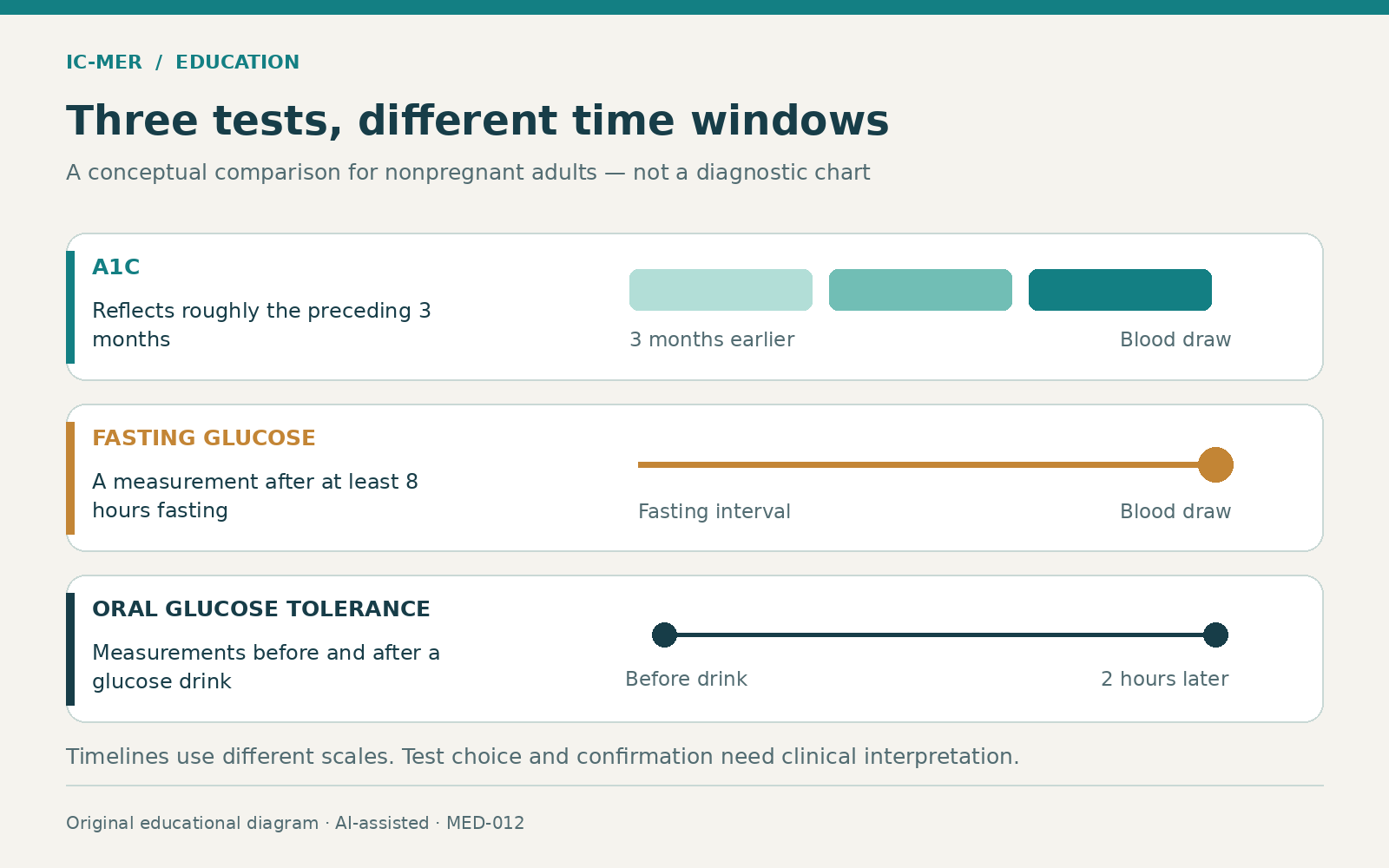
A1C measures the proportion of hemoglobin with glucose attached and reflects average glucose exposure over roughly three months. It is expressed as a percentage and ordinarily does not require fasting. It does not show every short-lived rise or fall, so it should not be read as today's glucose concentration.
Conditions affecting red blood cells or hemoglobin can distort A1C interpretation. Examples include recent blood loss or transfusion, some anemias and hemoglobin variants. Kidney failure or certain treatments may also matter. Tell the clinician about relevant conditions rather than assuming the result is automatically invalid.
An appointment note might say: “My report lists A1C, but I also had a recent transfusion. Does that change which test you would use?” The value of the question is that it links a specific piece of history to interpretation. It does not ask the patient to determine the direction or size of a possible laboratory effect.
Sources: [2]
Fasting glucose and an oral glucose tolerance test are different snapshots
Fasting plasma glucose measures glucose at one time after at least eight hours without caloric intake; follow the laboratory's instructions about water and preparation. A1C does not normally need fasting, but other tests ordered alongside it might. Ask about the whole blood-draw appointment.
An oral glucose tolerance test measures the response to a standardized glucose drink, including a two-hour measurement for the usual nonpregnant adult diagnostic test. A random plasma glucose test is taken without waiting for a fast and can be useful when symptoms are present. These tests examine different aspects of glucose regulation, so their numbers are not interchangeable.
Before a scheduled test, ask the clinic about medication instructions rather than skipping doses on your own. If you accidentally eat during a required fast or cannot complete the drink, tell the staff. Accurate preparation notes are more useful than trying to make an imperfect test look routine.
Sources: [1]
Read the ranges with their test and units attached
The usual U.S. nonpregnant adult prediabetes ranges are A1C 5.7–6.4%, fasting plasma glucose 100–125 mg/dL, or two-hour glucose 140–199 mg/dL. Diabetes-range results are A1C at least 6.5%, fasting plasma glucose at least 126 mg/dL, or two-hour glucose at least 200 mg/dL. These are diagnostic categories, not personalized treatment targets.
A random plasma glucose of at least 200 mg/dL can support diagnosis in someone with classic hyperglycemia symptoms or a hyperglycemic crisis; an isolated random number should not be treated as a universal self-diagnosis rule. A clinician determines how symptoms and confirmation requirements apply.
Copy the test name beside every value. “Glucose 130” without a fasting status, units or timing leaves essential information missing. A percentage belongs to an A1C result, while mg/dL describes a glucose concentration. Results reported in other units need the correct conversion and clinical interpretation, not a direct comparison of the printed numbers.
Why another measurement may be needed
In the absence of unequivocal hyperglycemia, diagnosis usually needs confirmation with another abnormal test result. The clinician may repeat the same test or use another accepted test. If results disagree, the response is to investigate and confirm appropriately, rather than selecting whichever value seems more reassuring.
These glucose tests also do not, by themselves, identify the type of diabetes. Clinical history and sometimes additional testing are needed. A home glucose meter is useful in appropriate monitoring plans, but it is not a substitute for clinical diagnostic testing.
Consider a fictional person whose A1C is in the diabetes range while fasting glucose is below the diabetes cutoff. A useful next step is to ask which result needs confirmation and whether anything could affect A1C reliability. It would be premature to announce either “definitely type 2 diabetes” or “definitely no diabetes” solely from that mismatch.
Turn a risk result into a feasible plan
CDC describes structured lifestyle-change programs as one way to help people with prediabetes lower their risk of type 2 diabetes. Physical activity, eating patterns and, when appropriate, weight management can be part of prevention. The suitable plan depends on the person's circumstances; this article does not prescribe a particular diet, exercise dose or medicine.
Choose a manageable action with the care team and identify the support needed. A fictional shift worker might ask for help planning meals across changing work hours rather than promising to follow an unrealistic daily timetable. Someone with mobility limits might need an adapted activity discussion. The point is to specify the barrier rather than treating difficulty as failure.
Ask when repeat testing is due and who will arrange it. Put that date in the same place as the plan. A prevention conversation is incomplete if no one knows how follow-up will occur or what to do when circumstances change.
Sources: [6]
After diagnosis, monitoring has a different purpose
Once diabetes is diagnosed, tests may be used to monitor treatment and guide adjustments. NIDDK emphasizes that A1C targets differ between people. The diagnostic cutoff is not automatically the best treatment target for every individual, and a favorable average does not answer every question about glucose variation.
Keep two questions separate in your notes: “What established the diagnosis?” and “What are we now aiming to achieve?” Ask which monitoring method is needed, how often, what results should trigger contact, and who will review the data. Do not assume a friend's monitoring schedule or device is appropriate for you.
Bring symptoms, medicines, supplements, prior results and relevant laboratory history to the visit. If testing was obtained at a community event or pharmacy, take the written result rather than a remembered number. New or worsening symptoms should prompt timely medical assessment instead of waiting for a scheduled screening discussion.
A short worksheet for the next conversation
Prepare a one-page note with five entries: the reason for testing, exact test and date, result with units, preparation or medical factors that may affect interpretation, and the agreed next step. Add a contact name or clinic route so you know where questions should go.
Leave space for uncertainty. A note reading “repeat test pending; clinician will review afterward” is more accurate than forcing a final label before the assessment is complete. If you do receive a diagnosis, ask for an explanation in your own words and a copy of the care plan.
The aim is to leave with an understandable decision and a practical next action. Knowing what a test measures, what it cannot settle and when it will be reviewed is more useful than memorizing cutoffs without their context.
Sources & further reading
- Diabetes Tests & DiagnosisChecked 2026-10-22
- The A1C Test & DiabetesChecked 2026-10-22
- Insulin Resistance & PrediabetesChecked 2026-10-22
- Diabetes TestingChecked 2026-10-22
- Type 2 DiabetesChecked 2026-10-22
- Prediabetes: Your Chance to Prevent Type 2 DiabetesChecked 2026-10-22
- Diabetes DiagnosisChecked 2026-10-22
About this article
Prepared with AI assistance and an AI fact-checking pass against the sources listed above. No human clinical review is claimed. Evidence may change; consult appropriate qualified professionals for decisions about your circumstances.
Spotted a problem? Suggest a correction.