Medicine · 7 min read
Screening versus diagnosis: why the distinction matters
Learn what screening and diagnostic tests are designed to answer, why abnormal results need follow-up, and how benefits and harms shape screening choices.
General education about screening and diagnosis, using cancer examples; not an individual screening schedule or medical diagnosis. Discuss symptoms and testing decisions with a qualified clinician. All numerical scenarios are hypothetical. Prepared with AI assistance; no human clinical review is claimed.
Information may contain errors, omissions or outdated guidance. This article is general education, not individual medical or other professional advice. Verify important information before acting and consult an appropriately qualified professional. Never disregard medical advice, delay care or change treatment because of this article. See our accuracy disclaimer and terms.
The purpose of a test changes its meaning
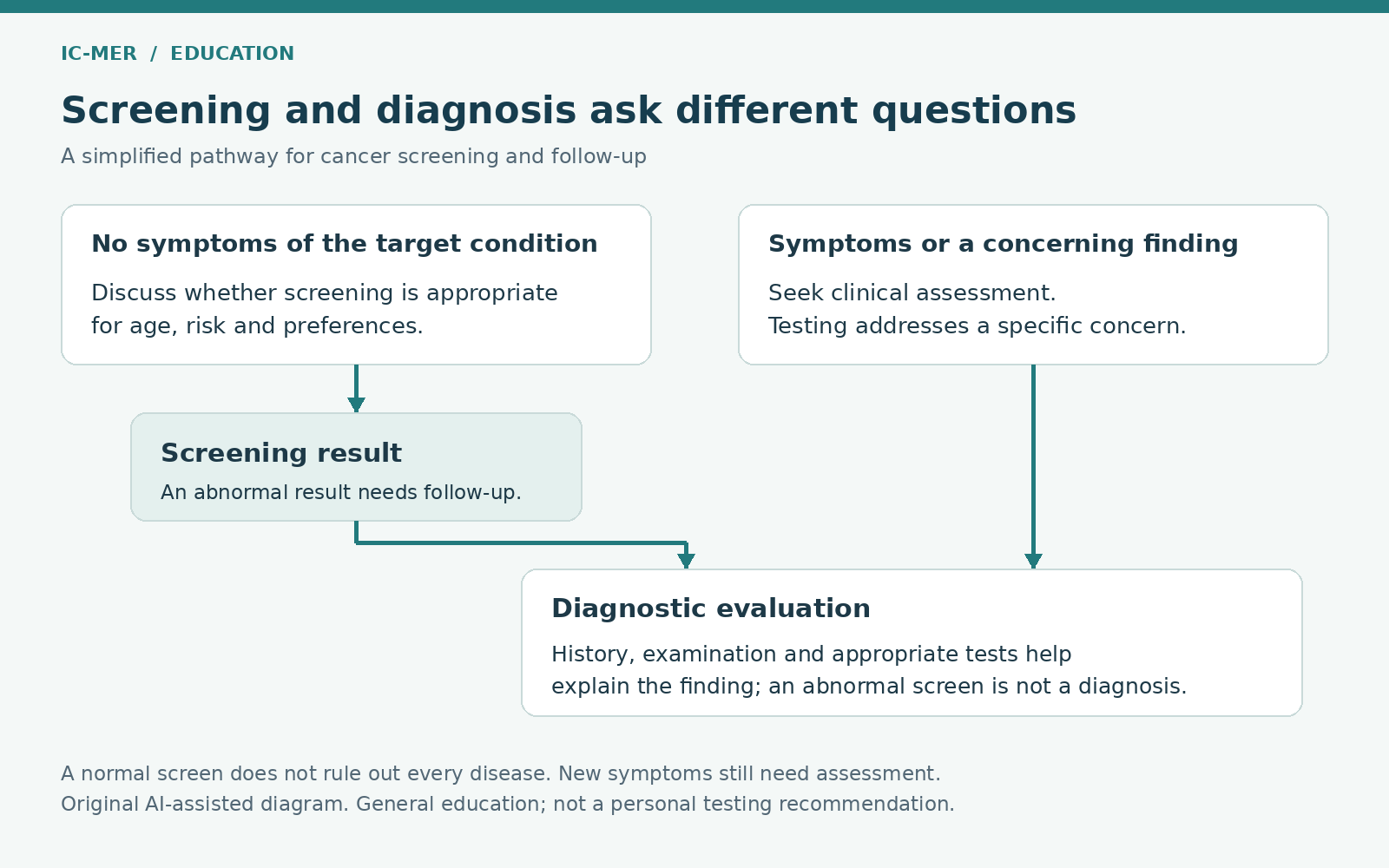
Screening looks for a disease or a precursor in people who do not have symptoms of the condition being screened for. Diagnostic evaluation investigates a symptom, sign or abnormal finding to determine its cause. The same technology may sometimes be used in either setting, but the reason for testing and the decisions that follow can differ. This distinction is especially clear in cancer care, which supplies the examples in this article.
An invitation for a screening test does not mean that a clinician has already concluded you have cancer. It usually means that a particular test may be appropriate for a defined group. Conversely, someone with a new concerning symptom needs an assessment of that symptom, even if a routine screening test was recently normal. Screening is not a substitute for investigating a clinical problem.
Before an appointment, write down why the test was ordered in one sentence. If the answer is unclear, ask whether it is routine screening, follow-up of an earlier result, investigation of symptoms or monitoring of an established condition. Those are different purposes, and knowing which one applies helps you ask useful questions about preparation, results and next steps.
A screening result begins a pathway
A positive or abnormal screening result may identify someone who needs additional evaluation. It does not necessarily establish the disease. Follow-up might involve more detailed imaging, another kind of test or a procedure, depending on the condition and the screening method. In cancer evaluation, a biopsy is often needed to establish the diagnosis. There is no single universal test that diagnoses every cancer.
Imagine two fictional people who receive the same phrase, further assessment recommended, in a portal. One may need additional views because an image was incomplete; another may need a targeted evaluation of a suspicious finding. The phrase alone cannot tell either person the final diagnosis. The useful task is to obtain the actual report, understand the recommended next step and confirm who is arranging it.
Keep a simple follow-up record: test date, ordering clinician, expected result date, result received, recommended action and person responsible. If the result has not arrived when expected, contact the clinical team rather than assuming silence means normal. This is an organizational aid, not a way to interpret an image or laboratory value independently.
False alarms and missed disease are different errors
A false-positive result suggests that a condition may be present when subsequent evaluation shows that it is not. A false-negative result fails to identify a condition that is actually present. These possibilities mean that neither positive nor negative should be interpreted as an absolute answer without considering the test and clinical context. False positives can lead to anxiety and additional procedures; false negatives can create misleading reassurance.
For a purely hypothetical exercise, imagine one hundred people screened, with five ultimately found to have the target condition. Suppose a test flags four of those five and also flags ten people without it. Fourteen people have positive results, but only four of those fourteen have the condition. The remaining affected person has a negative test. These invented numbers describe no real screening product and should not be used to estimate personal risk.
The exercise demonstrates why the phrase most affected people are detected cannot by itself tell you what a positive result means. The number of people with the condition in the tested population also matters. Ask for test information relevant to the people being screened and for the usual follow-up pathway, rather than assuming a general accuracy claim is the chance that your own result is correct.
Earlier detection is valuable only when it improves outcomes
Some established cancer screening methods can reduce the chance of dying from particular cancers in appropriate populations. Some methods can also detect and permit treatment of precancerous changes. However, finding more abnormalities, or finding a disease earlier on a calendar, does not automatically demonstrate a health benefit. The important question is what happens to people because screening was offered.
One reason for caution is lead-time bias. Imagine two fictional people with the same illness who both die at age seventy. If one is diagnosed at sixty-five and the other at sixty-eight, the first has longer survival measured from diagnosis even though the date of death is unchanged. This invented example explains why longer survival after detection is not by itself proof that screening extended life.
When reading a claim for a new test, ask which outcome was studied: detection rate, stage at diagnosis, disease-specific mortality, overall mortality or another outcome. These are related but not interchangeable. Also ask whether the study evaluated the entire screening pathway, including the tests and treatments prompted by an abnormal result. A promising detection technology may still need evidence about benefits and harms in practice.
Overdiagnosis is not the same as a false positive
Overdiagnosis means identifying a real cancer that would not have caused symptoms or death during the person’s lifetime. A false positive, in contrast, is a suspicious result when the target disease is not actually present. Overdiagnosis can lead to treatment that provides no benefit to that person while exposing them to burdens or complications. It is difficult to determine with certainty which individual detected cancer would never have caused harm.
Other harms can arise from the screening procedure itself or its follow-up: discomfort, radiation exposure for some tests, bleeding from some procedures, and time and financial burdens. Their importance depends on the specific test and pathway. A useful discussion considers both what screening might prevent and what additional testing or treatment it might trigger.
For your appointment notes, make separate spaces for false alarms, missed disease, overdiagnosis and procedural harms. This prevents the broad word accuracy from swallowing several different questions. The aim is to understand the tradeoffs for an evidence-based screening option, not to conclude that all screening is harmful or that every possible harm is equally likely.
Eligibility and intervals reflect a balance of benefits and harms
Recommendations specify populations because a screening strategy’s net benefit depends on factors such as baseline risk, the condition’s behavior and the consequences of testing and treatment. Age, personal and family history, prior results and other clinical factors may change the discussion. A recommendation for an average-risk group may not cover someone with a relevant inherited syndrome or a previous diagnosis.
The U.S. Preventive Services Task Force grades recommendations according to evidence and net benefit. An A or B recommendation supports offering the service to the described population. A C recommendation involves selective offering based on professional judgment and patient preferences. A D recommendation advises against the service, while an I statement means evidence is insufficient to determine the balance. An I statement is not the same as a recommendation against screening.
Use the current recommendation for the specific condition, not a remembered age cutoff from a headline. Read the population and exclusions as carefully as the recommended interval. This article deliberately does not prescribe a universal testing schedule. Screening decisions may also depend on national guidance, available follow-up and an individual’s health circumstances.
Prepare questions that lead to a complete decision
Take a short list to the clinician: what condition is this test looking for, and why does the recommendation fit me? What benefit has been shown for people like me? What are the important harms? What happens after an abnormal result? If several recommended options exist, how do preparation, frequency and follow-up differ? Ask which factors in your history would change the plan.
Also explain practical barriers. A test that requires transport, time away from work or a follow-up procedure may need arrangements before the first step. Ask who will communicate results and how to obtain help if an appointment cannot be scheduled. The purpose is to make a chosen pathway workable, rather than leaving an abnormal result unresolved because responsibilities were never clear.
Bring previous reports when available and describe new symptoms directly. Do not assume the word screening tells the clinician everything that matters. Your record can finish with a clear plan: the agreed test or reason to defer, the follow-up process and when the decision should be revisited. The outcome of the conversation should be informed understanding, not simply a larger number of tests.
Sources & further reading
- NCI: Cancer screeningChecked 2026-10-21
- NCI: How Cancer Is DiagnosedChecked 2026-10-21
- NCI: Cancer Screening Overview, health professional versionChecked 2026-10-21
- NCI: Cancer Screening Overview, patient versionChecked 2026-10-21
- NCI: Screening TestsChecked 2026-10-21
- USPSTF: Grade DefinitionsChecked 2026-10-21
About this article
Prepared with AI assistance and an AI fact-checking pass against the sources listed above. No human clinical review is claimed. Evidence may change; consult appropriate qualified professionals for decisions about your circumstances.
Spotted a problem? Suggest a correction.