Business · 4 min read
Break-even analysis for a new service or program
A worked example shows how many services cover modeled costs—and why reaching that number still does not prove a program is sustainable.
General business education, not individualized accounting, tax, legal, investment, or medical-billing advice. All dollar amounts and operating scenarios are hypothetical. Prepared with AI assistance by the IC-MER Editorial Team; independent review does not constitute professional certification.
Information may contain errors, omissions or outdated guidance. This article is general education, not individual medical or other professional advice. Verify important information before acting and consult an appropriately qualified professional. Never disregard medical advice, delay care or change treatment because of this article. See our accuracy disclaimer and terms.
Choose the period and define the service
Break-even analysis asks what activity level covers the costs included in a model. SBA presents the basic single-service calculation as fixed costs divided by the difference between selling price and variable cost per service. The result is an estimate under stated assumptions, not proof that customers will arrive or pay.
Use one period consistently. In this original hypothetical example, a small organization sells a defined educational workshop service. Each sale means one completed workshop of the same scope. All costs and volume below are monthly. These are invented teaching figures, not IC-MER financial data or recommended charges.
Sources: [1]
Separate costs before doing the arithmetic
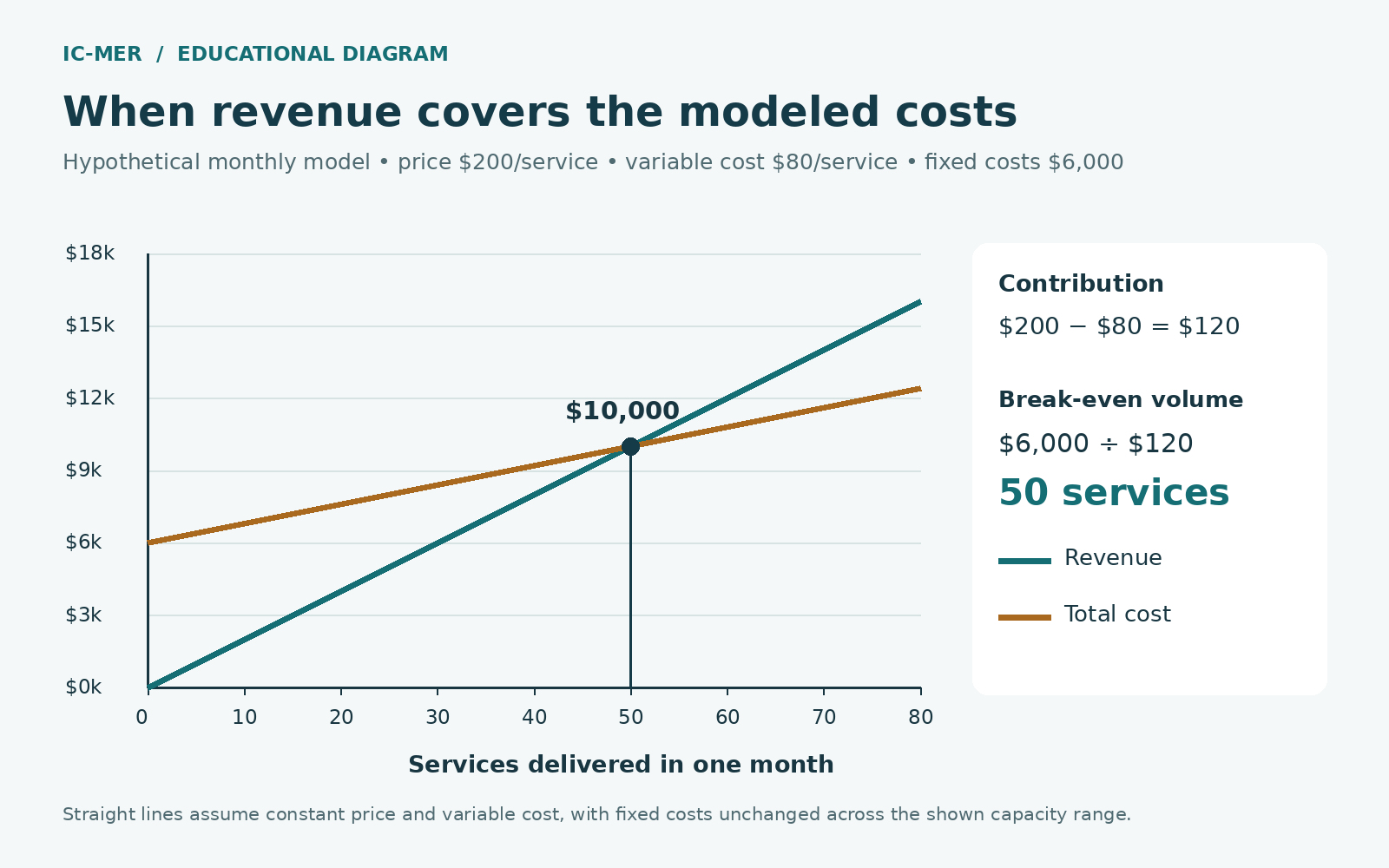
Assume the program has $6,000 in monthly fixed costs and $80 of additional cost for each workshop delivered. The selling price is $200 per workshop. Fixed costs remain unchanged within the capacity range assumed here; variable costs rise with the number of workshops. Real arrangements may contain both components or jump when additional capacity is needed.
SBA’s startup-cost guidance distinguishes initial expenditures from recurring spending. Build an inventory before deciding what belongs in this monthly model. A startup equipment purchase, for example, raises a separate question about funding and cost allocation; do not quietly omit it or count the entire purchase in every month.
Calculate contribution and the break-even volume
Each hypothetical workshop brings in $200 and consumes $80 of variable resources. That leaves $120 toward fixed costs. Dividing $6,000 by $120 gives 50 workshops per month. At that volume, revenue is $10,000, variable costs are $4,000, and fixed costs are $6,000. The modeled balance is exactly zero.
At 40 workshops, revenue is $8,000 and variable costs are $3,200. After the same $6,000 fixed costs, the model shows a $1,200 shortfall. At 60 workshops, revenue is $12,000 and variable costs are $4,800, leaving $1,200 after fixed costs. These calculations follow directly from the fictional inputs; they are not a demand forecast.
For a whole-service model, round a fractional break-even result upward. If the contribution per service is zero or negative while fixed costs are positive, selling more identical services cannot cover those fixed costs under this simple model. The price, cost structure or funding arrangement needs reconsideration.
Sources: [1]
Test the assumptions that could change the decision
Suppose the fictional program lowers its price to $180 while variable cost stays $80. Contribution becomes $100 and break-even rises to 60 workshops. If price stays $200 but variable cost increases to $100, the same 60-workshop threshold results. The identical answer comes from two different operational problems.
Now suppose the team can reliably deliver only 45 workshops monthly. At the original $120 contribution, 45 workshops contribute $5,400 and leave a $600 shortfall. A target of 50 is not feasible without changing the operation. Adding staff might increase capacity but could also increase fixed costs; recalculate both sides before assuming expansion solves the gap.
Test a quieter month, a delayed opening and a canceled workshop. Write down which costs disappear with cancellation and which remain. The point is to locate the fragile assumption before committing resources, not to search for the scenario with the most attractive answer.
Keep a dated assumption sheet beside the calculation. For each input, name the evidence and the person who can update it. A signed venue quote and a tentative attendance estimate deserve different confidence. When actual delivery begins, compare the estimate with completed, paid services and explain the differences.
Handle mixed services and funding explicitly
A second service with a different contribution changes the calculation. If the fictional program offers both workshops and reports, it cannot treat one report as interchangeable with one workshop unless their contributions match. Build a scenario using the expected quantity and contribution of each, then compare the combined contribution with shared fixed costs.
For a subsidized program, show service income and committed support separately. A scenario may ask how much funding would close a gap, but a hoped-for award is not confirmed revenue. Define which costs the exercise includes, including paid staffing where applicable, and identify donated resources that may need replacement. This is an editorial planning method, not a grant-accounting rule.
Keep a cash calendar alongside the model
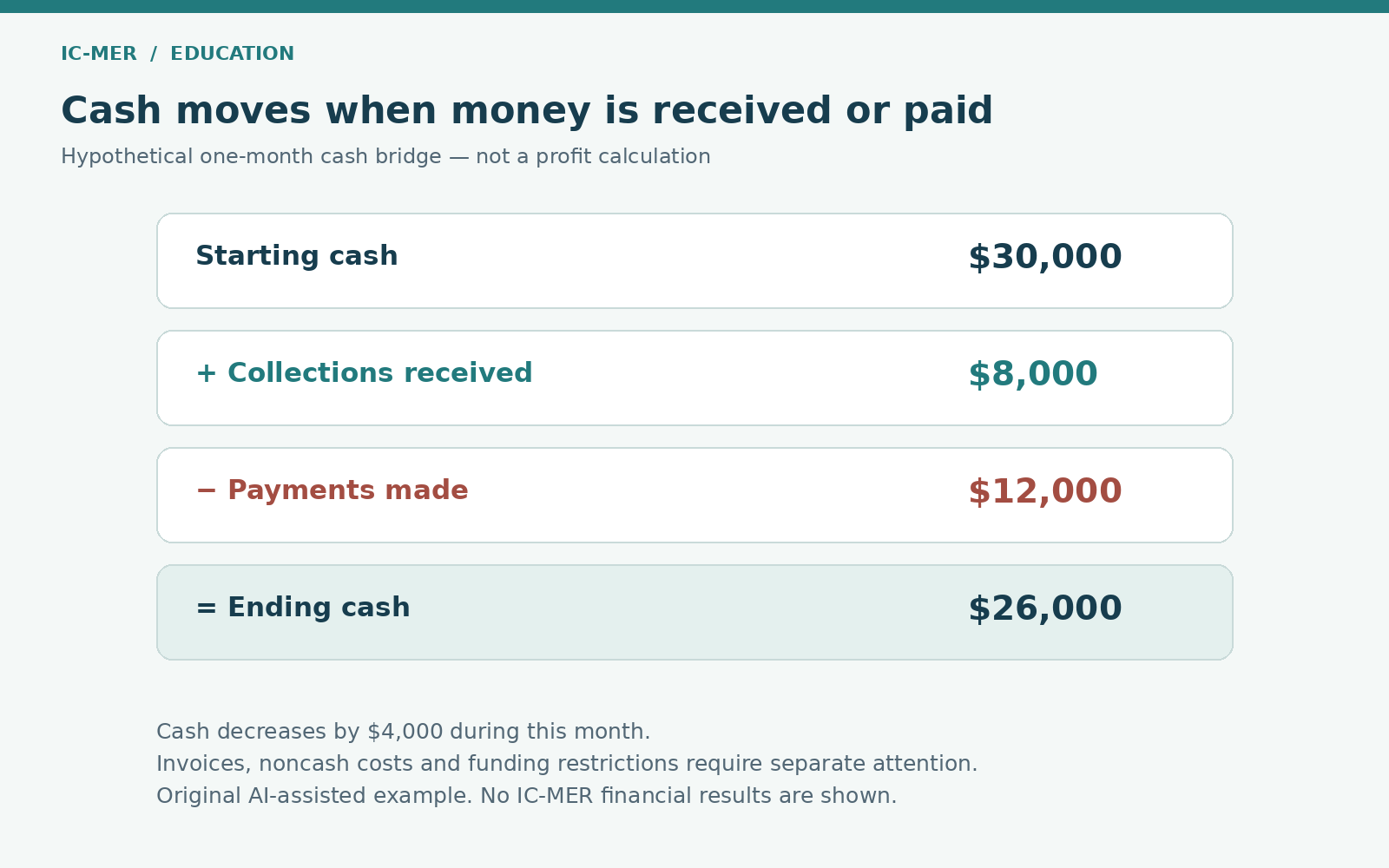
SBA’s finance guidance highlights available cash and outstanding payments. A program can cover modeled monthly costs yet need money earlier than customers pay. Therefore, pair the volume calculation with a simple calendar of expected receipts and payments; check real invoice terms rather than assuming immediate collection.
For example, the fictional organization may pay instructors before receiving workshop fees. The break-even number remains 50 under the original inputs, but it does not tell the owner how to bridge that timing gap. Review both questions before proceeding: can the activity cover the chosen costs, and can the organization meet payments as they fall due?
Sources: [3]
Sources & further reading
- SBA: Break-even pointChecked 2026-10-21
- SBA: Calculate your startup costsChecked 2026-10-21
- SBA: Manage your financesChecked 2026-10-21
About this article
Prepared with AI assistance and an AI fact-checking pass against the sources listed above. No human clinical review is claimed. Evidence may change; consult appropriate qualified professionals for decisions about your circumstances.
Spotted a problem? Suggest a correction.