Business · 7 min read
Understanding cash flow profit and cash runway
Separate accounting profit from available cash, build a rolling cash forecast and calculate runway without overlooking payment timing or restricted funds.
General business education, not accounting, tax, legal or investment advice. All dollar figures and scenarios are hypothetical and are not IC-MER financial data. Accounting and funding terms require case-specific professional review. Prepared with AI assistance.
Information may contain errors, omissions or outdated guidance. This article is general education, not individual medical or other professional advice. Verify important information before acting and consult an appropriately qualified professional. Never disregard medical advice, delay care or change treatment because of this article. See our accuracy disclaimer and terms.
Three questions that belong on different lines
A small research or healthcare venture needs to understand whether its work earns a surplus, whether it can pay its bills when due and how long its available money may last. Profit, cash flow and runway help answer those questions, but they are not interchangeable. The SEC’s financial-statement guide distinguishes the income statement from the statement of cash flows: one reports financial performance over a period, while the other explains cash movements.
A useful management habit is to show all three on one page with the period and assumptions visible. Put reported revenue and expenses in one section, expected receipts and payments in another, and the projected low point in available cash below them. For a nonprofit, the terminology and reporting framework differ, but the practical need to distinguish operating results from spendable cash remains.
The worksheet described here is an original planning exercise. It is not an accounting standard, a tax calculation or a model of IC-MER’s actual finances. All amounts are fictional. Use your accountant’s definitions and reconcile planning totals to actual records before relying on them for decisions.
Understand when transactions enter the books and the bank
Under accrual accounting, revenue and expenses are recognized according to the applicable accounting rules, which need not coincide with when money changes hands. Cash-method accounting generally records income and expenses when cash is received or paid, subject to relevant rules. SBA introduces this timing distinction and recommends appropriate accounting support. The method suitable or required for an organization depends on its circumstances.
Imagine a fictional consulting service that completes a project and records $15,000 of revenue in a month under its accounting policies, together with $10,000 of related expenses. Its simplified accounting profit is $5,000. If the customer has not paid by month-end while the service has paid the full $10,000, the cash effect from those specified transactions is an outflow of $10,000. Profit did not provide the missing payment.
Now imagine the business receives loan proceeds. Its bank balance increases, but borrowing is not sales revenue. A repayment of loan principal uses cash without being the same thing as an operating expense. Equipment purchases, depreciation and owner transactions can also make profit and cash move differently. Ask your accountant how each is recorded; the management forecast still needs the actual cash timing.
Build a rolling forecast from dates and evidence
Choose a planning interval short enough to reveal payment pressure. A thirteen-week forecast is one practical option, not a universal requirement. Start with a reconciled bank balance, identify money that is unavailable for the planned purpose, and list expected receipts and payments by week. Carry each week’s closing balance into the next week’s opening balance. Extend the horizon as the weeks pass.
For each expected receipt, record the payer, invoice or agreement, amount, due date and realistic collection date. Keep an unsigned proposal separate from an issued invoice, and an issued invoice separate from money received. Label uncertain amounts explicitly. For each payment, record its due date and whether changing the timing would require agreement. A forecast should not silently assume that every customer pays early and every supplier accepts delay.
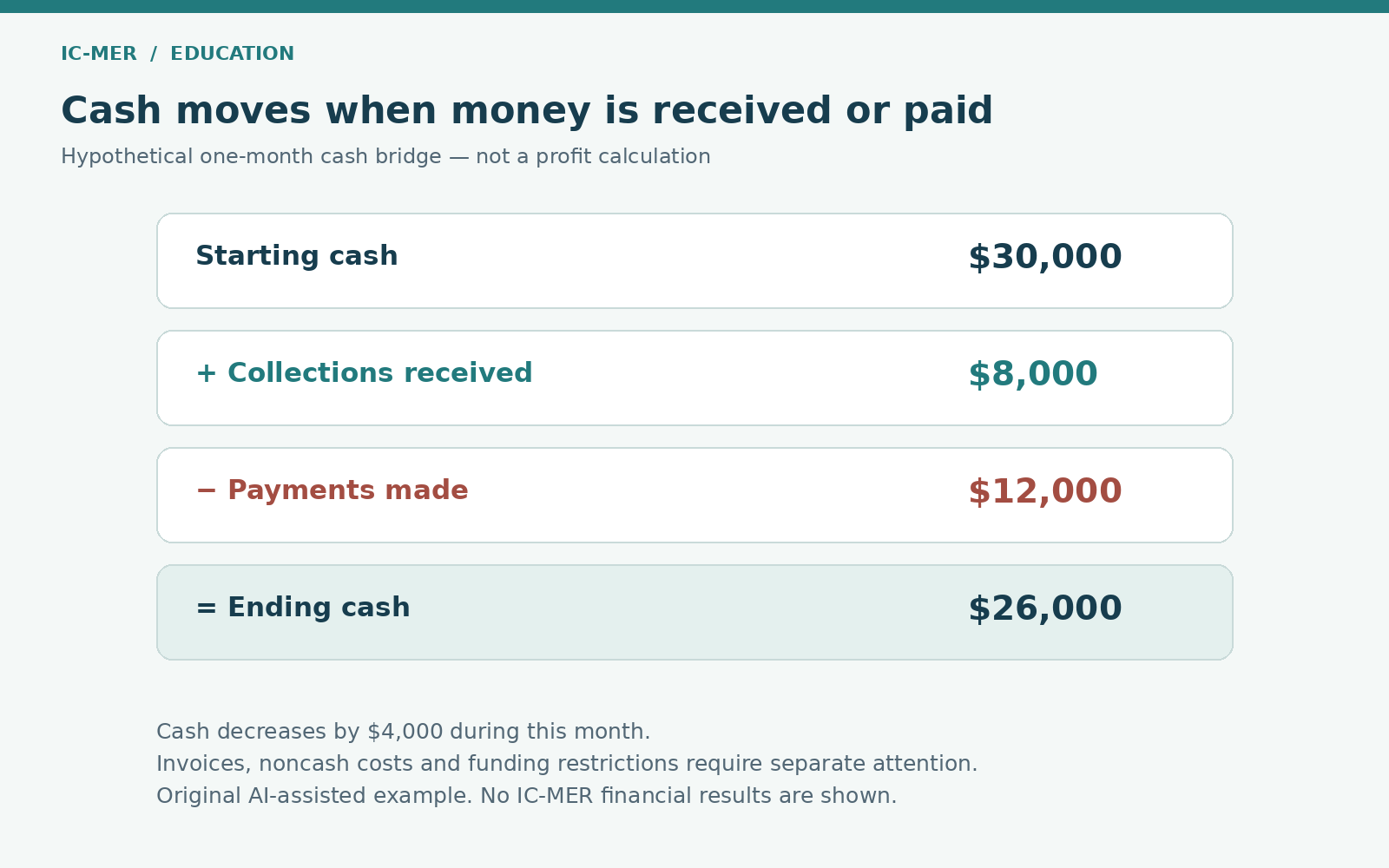
For a compact illustration using monthly periods, one hypothetical month starts with $30,000 of available cash, receives $8,000 and pays $12,000. Its closing balance is $26,000: $30,000 plus $8,000 minus $12,000. If the $8,000 receipt arrives the following month instead, this month closes at $18,000. The eventual total collection may be unchanged, but the timing changes the lowest balance and the decisions needed before it occurs.
Sources: [2]
Use the forecast to expose the pressure points
Extend the fictional example. Month two begins with $26,000, receives $6,000 and pays $15,000, ending at $17,000. Month three receives $14,000 and pays $9,000, ending at $22,000. Across the three months, receipts total $28,000 and payments total $36,000, so cash falls by $8,000 from the initial $30,000. The month-two balance of $17,000 is lower than the ending balance and deserves attention.
Set a clearly described planning buffer, rather than treating zero as the only meaningful threshold. If this fictional team wants at least $20,000 available, the forecast shows a $3,000 buffer shortfall in month two. That is a management warning under the chosen assumption, not a legal definition of insolvency or a claim that $20,000 suits every organization.
Write a possible response next to each pressure point and check its feasibility. Could a discretionary purchase be postponed? Is an invoice missing information that prevents payment? Could contract milestones be negotiated for future work? Do not treat delaying payroll, taxes or committed obligations as a casual cash-management tactic. The exercise is to find lawful, agreed and operationally realistic choices before a deadline arrives.
Calculate runway only after defining burn and available cash
A simple runway estimate divides available cash by average net cash outflow per period, when that outflow is positive and reasonably representative. Net burn means cash going out minus cash coming in under the definition you specify. It is different from gross spending. Define whether the estimate includes debt service, capital purchases, fundraising costs and other material items so readers know what the number contains.
For example, $48,000 of genuinely available cash divided by $8,000 of steady monthly net burn gives six months of simple runway. If net burn rises to $12,000, the same balance gives four months. If management chooses to preserve a $12,000 reserve, the $36,000 above that reserve covers four and a half months at $8,000 per month. These are arithmetic scenarios, not forecasts of a real organization’s survival.
When cash inflows equal or exceed outflows, the simple positive-burn formula does not provide a useful depletion date. That does not mean financial risk has disappeared. A major annual payment, delayed customer or lost contract can still create a shortfall. Where cash flows are uneven, rely on the dated forecast and its lowest balances instead of presenting a single runway number as certain.
Sources: [1]
Separate restricted, expected and accessible funding
An account balance is not automatically a budget for every purpose. For planning, tag funds whose use is limited by an agreement, donor restriction or another applicable condition, and confirm the actual terms with the responsible adviser. Do not assume that a pending grant, verbal pledge or unapproved credit line can fund next week’s payments. This is a conservative planning convention, not a conclusion about the legal treatment of any particular award.
Use separate lines for confirmed available cash, expected but uncertain receipts, and possible financing. If you build an optimistic case that includes new funding, also show a case in which it arrives later or not at all. Label the assumptions so a board member or project manager can see what would have to happen for the optimistic version to hold.
For a fictional research project, a proposed $50,000 award should not be entered as cash received simply because the application was submitted. Ask what agreement, conditions, payment milestones and permitted uses would apply if it were awarded. If those details are unknown, keep them unknown. Inventing an award date makes the forecast look complete while removing exactly the uncertainty it should communicate.
Sources: [2]
Maintain a short review routine and seek help early
Update the forecast using actual receipts and payments, then compare each material variance with the previous expectation. Was the difference a timing issue, an incorrect amount, a missing cost or an assumption that no longer holds? Assign a person to investigate important differences. A repeated collection delay should change the next forecast; otherwise the worksheet becomes a record of recurring optimism.
Include one-time and recurring costs. SBA’s startup guidance separates these categories and encourages estimating the expenses specific to the venture. An annual insurance payment should appear when it must be paid in a cash forecast, even if an internal budget spreads the cost across months. A new equipment purchase should not disappear because it is unusual. The point is to anticipate the bank movement as well as understand the economic cost.
Bring an accountant or qualified financial adviser into questions about reporting rules, tax obligations, grant restrictions, debt terms or inability to meet commitments. A concise review pack can contain the latest financial statements, reconciled balances, receivables and payables, the cash forecast and its major assumptions. Good records make the conversation specific: what changed, when cash becomes tight, which decisions are available and who must approve them.
Sources & further reading
- SEC: Beginners’ Guide to Financial StatementsChecked 2026-10-21
- SBA: Manage your business, finances and accountingChecked 2026-10-21
- SBA: Plan your business, startup costsChecked 2026-10-21
About this article
Prepared with AI assistance and an AI fact-checking pass against the sources listed above. No human clinical review is claimed. Evidence may change; consult appropriate qualified professionals for decisions about your circumstances.
Spotted a problem? Suggest a correction.