Business · 7 min read
Pricing professional services with a realistic cost model
A practical way to estimate what a service needs to earn, test whether buyers value it, and learn from the work actually delivered.
General business education, not individualized accounting, tax, legal, investment, or medical-billing advice. All dollar amounts and operating scenarios are hypothetical. Prepared with AI assistance by the IC-MER Editorial Team; independent review does not constitute professional certification.
Information may contain errors, omissions or outdated guidance. This article is general education, not individual medical or other professional advice. Verify important information before acting and consult an appropriately qualified professional. Never disregard medical advice, delay care or change treatment because of this article. See our accuracy disclaimer and terms.
Start with the work a customer can actually accept
A useful service price connects three things: a clearly defined result, the resources needed to deliver it, and evidence that a buyer will pay. A spreadsheet can illuminate the second question. It cannot settle the other two. This guide develops an original, hypothetical planning exercise for a small research-support or consulting service. The amounts are teaching assumptions, not recommended market rates or IC-MER financial results.
Begin with a deliverable narrow enough for both parties to recognize completion. For example, a fictional operations consultant offers a workflow map, a list of three implementation priorities, and one discussion meeting. The proposal specifies the number of interviews, the records the client must supply, the delivery date, and one revision round. It excludes software implementation and continuing support. That description is easier to estimate than an open-ended promise to improve operations.
Write down acceptance questions before calculating a fee. What will the client receive? Who supplies missing information? What happens if additional departments join? Which work needs a separate estimate? This is a planning exercise, not a contract template. Its purpose is to expose assumptions before they quietly become unpaid work.
Build a cost inventory with a consistent boundary
SBA guidance recommends identifying startup expenses and distinguishing initial spending from recurring costs. Relevant categories may include software, equipment, insurance, professional support and marketing. Obtain actual quotes where possible and label estimates. Avoid assuming that a business conducted from home has no operating costs.
For the fictional service, create four columns: item, annual planning amount, evidence, and review date. A software invoice is stronger evidence than a remembered advertised price. A proposed insurance allowance remains provisional until a suitable quote exists. Identify costs included elsewhere so the same subscription or salary is not counted twice.
Keep the planning model separate from tax reporting. A target for owner compensation is not automatically a deductible wage expense, and money set aside as a reserve is not automatically an accounting expense. The model below asks what revenue the owner wants to support; an accountant would determine how actual payments and transactions are classified.
Sources: [1]
Estimate billable capacity before choosing an hourly target
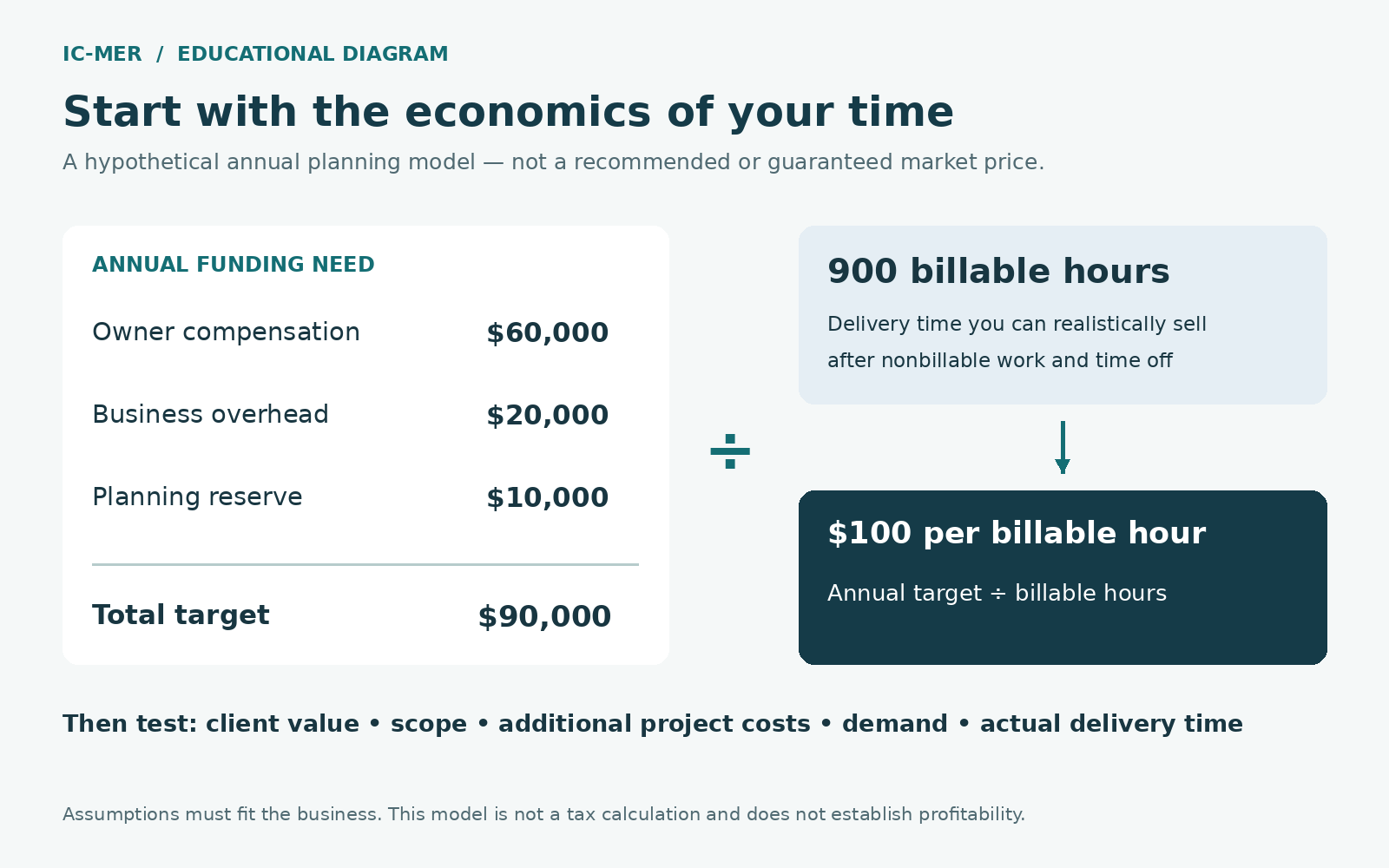
Consider an entirely hypothetical annual plan with a $60,000 owner-compensation target, $20,000 of operating overhead, and a $10,000 reserve target. Together they create a $90,000 revenue objective. Assume project-specific outside costs are charged separately and that the $20,000 already includes the recurring costs being modeled. Personal income tax and other items are not silently added or claimed to be covered.
Now assume 900 hours of client work can realistically be billed and collected during that year. Dividing $90,000 by 900 produces a planning target of $100 per billable hour. It is a target under the stated assumptions, not an observed market price, a guaranteed income, or an accounting break-even figure. Collection losses would require a separate adjustment.
Test the denominator. With only 750 billable hours, the same objective requires $120 per hour. At 600 hours it requires $150. Neither calculation means that clients will accept the rate. It shows how a weak capacity assumption can disguise a difficult business model. Sales calls, bookkeeping, training, leave, revisions outside billable scope and empty calendar slots must fit somewhere in the year.
As an editorial exercise, sketch a sample week and mark the time genuinely available for contracted delivery. Then compare that sketch with several weeks of actual time records. A new venture without history can retain a range and update it after a small pilot; there is no need to invent precision.
Translate the annual model into one project
Return to the fictional workflow review. Estimate two hours for preparation, four for interviews, three for analysis, two for producing the written deliverable, and one for the agreed revision. Total delivery time is twelve hours. At the illustrative $100 planning target, that represents $1,200 before any separately modeled direct costs.
Suppose the project also needs a $100 external transcription service. A provisional project target would then be $1,300, assuming transcription was not already included in overhead. If the work actually takes sixteen hours, the remaining $1,200 after that direct cost represents $75 per delivery hour. This arithmetic identifies an estimating problem even if the client is happy.
Do not automatically solve the problem by raising every future price. Review where the four extra hours went. In this fictional case, perhaps the client supplied unusable records, the interviews expanded, or the consultant repeated an analysis unnecessarily. Each cause suggests a different response: clearer inputs, a narrower scope, or a better production process.
The time estimate should include the checking required for responsible delivery. A health-related educational project, for example, may require source verification and appropriate subject expertise. Removing a necessary check to make the spreadsheet attractive changes the service being offered.
Choose a pricing structure that makes uncertainty visible
An hourly arrangement ties the bill to recorded time and needs a clear definition of chargeable work. A fixed project fee ties the bill to the agreed deliverable and places more estimating risk on the provider. A retainer can reserve defined capacity or provide defined recurring work, but the proposal should say which. These are planning descriptions, not assurances that any arrangement fits a particular profession or jurisdiction.
For the twelve-hour fictional project, compare two written examples: an hourly estimate with a spending checkpoint, and a fixed fee with the interview count and revision allowance stated. Ask how each handles a fifth interview, late client input, or a second workshop. The better structure is the one both parties can understand and the team can administer.
Avoid promising unlimited work unless the operational limits are genuinely understood. A monthly fee with no clear service boundary can conceal a wide range of delivery time. Conversely, an excessively narrow package may fail to solve the client’s actual problem. Pricing and scope should be tested together.
Compare alternatives and test willingness to buy
SBA recommends examining demand, competing alternatives, market conditions and what customers pay for those alternatives. Use those questions to put the internal cost model in context. A cost-based target tells you what the proposed operation needs; it does not prove that a market exists.
A fictional prospect might compare the workflow review with hiring an employee, doing the work internally, purchasing software, or postponing the problem. Ask what outcome matters, how the decision will be evaluated, and what would make the purchase unnecessary. Describe the offer accurately and record whether the prospect requests a proposal or makes a real commitment, while recognizing that a few conversations are not a representative market survey.
BLS publishes occupational wage estimates by geography and other groupings. Those data can inform questions about staffing costs. They should not be presented as a consultant’s standard selling price: wages and a business’s client charge answer different questions. No wage figure from BLS is used in the hypothetical example here.
If a buyer cannot afford the offer, examine a genuinely smaller deliverable, a different buyer, or an explicitly funded subsidy. Do not hide the gap by assuming that volunteer time, donated facilities or owner effort will remain available forever. Record who is supporting the difference and for how long.
Review the model against actual delivery and collections
SBA’s financial-management guidance emphasizes bookkeeping and monitoring receivables, payables and available cash. For pricing decisions, a useful companion record is a project log containing the agreed fee, direct costs, delivery hours, invoicing date, payment date and scope changes. Keep financial records appropriate to the organization; this article does not prescribe an accounting method.
In the fictional pilot, compare three completed projects rather than relying on the best one. One may take twelve hours, another sixteen, and another ten. Record why. Look separately at time spent winning work that did not sell. Those observations can change the capacity estimate, package design and sales process without turning every inconvenience into a price increase.
Set a review trigger, such as completing the next three comparable projects or receiving a major supplier-price change. At that point, ask whether the service solves a valuable problem, whether delivery is repeatable, and whether cash arrives when needed. The model earns its place by improving the next decision, not by producing a reassuring number.
Sources: [3]
Sources & further reading
- SBA: Calculate your startup costsChecked 2026-10-21
- SBA: Market research and competitive analysisChecked 2026-10-21
- SBA: Manage your financesChecked 2026-10-21
- BLS: Occupational Employment and Wage StatisticsChecked 2026-10-21
About this article
Prepared with AI assistance and an AI fact-checking pass against the sources listed above. No human clinical review is claimed. Evidence may change; consult appropriate qualified professionals for decisions about your circumstances.
Spotted a problem? Suggest a correction.