Medicine · 7 min read
Breaking up long periods of sitting
Find manageable ways to add movement to desk work and home routines, without treating standing, reminders or short breaks as a substitute for an activity plan.
General health education, not individualized exercise or rehabilitation advice. Adapt activity to your abilities and medical guidance. AI assistance and AI factual checking do not constitute human clinical review.
Information may contain errors, omissions or outdated guidance. This article is general education, not individual medical or other professional advice. Verify important information before acting and consult an appropriately qualified professional. Never disregard medical advice, delay care or change treatment because of this article. See our accuracy disclaimer and terms.
Notice where stillness gathers in your day
A day can contain a walk and still include long stretches at a desk, in a vehicle or in front of a screen. You do not have to label the whole day a failure. Start by noticing where a small, suitable movement opportunity would fit.
For one ordinary day, write a few rough notes about the activities that keep you still. You might notice that paperwork runs into lunch, or that one television episode becomes an evening. There is no need to measure every minute. The point is to find a repeatable moment when you could do something different.
Choose an opportunity that is under your control. A person working a tightly scheduled shift may have different options from someone working at home. Rest, disability, illness and recovery also affect what is appropriate. A useful plan respects those constraints rather than turning a movement reminder into another source of guilt.
Keep two goals in view
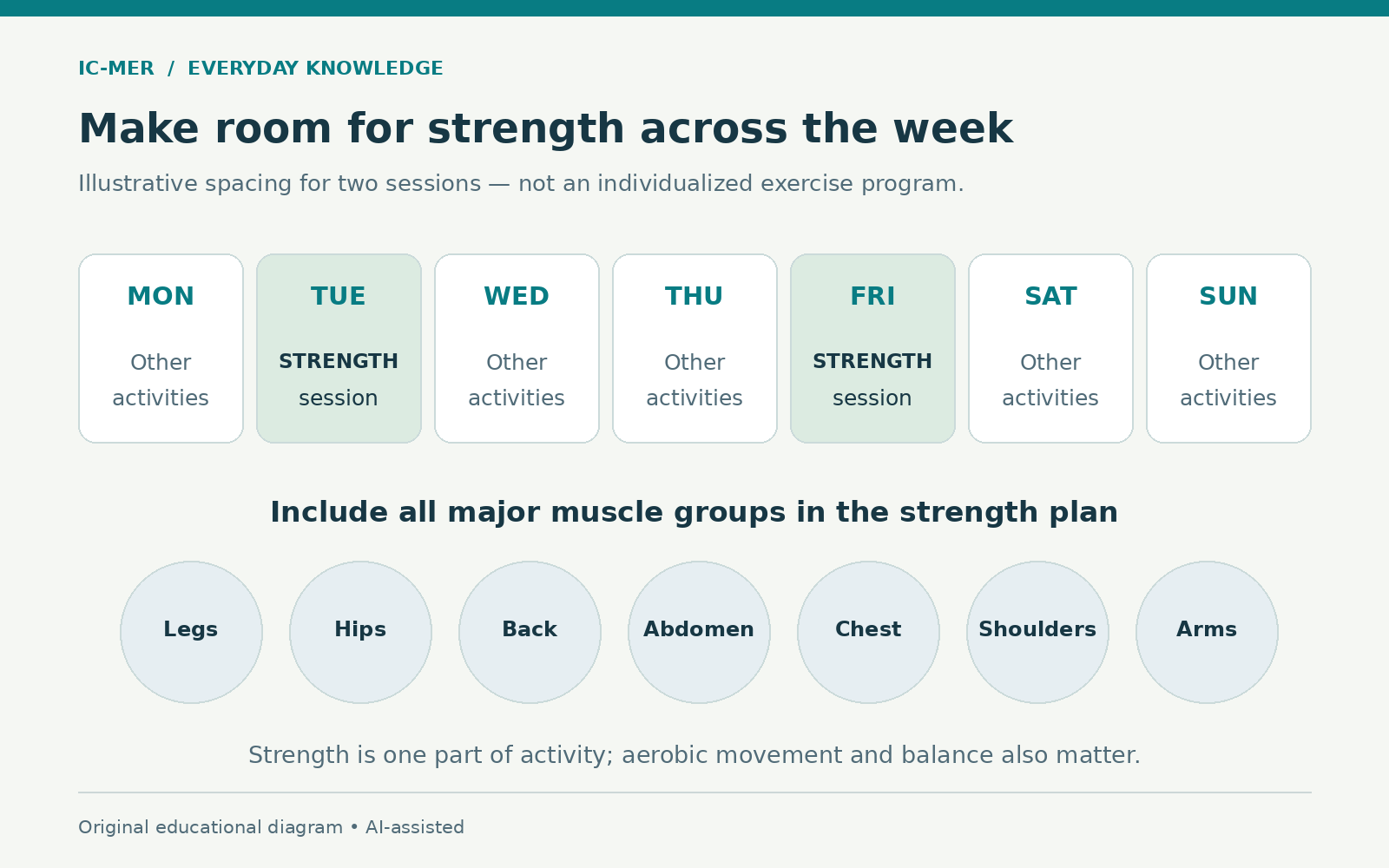
CDC advises adults to move more and sit less. It also recommends at least 150 minutes of moderate-intensity aerobic activity a week, or 75 minutes of vigorous activity or an equivalent combination, together with muscle strengthening on at least two days. Activity can be spread through the week in smaller amounts.
Think about two practical questions: Where can I interrupt a long inactive stretch, and where does my aerobic and strength activity fit? Answering the first does not automatically answer the second. A short stroll around a room can be a useful change of routine without being a complete weekly exercise plan.
A reminder is a tool, not a diagnosis. Missing a break does not establish that you have harmed yourself, and meeting a reminder target does not certify health. Use the broad guidance to make the next manageable change, not to invent a precise safe limit for every person.
Sources: [1]
Understand what a movement break does and does not count as
CDC explains that moderate-intensity aerobic activity raises breathing and heart rate; a common guide is being able to talk but not sing. The same activity can feel different to different people. Time spent moving at moderate or vigorous intensity counts toward the aerobic recommendation.
Standing up to organize papers is therefore not automatically equivalent to brisk walking. Nor is every movement break a muscle-strengthening session. This distinction helps you describe your routine honestly while still valuing modest changes.
Keep the break appropriate to the task and setting. You might choose a short familiar walking route when safe, or a suitable seated movement when standing is not an option. Avoid increasing intensity just to make a break count on an app. For a person who is very inactive, an achievable beginning can matter more than a complicated classification system.
Sources: [2]
Use an existing transition as a cue
NIDDK’s practical activity guidance suggests reminders, short walks and breaks from computer or television time. Its older 2017 page is used here for planning ideas; the current CDC guidance above provides the activity framework. You do not need a ten-minute minimum for an activity bout to count under current guidance.
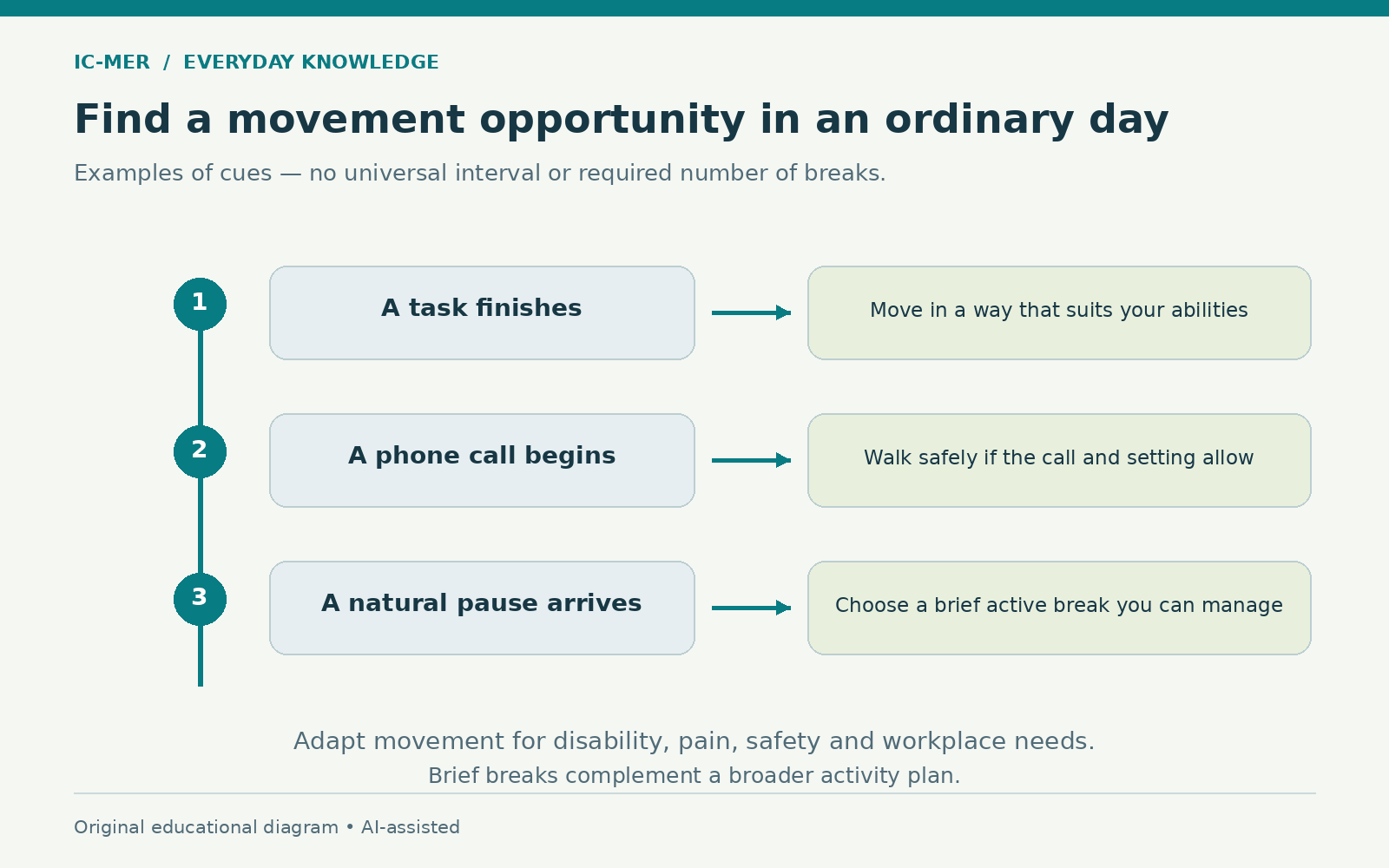
Try attaching movement to a transition that already occurs: finishing a document, ending a meeting or reaching a natural pause in a program. Choose one cue before adding several. A plan such as taking a comfortable walk after the morning paperwork is easier to remember than a vague intention to be less sedentary.
Timers can be useful if you like them, but this article does not prescribe one universal interval or duration. Select a reminder that fits your work and ability, and change it if it becomes distracting or impractical. The alert should make a useful action easier, not demand that you abandon a safety-critical task.
Make a small menu instead of one rigid rule
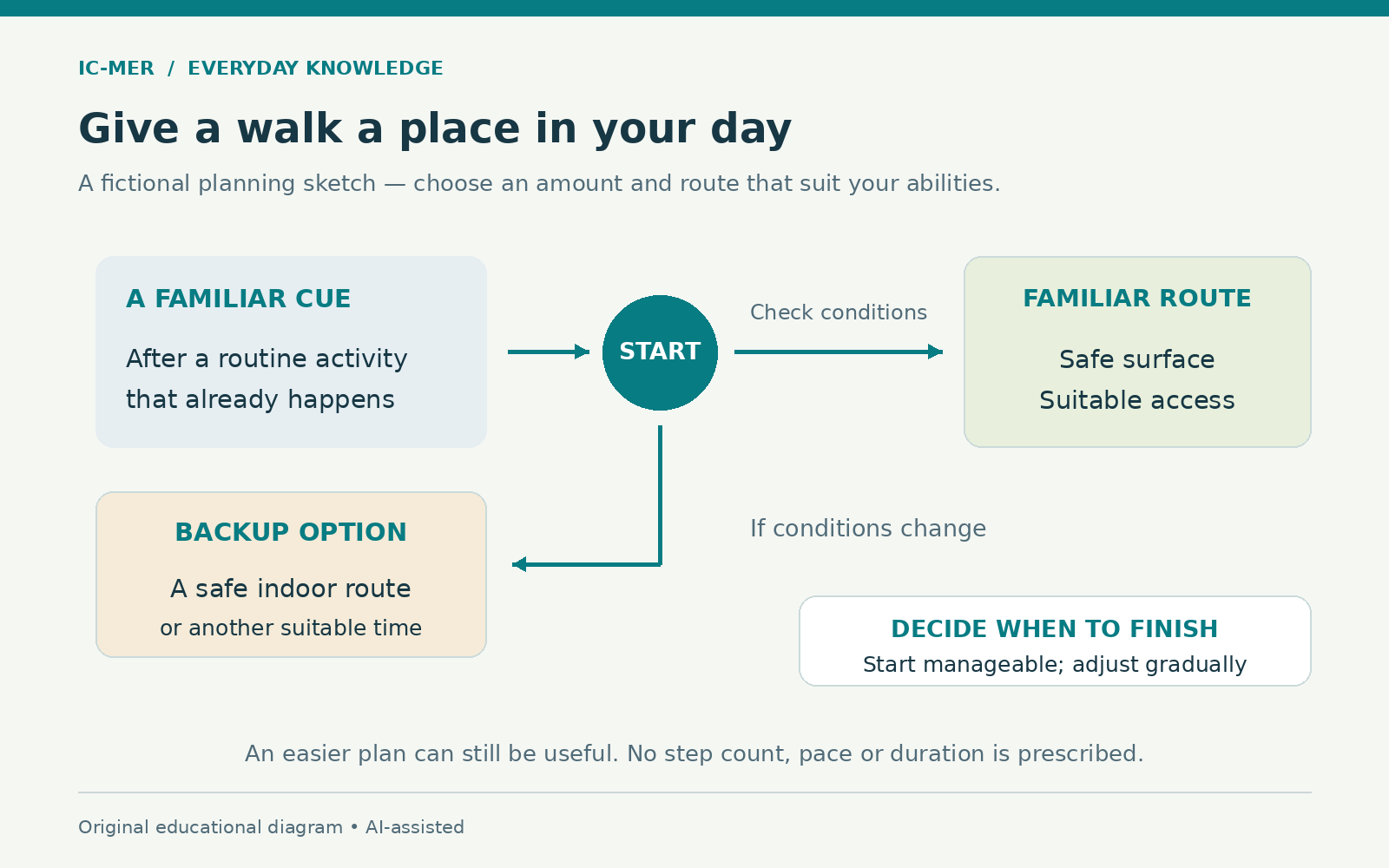
Write down two or three options for different circumstances. At home, one option might be moving to another room for a brief household task. At work, it might be a short walk during an authorized break. On a day when walking is unsuitable, use an activity already recommended for your abilities.
The menu is an editorial planning idea, not a validated medical program. Its purpose is to prevent a predictable obstacle from eliminating every option. Rain may rule out an outdoor route without ruling out all suitable activity.
Keep pathways clear and avoid carrying hot drinks or reading a screen while moving. If you are responsible for a child, dependent adult or equipment, preserve that supervision. A movement plan should fit safely around the responsibility, not compete with it. When no safe opportunity exists at that moment, choose another time rather than forcing the plan.
Let the workplace support the routine
In an office, a movement break may require a small scheduling change rather than new equipment. Meetings can include a pause; a colleague can cover a desk during an agreed break; a block of computer work can end before the next task begins. Discuss what is realistic for the role.
For a small team, offer choices instead of making everyone stand during a meeting. People may have health conditions or disabilities they do not want to disclose. A suggestion that works for one person should not become a public test of commitment or fitness.
A height-adjustable desk may change how work is arranged, but buying one does not automatically create an activity routine. Before buying equipment, decide which task it would help, whether it fits the available space and how you would actually use it. This article makes no promise that a product prevents disease, relieves pain or replaces appropriate movement.
Keep activity accessible and individualized
NIDDK recommends asking a healthcare professional about suitable types and amounts of activity when a disability or a health problem affects the plan. Activity can include options such as wheeling and chair-based exercise. Being seated does not mean a person is incapable of being active.
If you have been advised to rest, follow that advice and ask what movement is appropriate during recovery. If symptoms, balance problems or pain make a proposed break difficult, ask for help adapting it. Do not turn a general sit-less message into an instruction to stand without the support you need.
Enjoyment also matters in building a routine. NIDDK suggests choosing activities you like and, when helpful, involving another person. The invitation can be simple: would a short suitable activity together fit the day? Keep the arrangement flexible so that company supports the plan rather than becoming a requirement for doing anything.
Use a fictional workday to test the idea
Imagine Alex, who works at a computer and repeatedly postpones lunch while finishing messages. Alex chooses the end of the morning work block as a cue to leave the desk for a brief, comfortable walk before lunch, when the workload permits. A separate after-work activity remains on the calendar. This is a fictional example, not a recommended dose.
On a busy day, the first plan fails because the work block has no clear end. Alex changes the arrangement by putting lunch on the calendar and agreeing with a colleague how urgent calls will be covered. The change addresses the obstacle instead of adding more reminders.
At home, Alex uses the end of an episode as a prompt to pause and decide whether to continue watching. Sometimes the pause includes a suitable household task; sometimes it is simply a decision to finish for the evening. Neither action comes with a promised calorie total or a claimed reduction in disease risk.
Review the routine without chasing a perfect score
After trying a change, ask whether you remembered it, whether it felt manageable and whether it interfered with anything important. Those observations are enough to improve the plan. A paper tick or a short note may be more useful than a complicated dashboard.
If you repeatedly ignore an alert, change the cue, the activity or the timing. If the break is uncomfortable, seek appropriate advice rather than escalating effort. If the plan works, keep it steady before adding another element. These are practical ways to organize a habit, not a claim about the optimal medical schedule.
The aim is a day with more suitable opportunities to move, alongside a broader activity plan. You can start with one workable change and build from there. Keep rest, accessibility and safety in the plan, and use guidance from your healthcare team when personal circumstances call for it.
Sources & further reading
- CDC: Adult Activity: An OverviewChecked 2026-10-23
- CDC: What Counts as Physical Activity for AdultsChecked 2026-10-23
- NIDDK: Tips for Starting Physical Activity (2017; practical tips only)Checked 2026-10-23
- NIDDK: Health Tips for AdultsChecked 2026-10-23
- HHS ODPHP: Physical Activity Guidelines Questions & AnswersChecked 2026-10-23
About this article
Prepared with AI assistance and an AI fact-checking pass against the sources listed above. No human clinical review is claimed. Evidence may change; consult appropriate qualified professionals for decisions about your circumstances.
Spotted a problem? Suggest a correction.