Business · 6 min read
Choosing a business structure: questions for a qualified adviser
Prepare for a useful conversation about business structure, tax treatment, ownership, liability and ongoing costs before filing formation paperwork.
General U.S. business education, not legal or tax advice. State law, ownership, activity and tax facts can change the appropriate choice; consult qualified advisers before formation or elections.
Information may contain errors, omissions or outdated guidance. This article is general education, not individual medical or other professional advice. Verify important information before acting and consult an appropriately qualified professional. Never disregard medical advice, delay care or change treatment because of this article. See our accuracy disclaimer and terms.
Bring the business, not just an acronym
Choosing a business structure is easier when you can describe what the business will actually do. A label such as LLC is not a complete plan for taxes, ownership, insurance or paying yourself. Before buying a formation package, write a short description of the work, who will own it, where it will operate and what could go wrong.
The aim is to arrive at a meeting with useful questions rather than a conclusion borrowed from an advertisement. A solo online service, a shop with employees and a venture owned by two friends may need different arrangements. Even businesses doing similar work can have different owners, funding plans and risks. This guide concerns general U.S. considerations; it does not select an entity for your circumstances.
Separate three decisions that often get mixed together
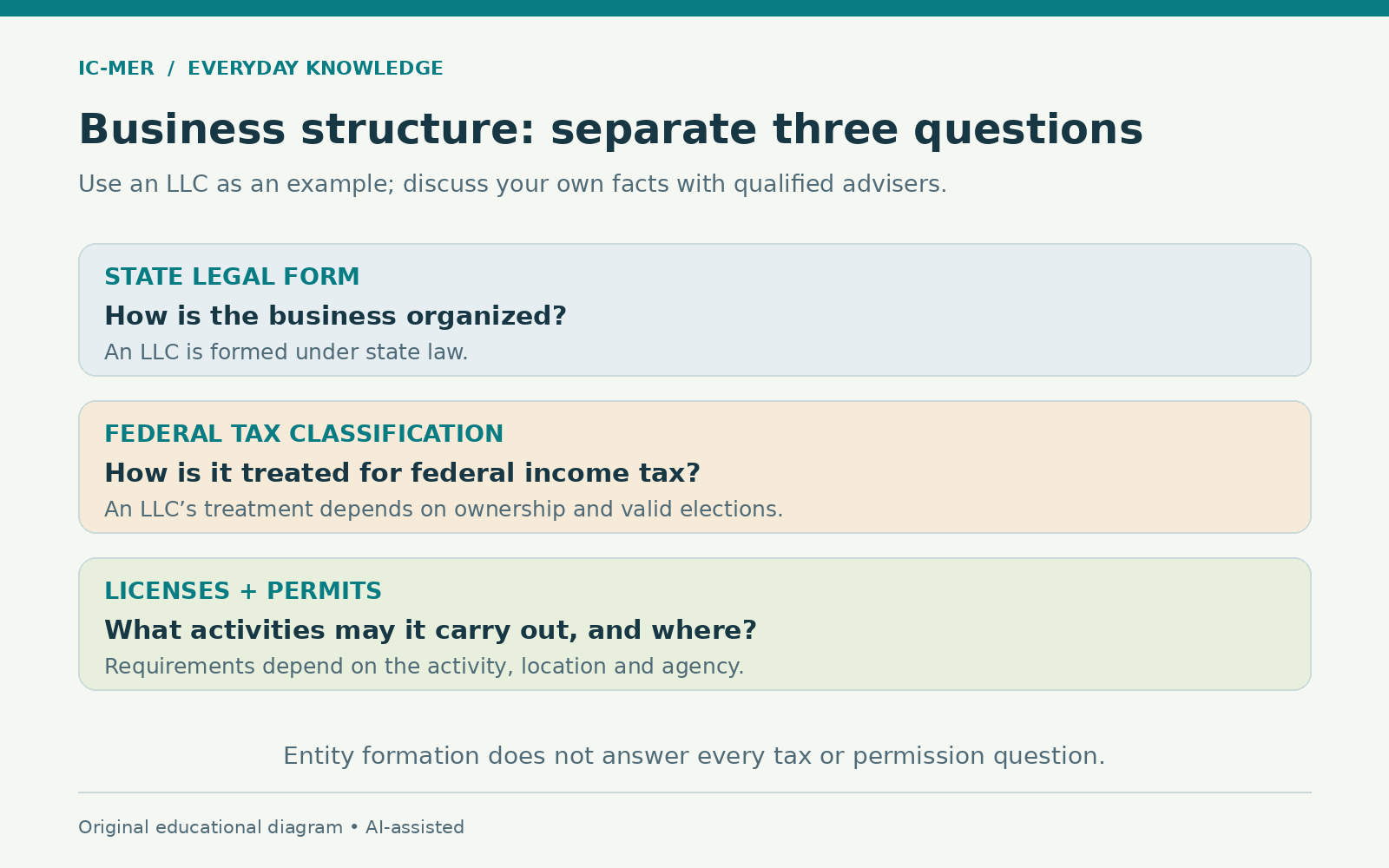
Start with the legal form recognized under state law. Then ask how the activity will be treated for federal and state tax purposes. Finally, identify the permissions needed to do the actual work. The diagram illustrates these as separate questions because an answer to one does not settle the others.
IRS guidance describes an LLC as a structure created under state law. Its federal tax classification can differ depending on membership and elections. That is why the question “LLC or S corporation?” can be misleading unless the adviser explains which legal and tax choices are being compared.
The everyday implication is simple: ask for the proposed legal form and tax treatment in separate lines of the written recommendation. Add another line for licensing and registration checks. If the explanation uses several acronyms, ask the adviser to connect each to an action, filing or ongoing responsibility. A filing receipt should not be mistaken for permission to offer a regulated service.
Understand what you are comparing
SBA describes a sole proprietorship as an arrangement that does not create a separate legal entity from its owner. Business obligations can therefore affect the owner personally. Partnerships, LLCs and corporations involve different ownership, liability and administrative features, and state rules matter. A simple-looking arrangement still deserves a discussion of risk.
Do not choose solely by counting the forms needed on the first day. Ask which risks a proposed structure may address and which it does not. Personal guarantees, the owner’s own conduct and professional obligations are questions to discuss with an attorney; the name on a registration is not a promise that every personal asset is protected in every situation.
Use a concrete example. If your business will enter a customer’s property, ask how an injury or property-damage claim would be handled. If it will rent space, ask who signs the lease and whether a personal guarantee is expected. These questions are more informative than asking whether one structure is universally safest.
Sources: [3]
Get the tax explanation in plain language
The IRS generally treats a domestic LLC with at least two members as a partnership for federal income tax unless it elects corporate treatment. A single-member LLC is generally disregarded as separate from its owner for income tax unless it elects otherwise; employment and certain excise taxes can be handled differently. Special circumstances require advice.
These classifications do not mean that business income escapes taxation. Ask who reports income, which returns are expected and how payments during the year will be handled. If the business has a loss, ask what limits apply before assuming the loss will reduce your other taxes. The answer should reflect your circumstances rather than a social-media example.
An S-corporation election has eligibility requirements and filing procedures. If it is proposed, ask the adviser to explain qualification, deadlines, state treatment and ongoing responsibilities. Do not sign an election merely because a salesperson describes it as a standard upgrade. Understand what is being elected and why it fits the expected business.
Compare continuing costs as well as possible savings
Ask for a list of expected setup and recurring work: formation filings, annual state requirements, bookkeeping, tax preparation, payroll if relevant and professional support. Request the assumptions behind estimates and identify which costs remain when revenue is low. A cheaper first-year package may exclude work you will still need.
For an invented illustration, suppose one proposal estimates an extra $1,200 in yearly administration and a possible $1,500 tax saving. The simple difference is $300 before any omitted costs or changes in income. That arithmetic is not a forecast and does not establish that the proposed treatment is worthwhile. Ask what happens if the assumptions change.
Where an S corporation pays a shareholder who works in the business, compensation needs particular attention. IRS guidance requires reasonable compensation for services before non-wage distributions in the circumstances it describes. An owner cannot assume that every withdrawal can be called a distribution to avoid employment taxes. Have the accountant explain the practical payroll process and cost.
Sources: [5]
Plan ownership before friendship has to carry it
If more than one person will own the business, write down the proposed contributions and responsibilities before discussing percentages alone. One person may provide money, another equipment and another most of the work. How will decisions, future contributions and compensation be handled? Those are related questions, but they are not interchangeable.
Consider a fictional two-owner service business. One owner wants to work full time while the other expects to remain an occasional adviser. A fifty-fifty ownership split does not by itself explain working hours, wages, approval of expenses or what happens when the full-time owner takes leave. Describe the intended arrangement and ask counsel how to document it.
Discuss uncomfortable possibilities while everyone is cooperative: an owner leaves, becomes unable to work, wants to sell, disagrees about borrowing or stops contributing. Ask how records, customer relationships and intellectual property would be handled. These are prompts for an agreement suited to the venture, not clauses to paste into a contract without review.
Check the activity and location separately
SBA explains that licensing and permit requirements depend on business activity and location. Identify the official state, county and city sources relevant to the work, including where customers are served. An entity filing and a business name do not settle professional licensing, zoning or insurance questions.
For a home-based business, describe whether customers visit, deliveries arrive or equipment is stored. For work across state lines, tell the adviser where owners and customers are located and where services are performed. Do not assume that an online service has no location-related obligations. The appropriate analysis depends on the actual operation.
Keep this separate from the choice of marketing name. You may need advice on registration, trademarks or other naming issues, but a domain purchase does not establish that the business is legally ready. Ask for a checklist that identifies who will confirm each requirement and where the evidence will be kept.
Sources: [3]
Leave the meeting with a usable decision record
Bring a one-page description of the activity, expected owners, realistic revenue and expense estimates, planned borrowing, staffing and location. Mark estimates as estimates. Tell the adviser about existing entities and employment commitments that may affect the decision. Missing information is easier to resolve when it is identified before paperwork is filed.
Ask for a written summary covering the proposed legal form, intended tax treatment, reasons, alternatives considered, outstanding questions and implementation steps. Confirm the scope of the engagement: who files which documents, who monitors deadlines and what is outside the quoted service. Avoid assuming an online filing service also provides individualized legal or tax advice.
Finally, set a reason to revisit the choice. Adding an owner, hiring staff, borrowing, entering a new state or changing the service may warrant a fresh conversation. Structure is part of an operating plan, not a badge of seriousness. A good decision is one you understand well enough to maintain and explain.
Sources & further reading
- Business structuresChecked 2026-10-22
- Limited liability company (LLC)Checked 2026-10-22
- Launch your businessChecked 2026-10-22
- S corporationsChecked 2026-10-22
- S corporation compensation and medical insurance issuesChecked 2026-10-22
About this article
Prepared with AI assistance and an AI fact-checking pass against the sources listed above. No human clinical review is claimed. Evidence may change; consult appropriate qualified professionals for decisions about your circumstances.
Spotted a problem? Suggest a correction.