Business · 7 min read
Separating business and personal finances from the start
Separate accounts help, but reliable records also explain where money came from, why it moved and what it was used for.
General U.S. small-business education, not individualized legal, tax, financial or investment advice. Examples and figures are hypothetical.
Information may contain errors, omissions or outdated guidance. This article is general education, not individual medical or other professional advice. Verify important information before acting and consult an appropriately qualified professional. Never disregard medical advice, delay care or change treatment because of this article. See our accuracy disclaimer and terms.
Give each movement of money a reason
When a business is new, personal and business spending can easily share the same card, inbox and memory. That makes a basic question difficult: how is the business doing? IRS Publication 583 recommends keeping business checking separate from personal checking and reconciling the account. The purpose is to create records that can be followed, not simply to own another bank account.
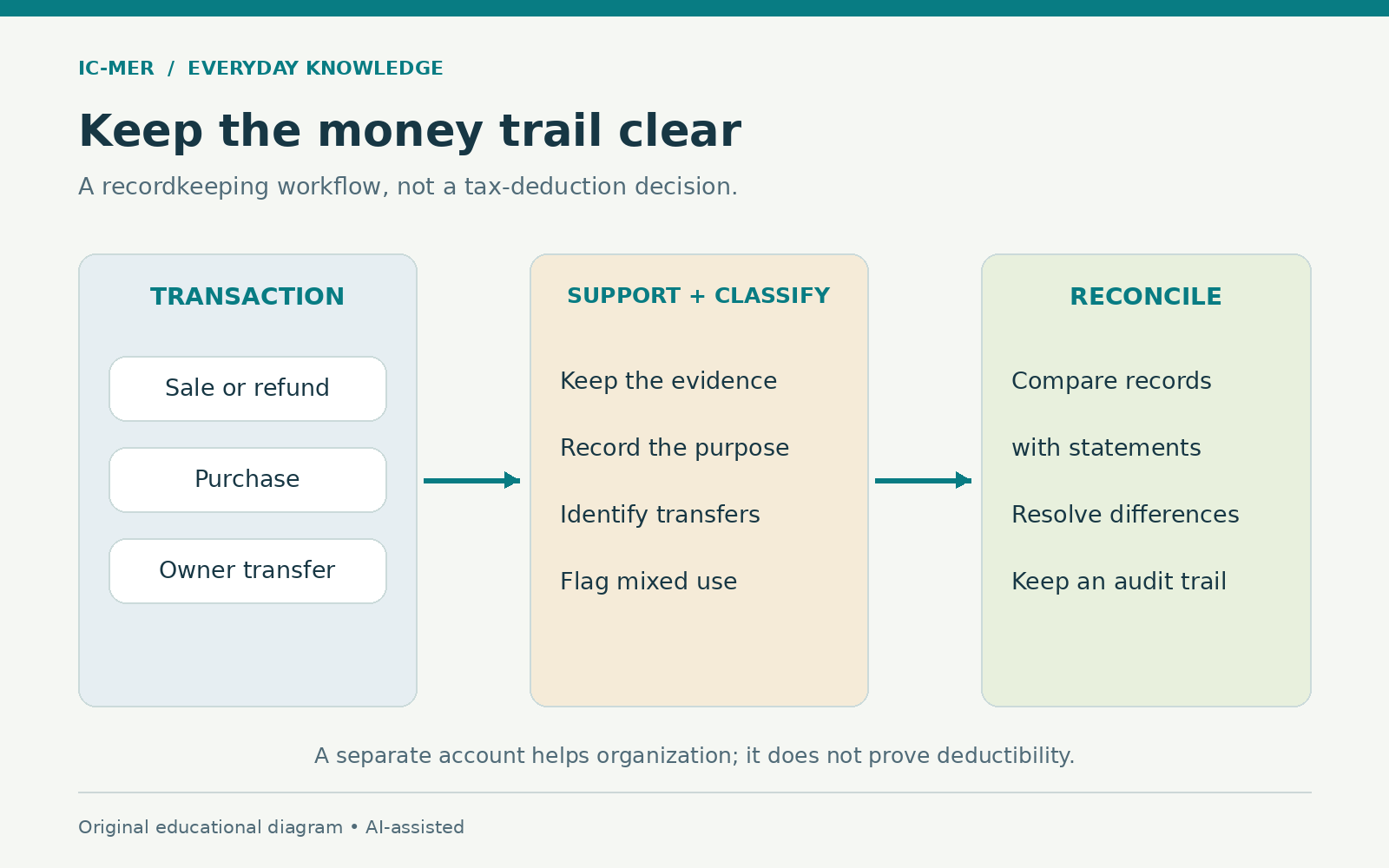
Start with one rule: every business transaction should have an explanation and supporting evidence. A bank statement shows money moving; an invoice, receipt or other record helps show why. Separation also makes errors easier to spot. It does not by itself determine tax treatment, create a legal entity or guarantee protection from liability.
Sources: [1]
Choose an account for the actual business
SBA’s launch guidance identifies fees, minimum balances, transaction costs and required documents as practical banking questions. Ask the bank what account is appropriate for your legal structure and activity. Requirements can vary; do not assume a personal account is permitted for commercial use or that every business needs the same paperwork.
Before moving payments, decide which account customers will pay, which card will handle ordinary business purchases and who may access each. Update invoice instructions carefully. If you use a payment processor, understand where settlements arrive and how fees, refunds and delays appear. A service that accepts payments and the bank account receiving them may be separate parts of the process.
A straightforward setup can be preferable to several accounts you do not regularly review. Add complexity only for a clear purpose. For example, a separate reserve can help organize cash for upcoming obligations, but moving money there is not itself a tax payment. Keep a simple list of accounts and their intended use.
Sources: [2]
Separate sales from money the owner puts in
For this fictional sole-proprietor example, the owner transfers $500 into the business account, receives $300 from customers and pays $80 for supplies. The account balance becomes $720, assuming there were no other transactions. The $500 owner contribution explains part of the cash balance; it is not an additional customer sale. Revenue in this simple example is $300.
Now suppose the owner takes $100 back for personal use. Cash falls to $620. Record that movement distinctly rather than calling it a supply expense. The example is a bookkeeping illustration, not a determination of how every entity should pay its owners. Corporations, partnerships and different tax arrangements can require different handling.
Avoid concluding that the account’s remaining $620 is profit. It includes owner-provided money, and the business may have unpaid bills or other expenses. Nor does a transfer from a personal account automatically establish a documented loan. Ask your accountant how contributions, loans, reimbursements and owner payments should be recorded for the actual structure.
Create a small transaction record
The IRS allows a recordkeeping system suited to the business that clearly shows income and expenses, while noting that the business activity affects required records. A spreadsheet can be a starting tool for a simple operation; more complex transactions may call for accounting software or professional help. The important question is whether the record can be understood and supported.
Useful working columns include date, counterparty, amount, payment account, purpose, category and a link to the evidence. Add an invoice number or job reference when relevant. Keep owner movements distinct from customer payments. Record a question when classification is uncertain instead of selecting a convenient category merely to finish the entry.
Choose a routine you can maintain. You might save the receipt immediately and review transactions at a regular weekly session. That frequency is an organizational suggestion, not a legal standard. If you have payroll, sales tax, inventory or multiple entities, obtain help setting up records appropriate to those activities.
Sources: [3]
Keep the evidence with the transaction
Purchases and sales generate supporting documents. Preserve them in a way that lets you retrieve the item later and connect it with the entry in your books. A vague note such as “office stuff” can be hard to interpret months afterward. A clear description of the item and its business purpose is more useful.
For example, save a supplier receipt under its date and supplier name, then link it to the payment entry. If a single checkout includes personal and business purchases, identify the business items and keep the full receipt. Do not classify the entire bill as business just because a business card paid it. Seek advice when mixed use, reimbursement or deductibility is unclear.
Retention periods depend on what the document records and the rules that apply; there is no single period suitable for every record. Follow current IRS guidance and other applicable requirements. Keep accessible backups and restrict access appropriately, especially when documents contain customer, employee or financial information.
Sources: [3]
Reconcile instead of trusting a running total
Reconciliation compares your own records with the bank statement and explains differences. A missing charge, duplicated entry, bank fee or payment that has not cleared can make the two totals differ. Investigate rather than changing a number just to force a match. Publication 583 includes a reconciliation example and describes checking accounts for errors.
In an invented case, your record shows $640 but the bank shows $620. If you discover a $20 bank fee omitted from the record, adding the supported fee explains the difference. If no explanation is found, leave the issue open and investigate. A matching total alone is not proof that every expense has the right category.
Payment processors add another step. A customer may pay $100 while the bank receives $97 after a $3 fee. Preserve the transaction and settlement evidence so that the gross customer payment, fee and net deposit can be distinguished. Refunds and chargebacks need their own explanation; do not treat all deposits as unrelated new sales.
Sources: [1]
Correct a personal purchase without hiding it
Mistakes happen. If a personal purchase goes through the business account, mark it promptly, retain the receipt and ask how to record the correction for your entity. Do not delete the transaction from the history or relabel it as a business expense. If a personal card pays a genuine business cost, keep the same evidence and document how it is handled.
A short correction note can say what happened, which transaction it concerns and how the accountant advised recording it. That is more useful than relying on memory at tax time. The goal is an honest trail that another person can follow. Repeated mistakes may mean the cards need clearer labels or the purchase process needs changing.
Keep separate businesses separate in the records as well. A shared owner does not make their receipts interchangeable. Before transferring funds between entities, understand the purpose, authority and accounting treatment. This article does not authorize using nonprofit funds for a personal or unrelated business expense.
Plan for obligations before paying yourself
A healthy-looking balance can still be needed for suppliers, taxes or work already promised. IRS estimated-tax guidance explains that income tax is generally paid as income is earned through withholding or estimated payments. The correct approach depends on the taxpayer’s situation. Moving money into a reserve account does not satisfy a payment obligation.
Make a short cash list: available funds, bills due, amounts needed to finish customer work and reserves based on actual advice or calculations. Review it before taking money out. Do not apply a universal internet percentage as though it were your final tax calculation. If your income also includes wages, discuss whether withholding changes are appropriate.
Choose a method of owner payment that fits the legal and tax structure. A sole-proprietor example does not establish how an S corporation should compensate someone who works in it. Professional help is particularly useful before payroll, partner distributions or entity changes begin, rather than after a year of inconsistent entries.
Sources: [4]
Make the next review easy
At your next bookkeeping session, confirm that each account has a clear purpose, each recent transaction has evidence and unexplained differences are listed for follow-up. Review unpaid invoices separately from money already received. A forecast can show what you expect; the transaction record should show what happened.
The result should be a record you can hand to a bookkeeper or accountant without a long oral explanation. Separate accounts provide a useful boundary, while receipts, classifications and reconciliation make that boundary meaningful. Start with a manageable routine and improve it when the business becomes more complex.
Sources & further reading
- Publication 583: Starting a Business and Keeping RecordsChecked 2026-10-22
- Launch your businessChecked 2026-10-22
- RecordkeepingChecked 2026-10-22
- Estimated taxesChecked 2026-10-22
About this article
Prepared with AI assistance and an AI fact-checking pass against the sources listed above. No human clinical review is claimed. Evidence may change; consult appropriate qualified professionals for decisions about your circumstances.
Spotted a problem? Suggest a correction.