Business · 9 min read
Starting a side business with a small budget
A small first offer, a spending limit and a clear review point can make a side-business idea easier to test.
General U.S. small-business education, not individualized legal, tax, financial or investment advice. Examples and figures are hypothetical.
Information may contain errors, omissions or outdated guidance. This article is general education, not individual medical or other professional advice. Verify important information before acting and consult an appropriately qualified professional. Never disregard medical advice, delay care or change treatment because of this article. See our accuracy disclaimer and terms.
Begin with a limit, not a shopping list
A side business often starts with an appealing picture: flexible hours, extra income and work you control. The practical question is narrower: what can you offer well, to whom, within the money and time you can afford to risk? Answer that before buying a logo, subscribing to software or paying someone who promises to build the business for you.
Set a cash limit and a weekly time limit that protect essential household commitments. A limit of $200 or six hours a week is only an example, not a recommended amount. Your suitable limit could be smaller, larger or zero for now. Include money already spent and recurring subscriptions rather than counting only the next purchase. Agree on a date to review the idea before adding more.
This article presents an original planning approach for a small service or similarly limited offer. It does not establish that a particular activity is licensed, insured or profitable. Regulated services, physical products, work in customers’ homes and handling sensitive information can need additional preparation. Small scale is not an exemption from applicable rules.
Choose one customer and one useful result
Describe a potential customer by a real problem rather than a broad label. “Local businesses” is vague; “a local shop that needs its existing menu reformatted for print” is a clearer starting point. Then describe a result you can deliver and a boundary around it. For example, you might format supplied text into one print-ready document, with one revision, while excluding photography, copywriting and ongoing updates.
The example is fictional. It illustrates why a small offer is easier to estimate than an open-ended promise to handle everything. You can identify the inputs, estimate the time, recognize missing skills and explain when the work is finished. If customers need something outside your competence, narrow the service or obtain appropriate help instead of promising to learn after accepting the job.
Compare the proposed work with your current obligations. Consider whether you have enough uninterrupted time, whether you are allowed to use particular materials, and whether the activity conflicts with an employment agreement or other commitment. Those questions need answers for your situation. A free tool does not automatically make its output suitable for every commercial use.
Check interest before committing to overhead
SBA’s planning guidance includes investigating demand, competitors and costs before launch. For a small pilot, translate those broad questions into a short list: who currently solves the problem, what buyers expect, what they pay for and what would make them choose your offer. Avoid treating a compliment from a friend as evidence that customers will pay.
You could discuss the problem with a few potential customers and show an original demonstration using your own or properly permitted material. Make clear what is a sample and what is work already completed for a client. Do not invent testimonials, sales or client logos. Ask what the customer would need before approving a purchase, not just whether the idea sounds good.
Record the answers briefly. If people describe a different problem, adjust the offer before building more. If there is no credible route to a first customer, buying advertising may not solve the underlying issue. This is a proposed learning exercise, not a guarantee that a particular number of conversations validates a business.
Sources: [1]
Separate essential costs from attractive extras
The SBA recommends distinguishing startup expenses from ongoing costs. In your own list, add a third category: optional purchases that can wait. Essential may include required registration, suitable insurance or equipment necessary for safe delivery. Optional might include an elaborate website or a subscription with features you will not use. What is essential depends on the activity, so verify rather than copying another person’s checklist.
Create a simple spending record with the item, amount, due date, purpose and cancellation terms. Ask whether each item is needed for the first job or only for an imagined larger business. A monthly fee is a commitment that continues when there are no customers. A trial that requires a payment card needs a reminder and a clear decision before renewal.
Do not confuse inexpensive with free of consequences. Borrowed equipment can create responsibility for damage; using a personal vehicle can raise insurance questions; working from home can involve local restrictions. Confirm those questions before describing your setup as ready. A small pilot should be simpler to understand, not casually exempted from preparation.
Sources: [1]
Price a bounded job and count all the work
Consider a fictional formatting service charging $180 for one clearly defined job. Suppose direct cash costs are $20 and delivery takes four hours. That leaves $160 before overhead, tax and compensation for the owner’s work, or $40 per delivery hour. If finding the customer, agreeing on the brief and collecting payment add two hours, the same $160 is spread over six hours: about $26.67 per hour.
These numbers are an illustration, not a market rate or a profit forecast. They exclude other expenses and assume payment is received. The difference matters because unpaid preparation and sales work are still part of running the business. Keep an honest time record for the first few jobs rather than estimating only the most visible production time.
Now imagine a third round of revisions that adds another two hours without an additional fee. The remaining cash has not changed, but it now covers eight hours, or $20 per hour before other costs and taxes. A clear revision policy helps prevent that surprise. Review the actual work with the customer when a request changes rather than quietly expanding the promise and hoping it will be profitable.
Put the agreement into ordinary language
Before starting, write down what will be delivered, what the customer must provide, the price, the payment timing and what happens if the scope changes. Include how many revisions are included and what acceptance means. A simple written agreement can reduce misunderstandings, but it should not be treated as a substitute for legal advice where the work warrants it.
For the fictional formatting job, the brief might specify one supplied menu, a print-ready PDF and one correction round within a stated period. It could identify whether the customer needs an editable source file. The parties should clarify who is responsible for checking names, prices and other facts before printing. Do not promise ownership rights you do not have.
Payment arrangements should match your actual capacity to perform and any relevant consumer rules. Money received before completion may still be needed to fulfill the job or resolve a refund. Avoid spending it as though it were spare income. Keep enough information to show what was agreed and which version was delivered.
Make the legal and tax checks fit the activity
SBA’s launch guidance explains that registrations, permits and other requirements depend on structure, location and activity. Identify the relevant official state and local authorities before accepting work. A social-media page or payment account does not establish permission to operate. Where licensing, professional services or liability is involved, qualified advice can be part of the startup cost.
In the United States, additional income can affect tax payments even when the work is part-time. IRS guidance explains that taxes are generally paid during the year through withholding or estimated payments; some employees can adjust withholding to account for other income. The correct method and amount depend on the full situation. There is no universal percentage in this article to set aside.
Keep business records from the beginning and discuss classification, deductions and payment obligations with a tax professional when needed. Do not assume that a small amount, a lack of an information form or the word “side” makes the activity irrelevant for tax purposes. This article is a starting framework, not a determination of your filing requirements.
Protect the first customer relationship
Delivering one small job reliably can teach more than launching several services at once. Confirm the brief, check the finished work and provide it in the agreed format. If you discover a delay or mistake, communicate clearly and propose a realistic remedy. Do not accept another job simply because money is available if you cannot meet both commitments.
Use only the customer information necessary for the task. Decide how files will be exchanged, who can access them and how the customer receives the completed work. If a tool’s privacy or commercial-use terms are unclear, resolve that before uploading confidential material. Choose a workflow you can explain rather than assembling many accounts that neither you nor the customer can manage.
After delivery, ask a specific question about the result and the process. If you want to quote feedback publicly or display the work, obtain the appropriate permission. A private compliment is not automatically a public testimonial. Keep criticism useful: a complaint about unclear instructions may suggest a better brief, while an issue with your skill may require training or a narrower offer.
Be skeptical of expensive shortcuts
The FTC warns about business opportunities and coaching programs that promise guaranteed income, extraordinary returns or easy success. Some begin with a cheap introduction and then pressure people into costly upgrades. Slow down when the pitch requires an immediate payment or claims that further spending is the only way to recover what you have already spent.
Before purchasing training, define the skill you need and what evidence would show the course teaches it. Check the complete cost and written cancellation or refund terms. Independent complaints or the absence of complaints are not a guarantee either way. A polished sales presentation is not proof that your own business will earn money.
If a service is useful, you should be able to explain its purpose without repeating the seller’s slogan. For example, learning a particular software function is a concrete need; buying “financial freedom” is not a deliverable you can inspect. Avoid financing a speculative package with money needed for ordinary living expenses.
Sources: [4]
Run a short pilot with a decision point
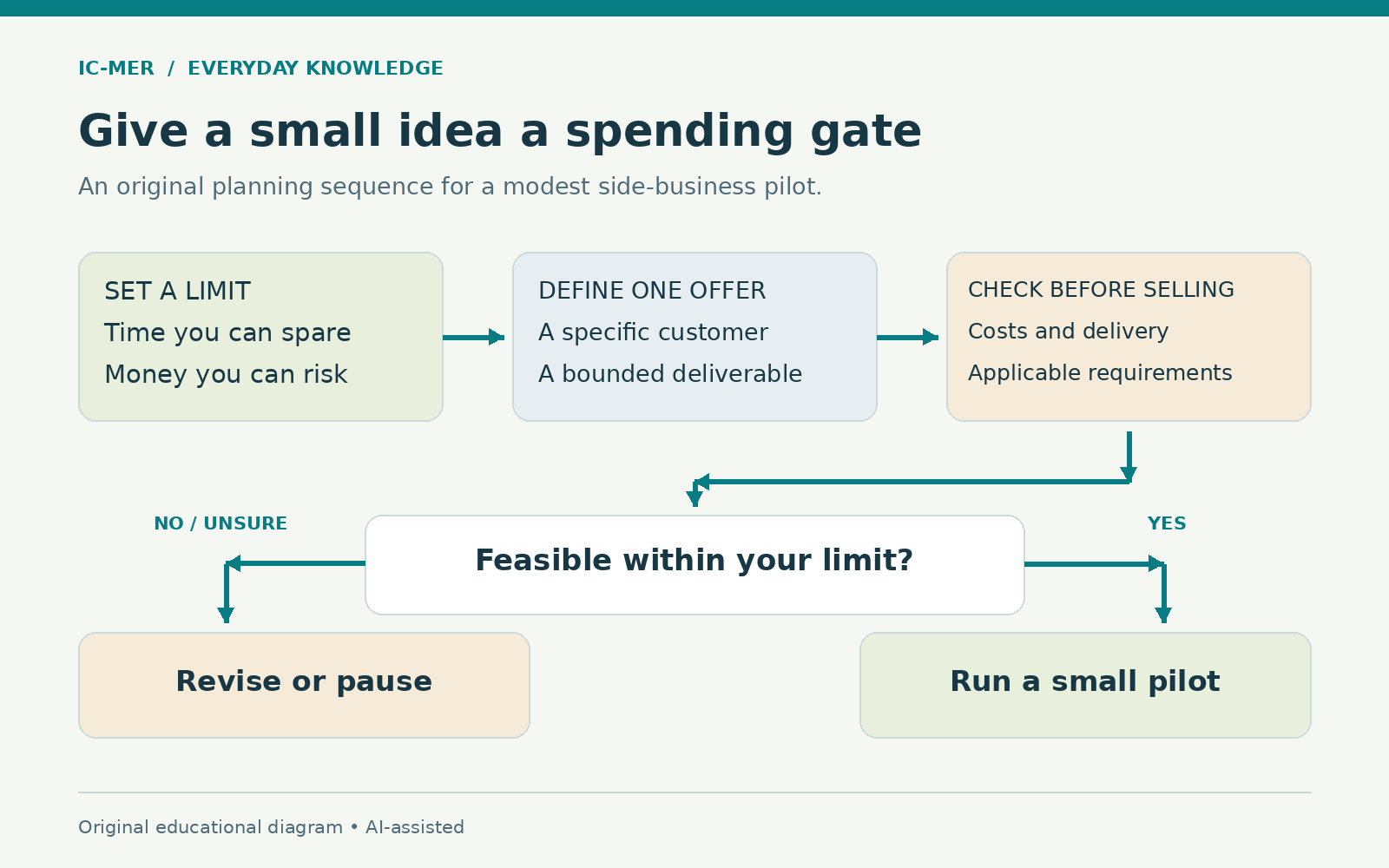
An illustrative first month might use week one to define the offer and list required checks, week two to investigate buyer needs and prepare a sample, and the remaining time for one appropriately authorized paid job. That sequence is not a required business formula. It is a way to keep spending connected to a real next step.
Before the pilot, write a decision rule in plain language. You might continue only if you can deliver within the time limit, collect payment and see a plausible path to another customer without breaking the cash limit. If the result is poor, change one feature or pause. A stop decision can protect your household and free time; it does not mean the entire idea was foolish.
At the review, list revenue actually received, expenses actually incurred, hours actually spent and outstanding commitments. Keep forecasts separate. Decide whether to repeat, revise, expand modestly or stop. Growth should follow evidence that the current offer can be delivered well, rather than a desire to justify previous spending.
Leave the pilot with a usable record
Keep the current offer, a cost list, an example agreement, the delivery checklist and a brief account of what you learned. This small collection is enough to improve the next attempt. It is also useful if you decide to ask a counselor, accountant or attorney for help: they can respond to actual choices instead of a vague ambition.
The first useful outcome is not necessarily a large profit. It may be discovering a service customers value, recognizing that a price does not cover the work, or identifying a requirement that changes the plan. A side business becomes more manageable when each commitment has a purpose, a cost and a review point. Make the next commitment only after you can explain those three things.
Sources & further reading
- Plan your businessChecked 2026-10-22
- Launch your businessChecked 2026-10-22
- Estimated taxesChecked 2026-10-22
- When a Business Offer or Coaching Program Is a ScamChecked 2026-10-22
- Gig Economy Tax CenterChecked 2026-10-22
About this article
Prepared with AI assistance and an AI fact-checking pass against the sources listed above. No human clinical review is claimed. Evidence may change; consult appropriate qualified professionals for decisions about your circumstances.
Spotted a problem? Suggest a correction.