Business · 4 min read
Customer discovery interviews that produce useful evidence
Use neutral customer interviews to investigate real problems, protect sensitive information, record contrary evidence, and choose the next useful test.
General business education, not individualized legal, financial, medical or investment advice. Examples and decision frameworks are original editorial illustrations, not measured IC-MER results. Prepared with AI assistance; no human professional review is claimed.
Information may contain errors, omissions or outdated guidance. This article is general education, not individual medical or other professional advice. Verify important information before acting and consult an appropriately qualified professional. Never disregard medical advice, delay care or change treatment because of this article. See our accuracy disclaimer and terms.
Choose a question that an interview can answer
Customer discovery is a way to learn how people handle a problem before committing to a solution. NSF describes its I-Corps program as experiential learning using customer discovery to assess commercial potential. NIH likewise emphasizes engaging potential customers when refining a market and business model. These programs support the general approach; the interview guide below is an original editorial tool, not an official government questionnaire or a promise of success.
Start with one uncertainty. A fictional research-support venture might ask whether independent study teams struggle to coordinate document revisions. An interview can explore what happened, why it mattered and how the team responded. It cannot establish clinical effectiveness, regulatory compliance or future sales. Write the hypothesis in a form that could be contradicted: “Teams recently experienced repeated revision delays that their existing tools did not resolve.”
Choose people with relevant experience
Recruit people who recently dealt with the workflow, including users, purchasing decision-makers and people satisfied with alternatives. Explain why their experience is relevant without praising the solution you hope to sell. A friend who wants to encourage you may still offer useful detail, but record that relationship when interpreting the conversation.
Create a small recruitment log with role, organization type, relevant experience and how the person was reached. Keep contact information separate from analytical notes when practical. Seek contrasting experiences deliberately. There is no universal interview count that makes a market proven; a handful of conversations should generate hypotheses and identify missing perspectives, not a statistically representative demand estimate.
Ask about an actual recent event
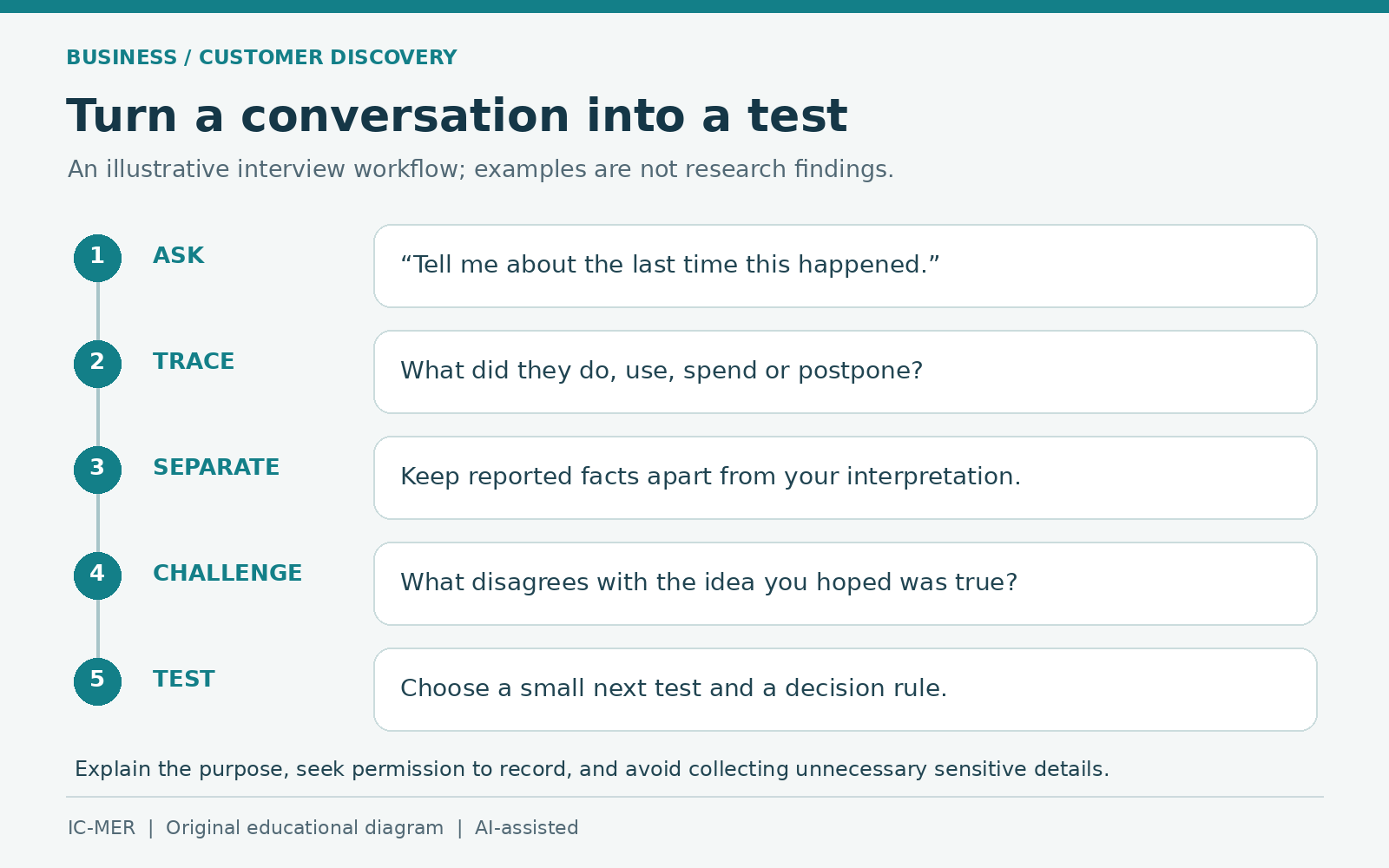
Open with a neutral prompt: “Tell me about the last document handoff that required several revisions.” Follow the sequence: what triggered it, what happened next, which tools were used, and who decided it was complete? If someone says the process was expensive, ask how they know and whether they can describe the cost without sharing confidential information.
Replace “Would our platform save you time?” with “Which part took the most time?” Replace “Would you pay for this?” with “How did you decide whether to spend money on the last solution?” A future promise can be sincere and still fail to predict purchasing. Record what someone actually did separately from what they hope to do. Avoid correcting their experience to fit your idea.
Make participation clear and protect sensitive information
Explain that the conversation is for understanding a business workflow, that declining questions is acceptable, and how notes will be used. Do not present the conversation as treatment, a clinical study enrollment invitation or a guaranteed service offer. For a general workflow interview, ask participants not to disclose identifiable patient information, protected research documents or other confidential material.
As an editorial practice, use minimal notes and do not record unless you have addressed permission and relevant rules. If the project starts collecting identifiable health data or testing an intervention, pause to obtain appropriate institutional or professional guidance. HHS decision charts help assess human-subject research under the Common Rule but explicitly have limits and do not cover all other requirements. The label “customer discovery” is not a blanket exemption.
Sources: [3]
Analyze observations before proposing features
After the interview, separate the observed account, the participant's interpretation and your own inference. For example: “Three staff members edited a draft” is an account; “the system is broken” is an interpretation; “a shared review queue may help” is your hypothesis. Keep short anonymized notes of contrary examples as well as supporting ones.
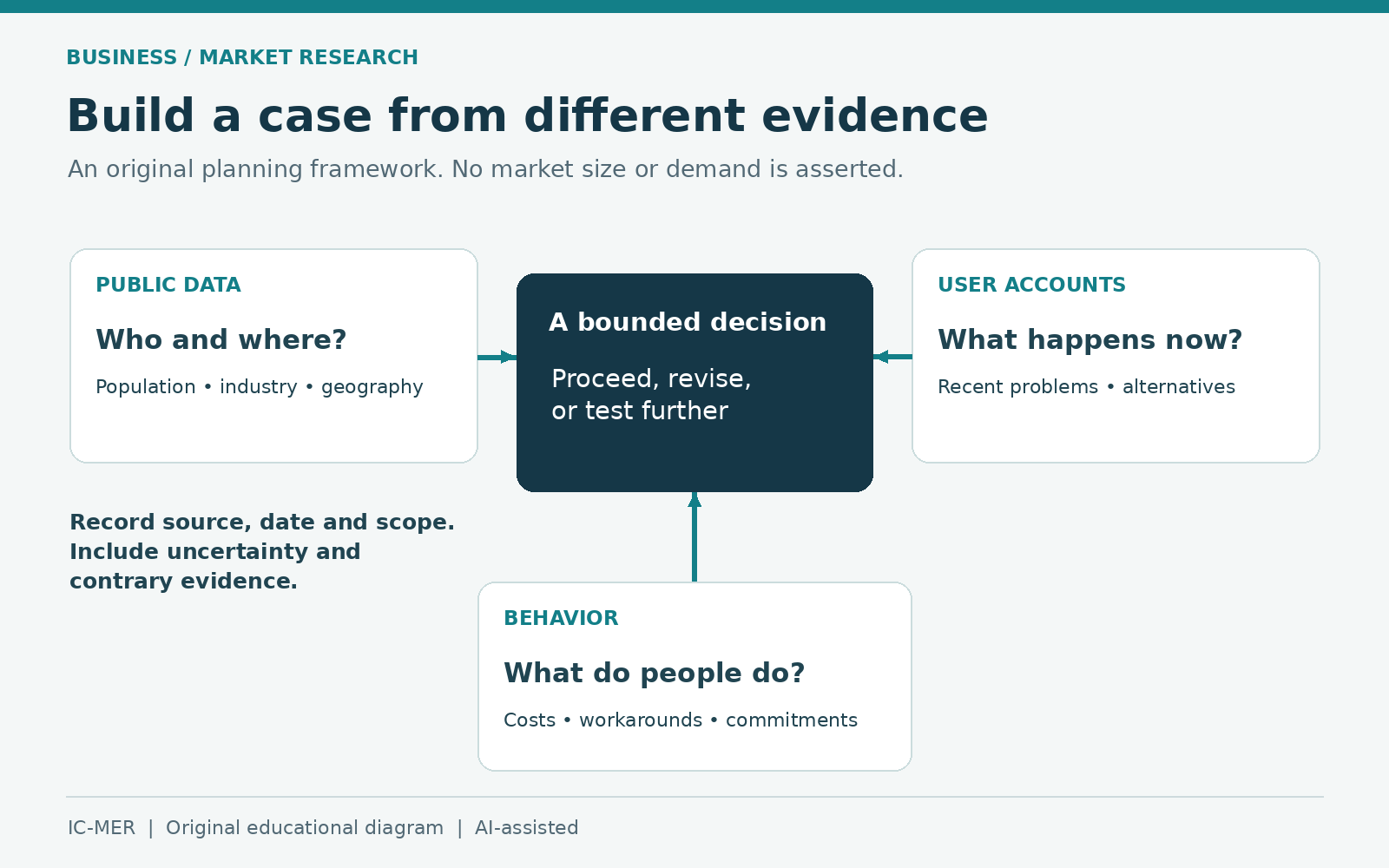
Group notes by workflow step or problem. Do not treat repeated comments from people at one organization as independent evidence from several buyers. Ask whether differences reflect roles, organization size, urgency or different definitions of the problem. The SBA identifies in-depth interviews as one direct research method; use broader market and competitor information alongside interviews when choosing a commercial direction.
Sources: [4]
Choose a test that can change your mind
A useful interview ends with a learning decision. Perhaps users report a delay, but purchasers say an existing internal service already solves it. The next test may be to understand access to that service, rather than build a competing product. Ask permission for a later follow-up instead of treating the conversation as consent to marketing or ongoing data collection.
For the fictional venture, a next step could be a simple mockup reviewed with people who described the problem. Decide beforehand what would support or weaken the proposed approach. Interest in the mockup is still distinct from an agreed pilot or purchase. Save a dated memo with the hypothesis, evidence, limitations and next action, so the next interview improves the investigation rather than merely adding another encouraging quotation.
Sources & further reading
- About I-CorpsChecked 2026-10-21
- I-Corps at NIHChecked 2026-10-21
- Human Subject Regulations Decision Charts: 2018 RequirementsChecked 2026-10-21
- Plan your business: market research and competitive analysisChecked 2026-10-21
About this article
Prepared with AI assistance and an AI fact-checking pass against the sources listed above. No human clinical review is claimed. Evidence may change; consult appropriate qualified professionals for decisions about your circumstances.
Spotted a problem? Suggest a correction.