Business · 8 min read
Market research for a small healthcare or research business
A practical guide to defining demand, using public data, comparing alternatives, and turning customer evidence into a decision for a small health or research venture.
General business education, not individualized legal, financial, medical or investment advice. Examples and decision frameworks are original editorial illustrations, not measured IC-MER results. Prepared with AI assistance; no human professional review is claimed.
Information may contain errors, omissions or outdated guidance. This article is general education, not individual medical or other professional advice. Verify important information before acting and consult an appropriately qualified professional. Never disregard medical advice, delay care or change treatment because of this article. See our accuracy disclaimer and terms.
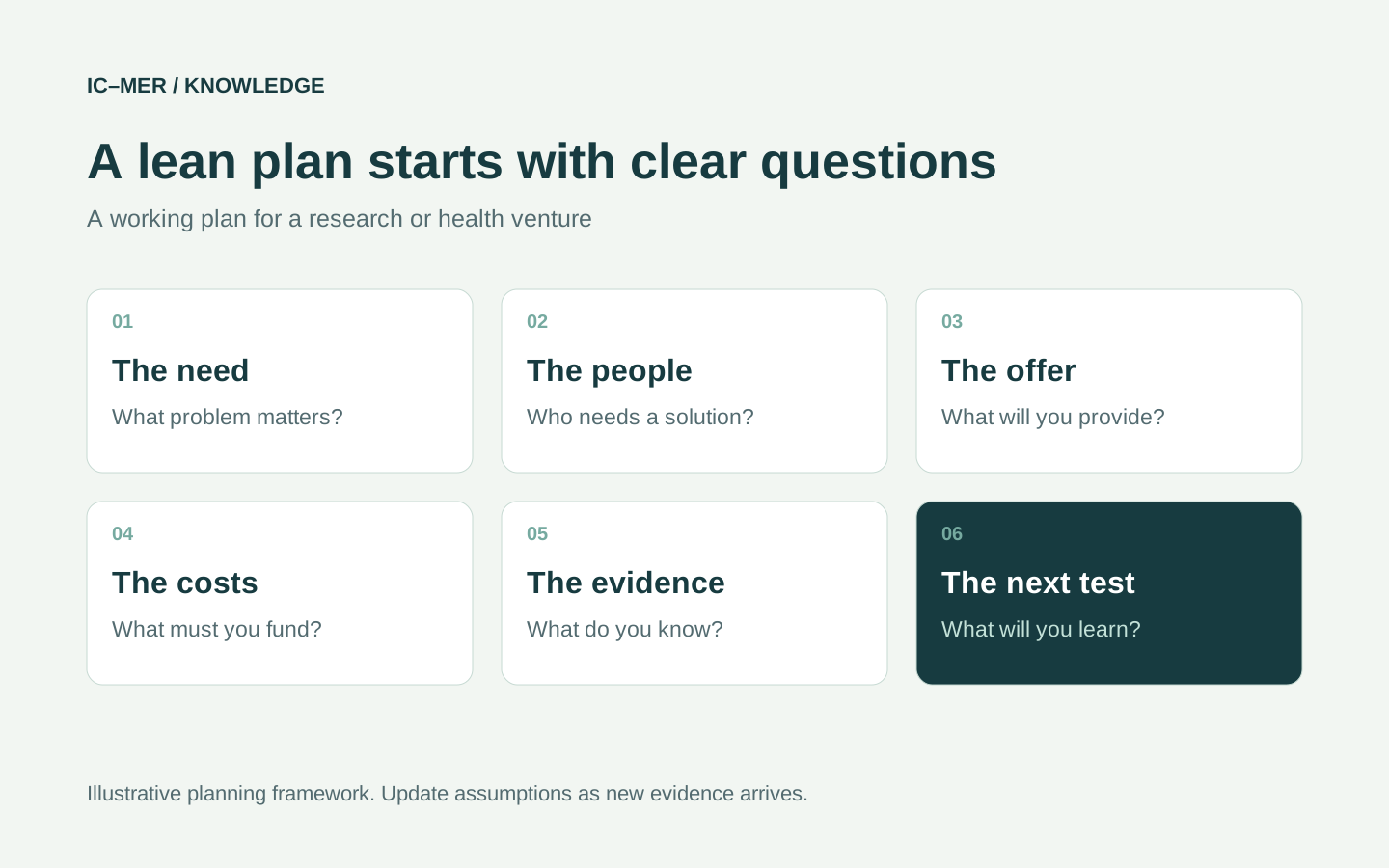
Start with a decision, not a large market number
A promising healthcare or research idea often begins with a real frustration: appointments take too much coordination, research teams lose time searching for documents, or community organizations struggle to explain technical information. A real frustration is a useful starting point. It is not yet evidence that a particular organization will pay for your solution at a sustainable price. Market research connects the problem to an identifiable buyer, a realistic route to that buyer, and a decision you can make next.
This guide offers an original working framework for a small venture. Suppose a fictional company is considering a plain-language document service for independent research teams. Its immediate decision is whether to test a narrowly defined service with a small number of prospective organizations. It is not trying to prove that it can capture a percentage of the entire healthcare economy. Write the decision at the top of the research sheet: what must we learn before spending further time or money?
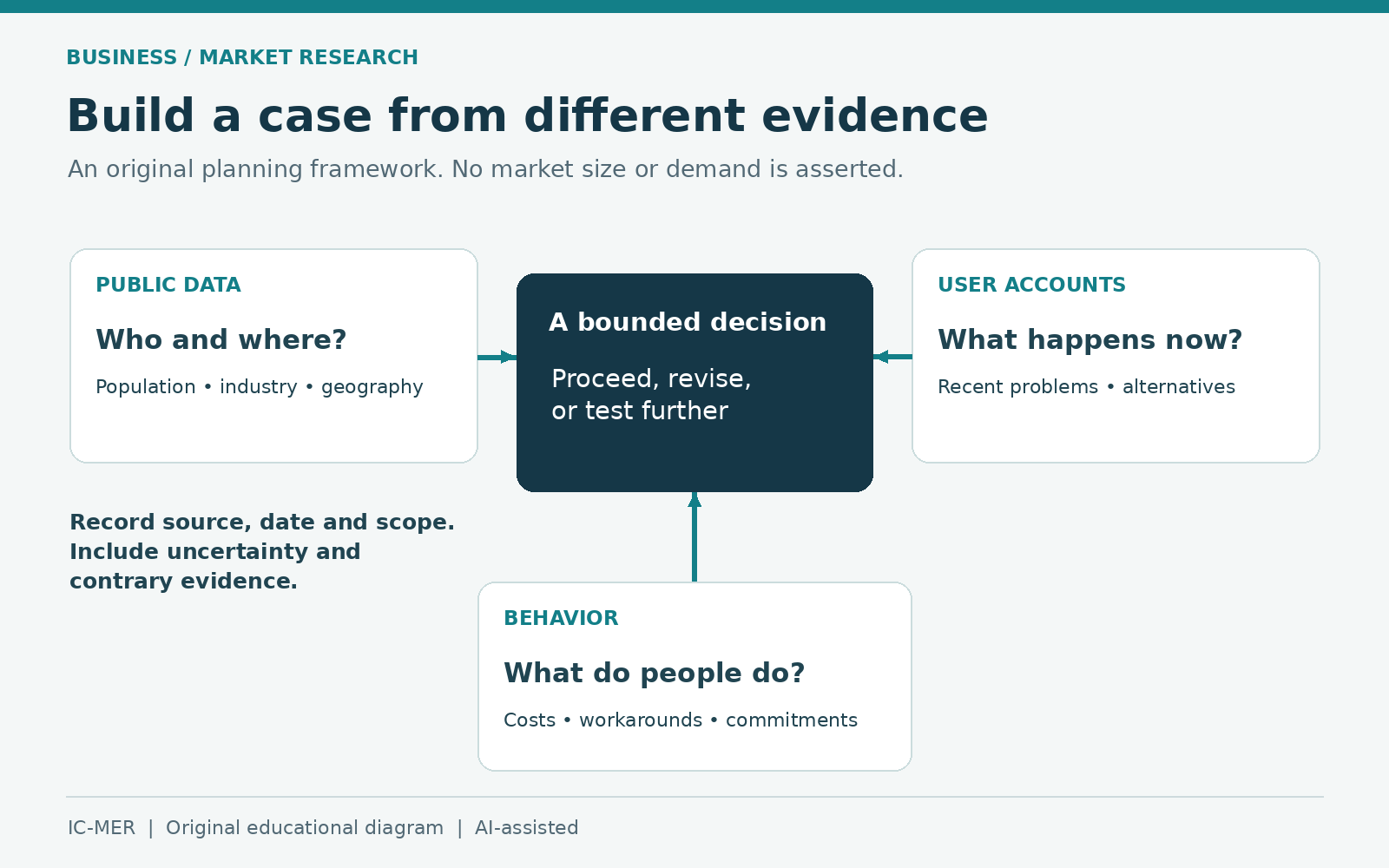
The SBA describes market research and competitive analysis as complementary activities. Its planning guidance covers demand, location, alternatives, market size and pricing, and distinguishes existing data from direct research. Use those categories to organize questions, while keeping the proposed service and decision specific. An impressive population total can describe context without establishing demand for your offer.
Sources: [1]
Separate the user, buyer and gatekeeper
For the fictional document service, the person struggling with a report may be a study coordinator, while a research director controls spending and an institutional procurement team approves vendors. Interviewing only coordinators could reveal a useful workflow problem while missing the purchasing constraints. Begin with a simple role map: who experiences the difficulty, who chooses the solution, who supplies the money, and who can prevent adoption?
Write a separate hypothesis for each role. A user hypothesis might concern time spent finding inconsistent terminology. A buyer hypothesis might concern the consequences of rework. A gatekeeper hypothesis might concern document access or vendor requirements. These are questions to investigate, not statements about how all institutions behave. When one person holds several roles, record that fact rather than assuming the same arrangement everywhere.
Also define who is outside the first market. A business offering editing for general educational materials should not imply that it validates clinical findings or provides regulatory approval. Narrow scope makes interviews more interpretable: interest in scientific consulting does not automatically demonstrate interest in a proofreading service. Keep the promised deliverable, exclusions and intended customer visible throughout the investigation.
Use public data for context and check its boundaries
Census Business Builder provides selected demographic and economic information through an accessible interface. It can help frame geography and industry questions before you conduct interviews. Record the dataset, reference period, geographic area and definition behind every number you use. A download date is not the date when the underlying activity occurred. A local count is also not a list of willing buyers.
Choose units carefully. An establishment, an enterprise, a professional and a household describe different things. One organization may operate several locations, and your service may be purchased centrally. A count of locations cannot simply become a count of separate contracts. For each proposed market-size input, add a sentence explaining why that unit is relevant to the buying decision.
County Business Patterns is an example requiring an extra check. On October 21, 2026, its official About page displayed a notice that information on the page was no longer current while the Census Bureau evaluated alternative approaches concerning noise infusion. Do not silently treat every methodological statement there as current. Check the specific release documentation before using a CBP figure, and record unresolved limitations. This article uses no CBP numerical estimate.
The Bureau of Labor Statistics Occupational Employment and Wage Statistics program provides occupational employment and wage estimates for different geographies. Those estimates can inform a preliminary staffing discussion. They do not establish what one particular worker will cost your business or what customers will pay. Separate a wage benchmark from a complete operating budget, then investigate the additional costs and contractual arrangements relevant to your own venture.
Compare the alternatives customers actually use
Build an alternatives sheet before building a feature list. For the fictional document service, possible alternatives to investigate include an internal staff member, a freelance editor, existing software, a university support office, or leaving the problem unresolved. The last option matters: a customer may recognize an inconvenience and still decide that changing it is not worth the effort.
For each alternative, record the task covered, quoted or published price if available, limits of the service, waiting time, and what you have not verified. Put the observation date beside a price. Do not fill an empty field with an invented competitor weakness. A statement such as “we have not found a published turnaround promise” is different from “this provider is slow.”
Choose comparison criteria from the user's workflow. A polished dashboard may be irrelevant if the buyer needs a particular document format or approval process. Ask what caused the organization to select its current arrangement and what would justify changing. A useful competitive position is a defensible reason to choose your service in a defined situation, not a claim that every alternative is inferior.
Collect direct evidence without turning interviews into sales pitches
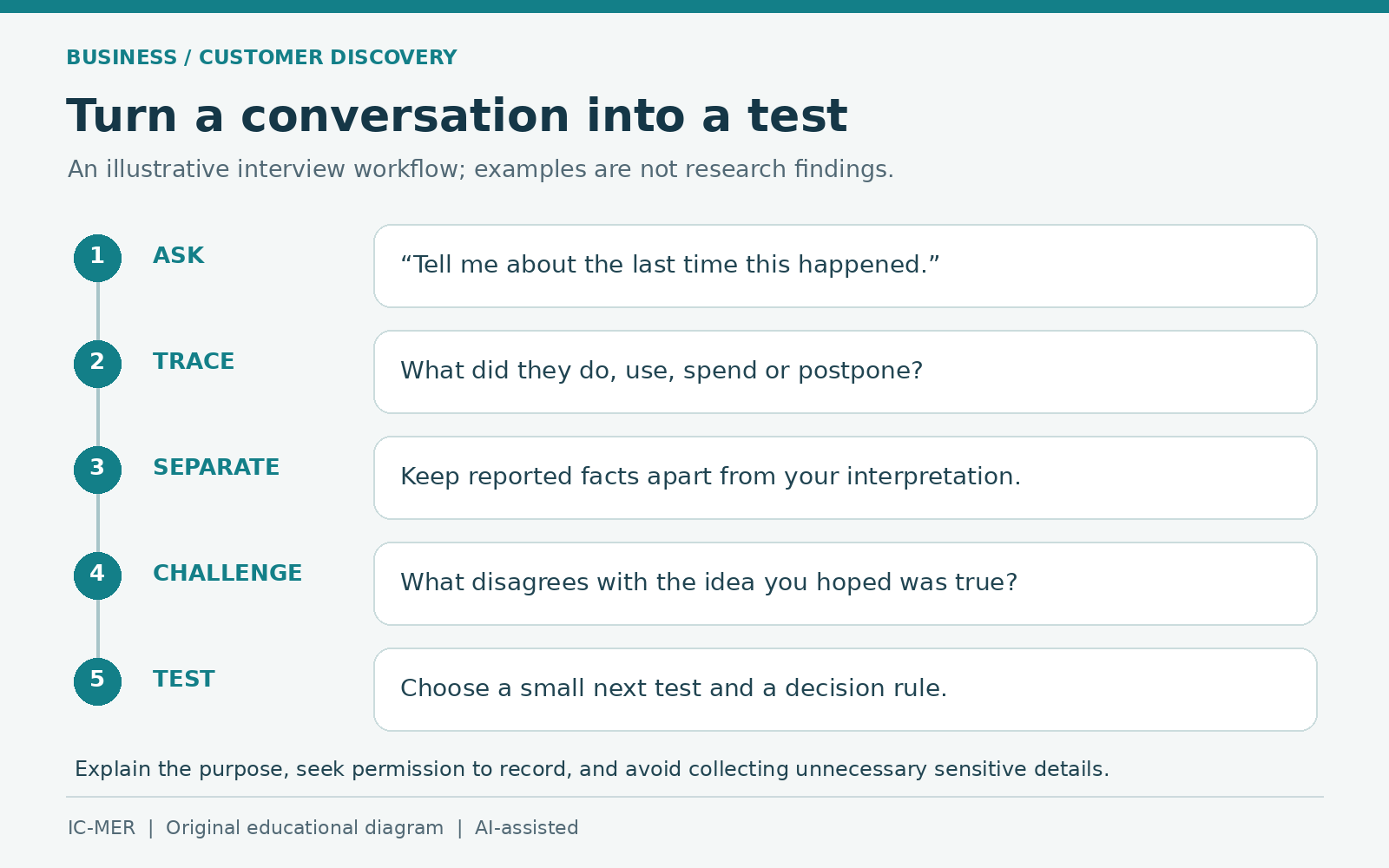
Use interviews to understand recent behavior: the last time the problem happened, the steps taken, the people involved and the consequences. Ask follow-up questions that clarify the sequence. A compliment about an idea is worth recording as a reaction, but it does not answer whether the person has authority, budget or a reason to act. Keep early problem interviews separate from demonstrations whenever possible.
NIH's I-Corps program describes engagement with potential customers as part of refining a target market and business model. That illustrates the role of customer discovery in research commercialization. It does not mean that every venture qualifies for the program or that participation guarantees commercial success. Use the principle of testing assumptions without borrowing an official program's reputation for your own service.
Recruit beyond personal supporters. As an editorial planning suggestion, seek people who use different alternatives and include some who declined a similar service. Record how participants were found and which relevant groups remain missing. A convenience sample can uncover issues; it cannot justify a population-wide purchasing percentage. If people disagree, investigate whether their roles or circumstances differ before averaging their comments into a single conclusion.
Sources: [5]
Respect privacy and know when the project changes scope
Explain the purpose of the conversation and what you will do with notes before asking substantive questions. For ordinary workflow discovery, request general process examples rather than patient names, identifiable case details, passwords or confidential research files. Do not ask someone to share material they are not authorized to disclose. Avoid recording by default; if a recording is useful, address permission and applicable requirements first.
Calling an activity “market research” does not itself resolve every legal or institutional question. The HHS Office for Human Research Protections provides decision charts to help assess research involving human subjects under its regulations, while explicitly warning that the charts are generalizations and do not cover all other authorities. If your activity extends into testing a health intervention, collecting identifiable health information or generating research evidence, obtain the appropriate institutional and professional assessment before proceeding. This guide does not determine exemption or regulatory applicability for a particular project.
Sources: [6]
Keep an evidence ledger and test the weakest link
An evidence ledger can have five columns: proposition, observation, source and date, limitation, next test. A fictional entry might read: “Coordinators need faster document review; two interviewees described recent delays; interview notes; neither controls purchasing; ask the budget owner how external services are approved.” This preserves what was learned without inflating it into proven demand.
Keep three labels distinct: observed, inferred and assumed. A public directory may support the observation that an organization exists. An interview may support an inference that the workflow is inconvenient. The assumption that it will buy your package remains untested until stronger evidence arrives. Write down contrary evidence as carefully as encouraging evidence.
Use arithmetic as a scenario, not a forecast. Imagine 40 potentially reachable organizations, of which 10 could realistically be contacted during an initial test. If two later purchased a fictional $500 pilot, gross receipts would be $1,000 before costs. Neither the two purchases nor the price is an observed conversion rate in this example. Changing those assumptions can change the decision completely. Capacity, costs and time to payment still need their own analysis.
End with a short decision memo
Finish with a one-page memo stating the proposed segment, the best-supported problem, the buyer, the current alternatives, and the uncertainty that matters most. Recommend one next action: proceed with a bounded test, revise the offer, investigate another segment, or stop. Include what would change that recommendation and a date to revisit it.
For the fictional document service, the next action might be a discussion with purchasing staff about a clearly scoped pilot, rather than a full website or software build. A pilot proposal is not a sale, and permission to discuss one is not permission to access confidential files. Define the limited test and obtain the relevant agreement before delivery. Market research has done its job when it improves this next decision, even if the most useful conclusion is that the original idea should change.
Sources & further reading
- Plan your business: market research and competitive analysisChecked 2026-10-21
- Census Business BuilderChecked 2026-10-21
- About County Business Patterns — page carries an outdated-information noticeChecked 2026-10-21
- Occupational Employment and Wage Statistics: frequently asked questionsChecked 2026-10-21
- I-Corps at NIHChecked 2026-10-21
- Human Subject Regulations Decision Charts: 2018 RequirementsChecked 2026-10-21
About this article
Prepared with AI assistance and an AI fact-checking pass against the sources listed above. No human clinical review is claimed. Evidence may change; consult appropriate qualified professionals for decisions about your circumstances.
Spotted a problem? Suggest a correction.