Business · 7 min read
Writing a lean business plan for a research or health venture
Turn a promising idea into a testable plan: identify the buyer, define the evidence needed, estimate delivery costs, and choose the next useful experiment.
General business education, not individualized legal, financial or investment advice. All venture scenarios and financial figures are hypothetical illustrations.
Information may contain errors, omissions or outdated guidance. This article is general education, not individual medical or other professional advice. Verify important information before acting and consult an appropriately qualified professional. Never disregard medical advice, delay care or change treatment because of this article. See our accuracy disclaimer and terms.
What a lean plan should accomplish
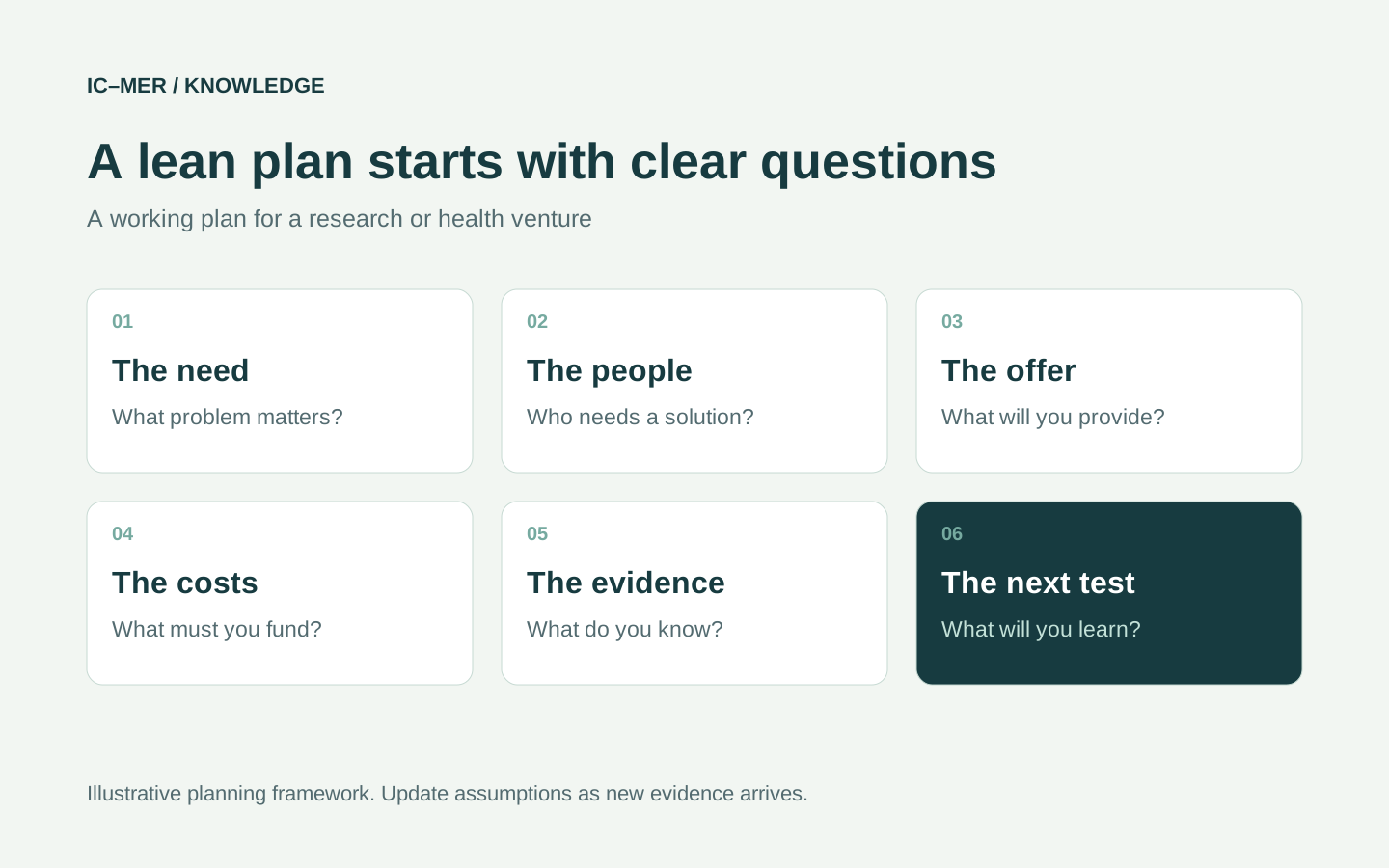
A research or health venture often begins with a scientific opportunity: an unmet need, an interesting dataset, or a better way to organize work. A business plan adds a different set of questions. Who will choose the offering? What must change for that organization to adopt it? What resources will delivery consume? What evidence would make the founder change direction?
The U.S. Small Business Administration distinguishes brief lean plans from more detailed traditional plans. Its lean framework covers the offering, customers, relationships, routes to market, resources, activities, partners, costs, and revenue. The appropriate format depends on the decision and the audience; a short internal plan may not satisfy a lender or investor. The worksheet and fictional example below are an editorial application of those ideas, not an official application template.
Sources: [1]
Start with one buyer and one difficult task
Consider a fictional venture called ClearStudy that helps small research teams organize project schedules and document responsibilities. It does not recruit patients, make clinical decisions, or process patient records in this example. Its first customer hypothesis is an independent research organization with several overlapping projects and no dedicated operations coordinator.
The user might be a study coordinator, while an operations director approves the purchase and a finance manager pays the invoice. Interviewing only the enthusiastic user could miss the reason a sale stalls. The plan should record each role and the question that person needs answered: Does this reduce rework? Who controls the records? How much staff time will onboarding require? Which budget pays for it?
Write a narrow initial promise: “We help the operations manager see overdue administrative tasks in one weekly review.” This is testable. “We transform research” is too vague to evaluate. Keep the scientific or clinical claims separate from the administrative promise; success at organizing a calendar would not establish improved patient outcomes.
Collect evidence before polishing the pitch
NIH’s I-Corps program emphasizes engaging potential customers to sharpen a business model. Its existence illustrates why scientific expertise and customer discovery are different activities. Eligibility for that particular program is restricted; a new venture should not assume that mentioning NIH or pursuing a health idea qualifies it for training or funding.
For ClearStudy, an initial learning exercise could involve conversations with five coordinators, five operations managers, and three finance or procurement staff. Those numbers are a manageable fictional starting point, not a statistically representative sample. Ask about the most recent delayed handoff, what happened next, the current workaround, and who approved spending on the last comparable purchase. Avoid leading questions such as “Would you like an easier system?”
Keep a dated evidence log. Distinguish an observed workflow, an interviewee’s estimate, a quotation from a supplier, and the founder’s guess. A compliment is not a purchase commitment. Record contrary evidence as carefully as positive comments, particularly a buyer who likes the concept but cannot identify a budget or a reason to change.
Sources: [2]
Size a reachable market, not an imaginary one
Census Business Builder provides demographic and economic information that can be explored by geography and business type. It can help establish context and identify useful comparisons. Check the dataset year and definition behind any number you use; a count of establishments is not automatically a count of likely buyers.
Build the first sales estimate from a named segment you can actually reach. In the fictional case, the founder might identify 40 relevant organizations, gain conversations with 12, and seek two limited pilots. These are planning assumptions, not forecasts. Explain why the proposed customers resemble the interviewees and which organizations were excluded.
Include the alternatives customers already use: spreadsheets, an employee taking on extra work, a larger software package, or simply tolerating delays. An alternative need not look like your product to compete for the same budget. Then ask what evidence would persuade a buyer that changing is worth the effort.
Sources: [3]
Describe the work behind the offer
ClearStudy’s initial package could include a kickoff meeting, an agreed task list, a weekly administrative review, and a closing handover. Write down the boundaries as precisely as the deliverables. For example, the service does not interpret study results or certify regulatory documents. These boundaries help the team estimate effort and prevent an inexpensive pilot from becoming an undefined support obligation.
Next, list the resources needed to deliver each step. Who prepares the materials? Who checks them? What happens when the client misses a meeting or changes the scope? Which tasks require specialist input? A founder’s time is still a resource even when there is no immediate salary payment.
Choose a small set of operational measures: time spent per project, number of unresolved handoffs, completion of agreed deliverables, and whether the customer wants a second engagement. Define each measure before the pilot. Do not substitute a flattering testimonial for evidence that the promised work was completed.
Make the cash model understandable
Suppose a fictional monthly engagement is priced at $1,200. Delivery requires six hours of work valued for planning at $75 per hour, plus $150 of other costs that arise for that engagement. The estimated contribution is $1,200 minus $450 minus $150, or $600. If the venture has another $1,800 of monthly fixed costs, three such engagements cover those modeled costs. This simplified illustration excludes taxes, financing, startup recovery, and any costs not already included.
Now change the effort assumption. If delivery takes ten hours, contribution falls to $300 and six engagements would be needed for the same fixed-cost coverage. Can the founder deliver six while also selling, administering the business, and checking quality? This sensitivity exercise is more informative than a single optimistic annual revenue number.
Cash timing adds another question. Work can be completed before an invoice is paid. Map the dates of deposits, supplier payments, payroll, and expected customer receipts; test a late-payment scenario. An anticipated grant belongs in a separate scenario until awarded and its spending conditions are understood. None of these sample figures establishes a viable price for a real venture.
Sources: [1]
Put evidence and oversight into the schedule
Health-related products can raise questions beyond ordinary sales planning. FDA explains that a product’s intended use and indications are central to determining whether it meets the medical-device definition. A founder should therefore resolve the relevant product pathway before making diagnosis or treatment claims. This article does not determine the status of any particular product.
Research involving people also needs an applicability assessment. HHS provides decision charts for the revised Common Rule, while warning that the charts are generalizations and do not cover every requirement imposed by other authorities. A pilot should not be labeled “just testing” to avoid the review that its actual activities require. Obtain the appropriate institutional or specialist assessment before collecting data or involving participants where those questions arise.
For the lean plan, record each unresolved question, who will resolve it, the evidence or advice needed, and the decision it blocks. That converts “we will deal with compliance later” into an identifiable dependency. Privacy, contracting, intellectual property, professional licensing, and reimbursement may require separate review depending on the real offering.
Use a 30-day learning cycle
In a fictional first month, ClearStudy could spend week one clarifying its target customer and interview questions, week two holding conversations, week three revising the offer and obtaining delivery-cost quotations, and week four deciding whether to propose a tightly defined pilot. Each week should end with a short note stating what changed and why.
Set a decision rule before the work begins. For example: proceed only if two plausible buyers can describe a recurring problem, identify a decision-maker, and agree on a measurable pilot scope. This is an illustrative management rule, not a validated success threshold. If the evidence is weaker, narrow the service, investigate a different buyer, or pause spending.
The finished first plan should let a colleague trace every major assumption to evidence, a calculation, or an open question. Keep the one-page summary readable, attach the underlying notes, and assign an owner and review date. A plan becomes useful when it changes the next decision, especially when that decision is to test less, spend less, or revise an attractive idea.
Sources & further reading
- Plan your businessChecked 2026-10-20
- I-Corps at NIHChecked 2026-10-20
- Census Business BuilderChecked 2026-10-20
- How to Determine if Your Product is a Medical DeviceChecked 2026-10-20
- Human Subject Regulations Decision Charts: 2018 RequirementsChecked 2026-10-20
About this article
Prepared with AI assistance and an AI fact-checking pass against the sources listed above. No human clinical review is claimed. Evidence may change; consult appropriate qualified professionals for decisions about your circumstances.
Spotted a problem? Suggest a correction.