Medicine · 7 min read
Dietary supplements: checking claims and understanding risks
A practical guide to choosing supplements carefully, understanding their limits and keeping your healthcare team informed.
AI-assisted general health education, not personal medical advice or human clinical review. Discuss supplements with your clinician or pharmacist, especially alongside medicines, during pregnancy or before procedures. Do not replace or alter prescribed treatment on your own. Seek urgent care for severe reactions.
Information may contain errors, omissions or outdated guidance. This article is general education, not individual medical or other professional advice. Verify important information before acting and consult an appropriately qualified professional. Never disregard medical advice, delay care or change treatment because of this article. See our accuracy disclaimer and terms.
Start with a reason, not a shopping basket
A shelf of vitamins, powders and herbal products can make good health look like something you assemble one bottle at a time. Some supplements have useful roles. Others offer uncertain benefits, unnecessary expense or risks that are easy to overlook. Choosing well starts with a specific question: what problem am I trying to address, and is this product an appropriate way to address it?
Supplements can help meet nutrient needs, but they do not replace a varied diet or prescribed treatment. Before buying one, discuss the potential benefit and risks with a qualified healthcare professional. A recommendation for one person is not automatically a recommendation for everyone in the household.
Try writing your reason in a single sentence before browsing. Compare 'I want to ask about a possible gap in my diet' with 'I saw a bundle promising complete wellness.' The first gives you something concrete to discuss. The second leaves the seller to define both the problem and the solution. You do not need to make a purchase to make progress on a health question.
Sources: [4]
What a supplement label can tell you
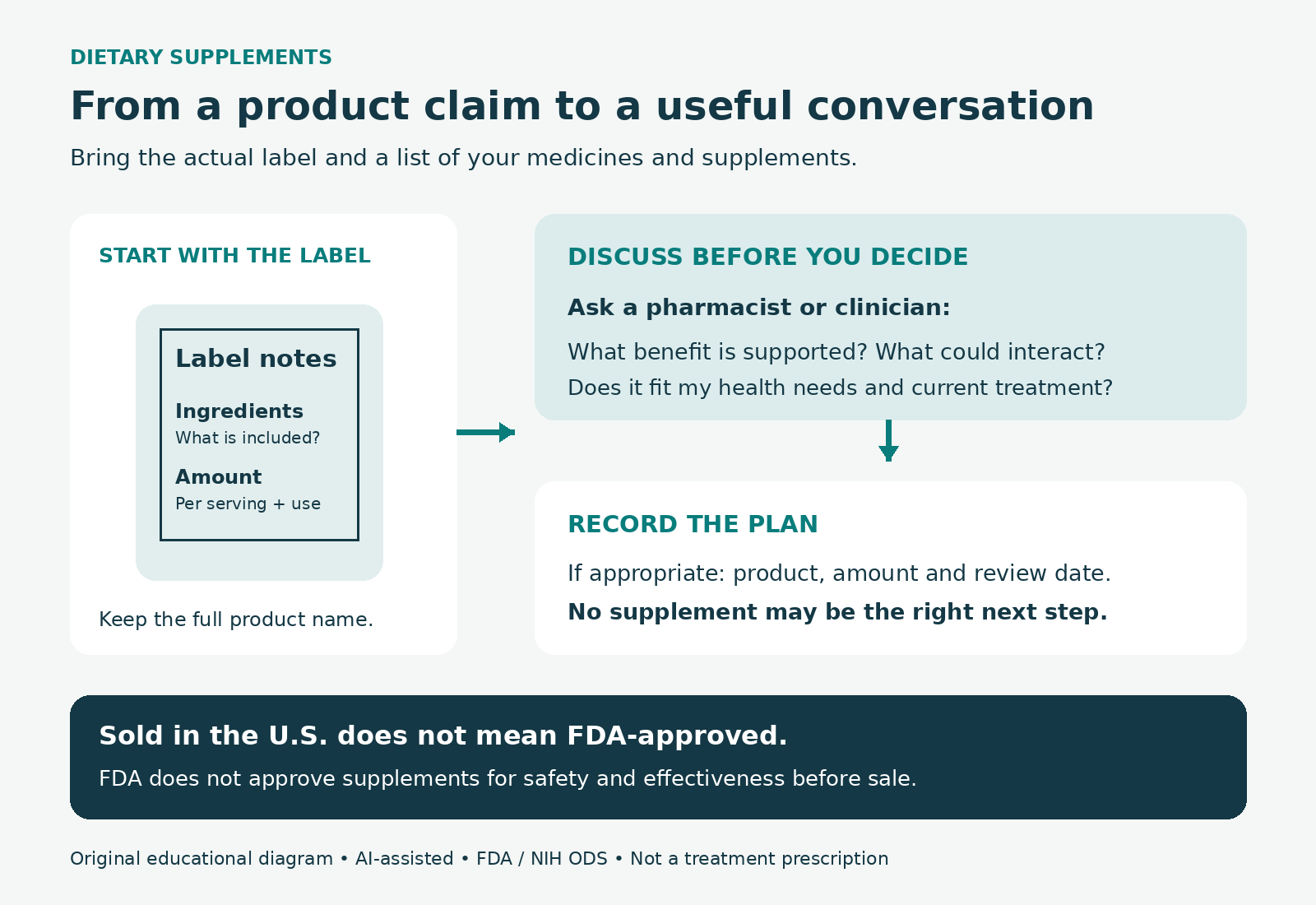
Supplements include vitamins, minerals, botanicals and other dietary ingredients. The Supplement Facts panel generally lists serving size, servings per container and ingredient amounts per serving. A proprietary blend may list its components without disclosing each individual amount. Check the separate other-ingredients list as well.
Read the serving size before comparing bottles. In a hypothetical example, a bottle containing 60 capsules could contain 60 one-capsule servings or 30 two-capsule servings. That changes both your comparison of amounts and your estimate of cost. It does not tell you which dose you personally need.
Photograph the front label, the full ingredient panel and the directions before a consultation. A description such as 'the green bottle for energy' is difficult to assess. Bring the actual product when practical. If a label is unclear, record the uncertainty rather than filling the gap from an advertisement for a similar-looking product.
Sources: [2]
Understand what FDA oversight does—and does not—mean
In the United States, FDA does not approve dietary supplements before they are marketed. Companies have responsibilities for product safety, labeling and manufacturing, and FDA can enforce the applicable rules. Some new dietary ingredients require advance safety notification; that notification is not the same as product approval.
Being offered for sale therefore does not establish that FDA has confirmed a supplement works for your intended purpose. Nor does the absence of premarket approval mean that every supplement is useless or that no rules apply. It means the buying decision needs more care than simply recognizing a familiar shop or professional-looking package.
For your own notes, separate three questions: what is in the product, what benefit is supported, and whether it suits your circumstances. A reassuring answer to one does not settle the other two. This distinction helps when a product page mixes manufacturing claims, customer stories and health promises into one sales pitch.
Sources: [2]
Look past sweeping promises
Evidence differs substantially among supplements. A product bought online may also differ from the preparation used in research. A claim about an ingredient cannot automatically be transferred to every mixture containing it, at any dose, for any purpose.
Be especially cautious about products sold for weight loss, sexual enhancement or bodybuilding. NCCIH warns that some products in these categories contain undeclared drugs or other potentially unsafe ingredients. A long ingredient list or an impressive product name cannot rule that out.
When a promotion promises broad improvements, ask which specific benefit you are considering and what uncertainty remains. For example, 'supports wellbeing' leaves you without a clear way to judge whether the purchase helped. Save the claim and bring it to your consultation instead of treating enthusiastic reviews as an individual care plan. There is no obligation to decide while a countdown timer or limited-time discount is on screen.
Sources: [3]
Natural ingredients can still interact with medicines
Natural does not mean risk-free. Supplements may change how medicines work. Vitamin K can reduce warfarin's anticoagulant effect, and St. John's wort can reduce the effectiveness of several medicines, including some contraceptives. These are examples, not a complete interaction checklist.
Tell your clinician and pharmacist about everything you use, including occasional products. Do not stop or alter prescribed medicine to make room for a supplement. Ask for a review before combining products, particularly when your medication list changes.
Imagine bringing three bottles to a pharmacist: a multivitamin, a single nutrient and a mixed wellness powder. The useful task is to compare the ingredients across all three, alongside your medicines. Counting bottles is not the same as counting ingredients. Ask the pharmacist to identify overlap and advise whether the combination is appropriate; do not assume each product can be assessed in isolation.
Sources: [1]
Quality checks and personal suitability are different
Independent quality-testing seals can provide information about manufacturing, listed ingredients and contaminants. They do not guarantee that a product is effective or safe for you. More is not necessarily better: high doses and overlapping products can increase exposure beyond what you realize, including nutrients also added to foods.
Use a quality claim as a question to investigate, not as permission to increase a dose. If you cannot tell what a mark on the bottle means, ask the pharmacist to help interpret it. Keep a clear distinction between the amount printed on the label and the amount a clinician recommends for your situation.
Budget also deserves a place in the discussion. Write down the price per container, the servings it provides and any delivery or subscription charge. For illustration, a $30 container with 30 servings costs $1 per serving before other charges. That arithmetic does not measure health benefit, but it makes the ongoing expense visible before you agree to repeat purchases.
Sources: [1]
Mention supplements before procedures and tests
Some supplements can interfere with laboratory tests or create problems around surgery. Tell the team arranging a procedure or blood test what you take, rather than waiting to be asked about prescription medicines alone. The team should give product-specific instructions; a general article cannot supply a universal stopping interval.
Pregnancy, breastfeeding and childhood also call for particular care because many supplements have not been adequately tested in these groups. Do not give a child an adult product or add products during pregnancy on the strength of a wellness advertisement. Discuss the exact product and circumstances with the appropriate clinician.
An easy preparation is to keep the product photographs in the same place as your appointment details. If someone helps you manage your care, agree who will bring the list. Tell the team about recent changes as well as longstanding use, and ask for instructions in writing when the plan is complicated.
Respond to a suspected bad reaction
FDA advises stopping the supplement and seeking medical care or advice if an adverse reaction occurs. Trouble breathing, swelling of the throat or tongue, chest pain or fainting warrant urgent medical attention. Other concerning changes, such as persistent severe vomiting or yellowing of the skin or eyes, also require prompt assessment. Do not dismiss a new symptom because the product was sold as natural.
Keep the container and note what you took, when you took it and when symptoms began. This can help a healthcare professional assess the situation. A suspected reaction does not prove the product caused it, but you do not need to settle that question yourself before seeking help.
You or a healthcare professional can report a suspected problem through FDA's reporting route linked below. Reporting helps FDA investigate safety concerns; it is not a substitute for medical care. Do not delay urgent help while completing an online form.
Leave the conversation with a usable plan
Keep a record of the product name, amount taken, frequency and reason for use. Ask what benefit is realistic, what risks matter for you and how long any recommended use should continue. Include supplements when reviewing your medicines with a healthcare professional.
Before you leave, check that you can explain the plan in your own words: whether to use the product, what instructions apply and whom to contact with a concern. If the answer is that more information is needed, write down the next step. An informed decision may be to use a supplement for a defined reason, choose another approach or buy nothing.
Sources: [1]
Sources & further reading
- NIH Office of Dietary Supplements: What You Need to KnowChecked 2026-10-27
- FDA: Questions and Answers on Dietary SupplementsChecked 2026-10-27
- NCCIH: Using Dietary Supplements WiselyChecked 2026-10-27
- FDA 101: Dietary SupplementsChecked 2026-10-27
- FDA: How to Report a Problem with Dietary SupplementsChecked 2026-10-27
About this article
Prepared with AI assistance and an AI fact-checking pass against the sources listed above. No human clinical review is claimed. Evidence may change; consult appropriate qualified professionals for decisions about your circumstances.
Spotted a problem? Suggest a correction.