Business · 7 min read
Grant readiness before writing the application
A grant-ready organization can show why the project fits, who can deliver it and how the award would be managed.
AI-assisted general organizational education, not legal, accounting or grant-eligibility advice. Examples are fictional. No award, registration, nonprofit recognition or application approval is implied; verify the specific opportunity and obtain authorized review before submission.
Information may contain errors, omissions or outdated guidance. This article is general education, not individual medical or other professional advice. Verify important information before acting and consult an appropriately qualified professional. Never disregard medical advice, delay care or change treatment because of this article. See our accuracy disclaimer and terms.
Readiness is a decision before it is a document
A persuasive application cannot repair an ineligible applicant, an unavailable project lead or a budget that excludes essential work. Grant readiness means checking those conditions before the team spends days polishing a narrative. It is an evidence-gathering exercise whose useful result may be to apply, partner, defer or stop.
This article offers an editorial planning framework for small research, health and community organizations. It uses U.S. federal application systems as examples, with sources checked on October 22, 2026. Foundation, state and international programs can have different requirements. This is not a list of currently open awards and does not establish that IC-MER or any other organization is eligible for a particular grant.
Start with a one-page decision sheet. Name the opportunity, proposed project, applicant entity, intended result, decision owner and internal decision date. Keeping those fields visible helps prevent enthusiasm for a funding amount from replacing an assessment of whether the work makes sense.
Check mission and eligibility separately
Grants.gov directs applicants to the eligibility section of each notice of funding opportunity, or NOFO. Broad applicant categories on a search page do not override the specific notice. Organizations with and without U.S. tax-exempt recognition can appear in different eligibility categories; neither the word “nonprofit” nor a tax identification number establishes eligibility for every award.
Make two independent notes: why the proposed work serves the organization's purpose, and the exact evidence that the applicant meets the opportunity's conditions. Add project location, eligible activities, lead-investigator restrictions and partnership requirements when the notice specifies them. If a requirement is unclear, record the question and use the official program contact route before making a commitment.
Do not quietly change the organization's mission to fit an attractive call. A fictional community education group might fit a public-education program but lack the staff or facilities for laboratory research. Writing both ideas in medical language would not make them the same project.
Sources: [1]
Verify the entity and the people authorized to act
For organizational applications through Grants.gov, the organization first needs SAM.gov registration. Registration is free, renewal is annual, and role assignments determine who may work on applications or represent the organization. Grants.gov warns that registration may take longer when information cannot be verified.
SAM.gov distinguishes a Unique Entity ID, or UEI, from a full active registration. An organization can obtain only a UEI for some purposes, but that alone does not enable it to apply directly for federal awards. Check the actual registration status and renewal date rather than treating possession of an identifier as completion.
Keep a private administrative checklist containing legal name, approved entity documentation, system status, responsible official and a renewal reminder. Do not put account passwords or sensitive identifiers into a shared narrative draft. Confirm who is authorized to submit and who must approve the application internally; writing permission and submission authority are different responsibilities.
Work backward from the real deadline
NIH's organization-registration guidance warns that the overall process can take six weeks or more and identifies additional systems such as eRA Commons. This is a planning warning, not a promised completion time. A small organization considering NIH should check the current requirements for its actual application rather than assuming a Grants.gov account completes every step.
Create a backward calendar with separate dates for partner materials, budget approval, content review, technical checks and authorized submission. Copy the funder's deadline and time zone precisely. Choose an earlier internal deadline so an unresolved attachment or system issue is visible while there is still time to respond.
For example, a fictional team with four weeks remaining and no completed registrations should not schedule all effort around writing in week four. Its first decision is whether essential prerequisites can realistically be completed. Deferring to a later opportunity can protect time for work the organization can actually deliver.
Sources: [4]
Define the project well enough to test feasibility
Use four sentences to describe the need, intended beneficiaries, proposed activities and expected result. Then ask what evidence supports each sentence. A local need should have a dated source or documented observation; an intended outcome should have a practical way to assess it. Distinguish what the team knows from what it proposes to find out.
A fictional project might offer six workshops to help residents interpret public water-quality reports. The immediate output is six delivered workshops and associated materials. A proposed outcome could be improved ability to find the correct report and explain its main terms. Claiming that the project will reduce disease would require a much stronger design and evidence than attendance records.
Write down the smallest credible version of the project. Which activities are essential, which could be removed without defeating the purpose, and which depend on a partner? If no one can describe how the work proceeds from the first month to the final deliverable, the concept needs development before the prose needs decoration.
Turn a team list into delivery commitments
A name on a proposal is not a schedule commitment. For each major activity, identify the person responsible, expected time, relevant capability, backup arrangement and evidence of agreement. A useful partner discussion covers exactly what will be contributed, when it will be available and what remains conditional on funding.
Separate confirmed resources from hoped-for resources. “Meeting space requested” and “meeting space available under written agreement” are different states. So are access to a dataset and permission to use it for the proposed purpose. Keep those distinctions visible in the planning sheet, and never invent a partner letter or imply approval that has not been given.
If an activity involves participants, health information, specialist equipment or regulated work, assign someone to determine the applicable review and permission requirements. The readiness task is to identify and resolve those dependencies through appropriate institutional or professional channels. This article does not decide whether a particular project needs ethical approval or satisfies a legal rule.
Build a budget that explains the work
NIH's budget guidance emphasizes a request consistent with the proposed work and the opportunity's instructions. Check the permitted cost categories, limits, cost-sharing conditions and required budget format. An arbitrary overhead percentage or a round-number total is not a substitute for determining the applicable treatment of costs.
Build the internal estimate from activities: staff time, materials, space, travel if necessary, data handling and administrative work. Record the basis for each figure, such as an actual quotation or a documented compensation assumption. Separate the full delivery cost from the amount the opportunity permits the applicant to request.
For a fictional readiness exercise, suppose six workshops require $900 of delivery time, $300 of materials and $600 of coordination. The simplified total is $1,800. If a partner has merely offered to discuss supplying the materials, the $300 has not disappeared. Show the dependency until support is confirmed. These invented figures illustrate planning, not reasonable market rates or a compliant grant budget.
Sources: [5]
Plan for managing an award, not only winning it
Before proceeding, ask who would track spending, retain supporting records, monitor deadlines and prepare progress reports. Read the opportunity's stated award conditions and identify obligations that need specialist help. The exact requirements depend on the sponsor and award; do not assume every grant uses the same reporting forms or payment arrangements.
Prepare a simple management rehearsal. Choose one imaginary purchase and trace who authorizes it, where evidence is stored, who checks the budget line and how it appears in the project records. Then choose one deliverable and trace how completion would be demonstrated. If the team cannot describe either path, the readiness plan should include building that capacity.
Consider what happens when an essential person leaves, a partner withdraws or delivery takes longer than expected. Identify decisions that would require sponsor approval under the actual award terms. A credible risk plan records actions and owners rather than promising that nothing will go wrong.
Make a documented go, revise or defer decision
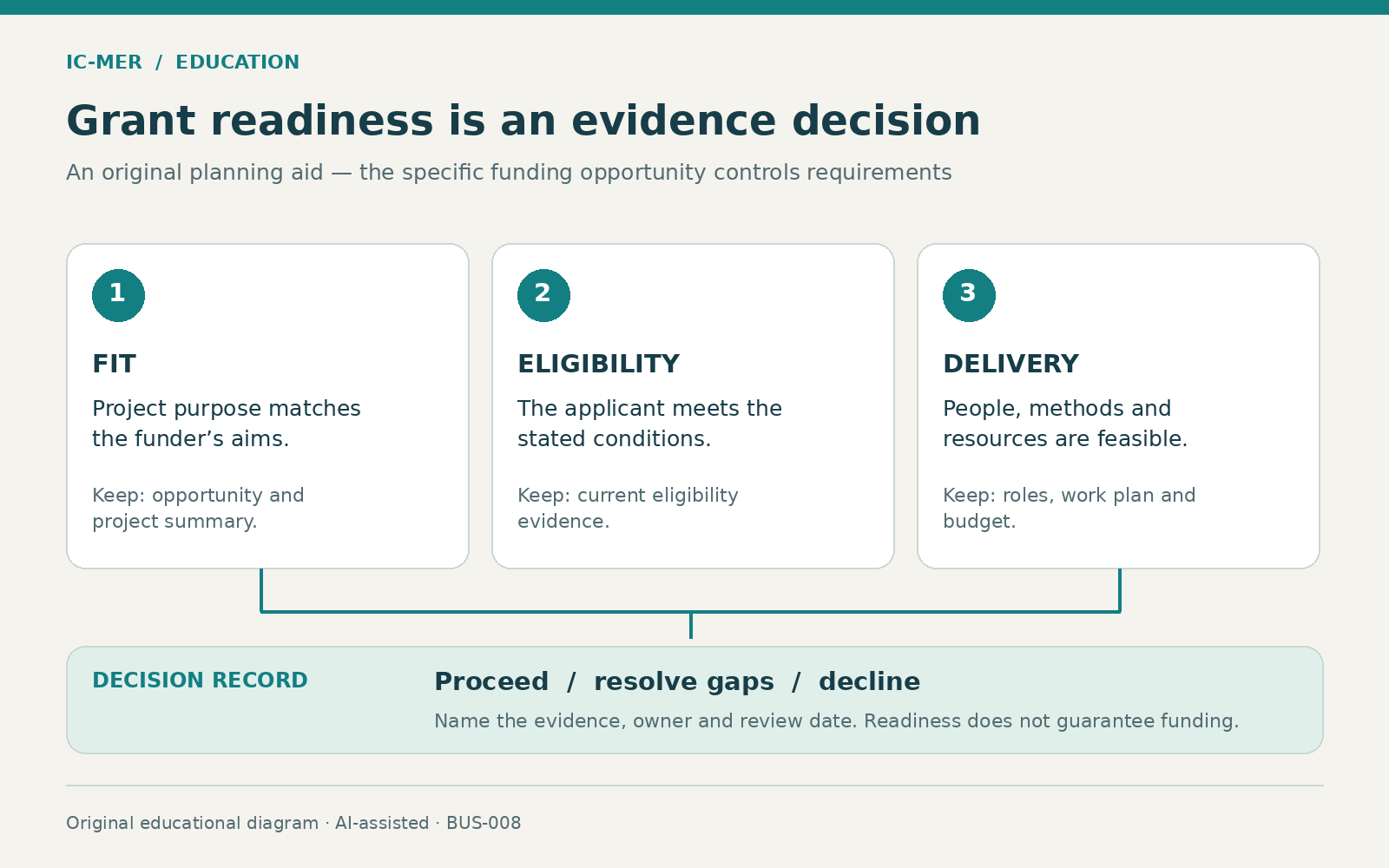
Finish with a short review of six questions: does the project fit, is eligibility evidenced, are registrations and authority in place, can the team deliver, does the budget cover the work, and can the organization manage the award? This is an editorial checklist, not an official funder scoring tool.
Mark each answer confirmed, unresolved or failed, with the supporting document and a responsible person. A failure on a mandatory eligibility condition cannot be averaged away by excellent writing. An unresolved delivery issue may justify revising scope or finding an appropriate partner. A missed prerequisite may justify waiting for a later opportunity.
Record the decision and its reasons. If proceeding, pass the writer a verified brief and an attachment list. If deferring, list the specific preparations that would change the decision next time. That produces reusable organizational knowledge without pretending that an attractive narrative guarantees funding.
Sources & further reading
- Grant EligibilityChecked 2026-10-22
- Applicant RegistrationChecked 2026-10-22
- Entity Registration and Unique Entity IDChecked 2026-10-22
- NIH Organization RegistrationsChecked 2026-10-22
- Develop Your BudgetChecked 2026-10-22
About this article
Prepared with AI assistance and an AI fact-checking pass against the sources listed above. No human clinical review is claimed. Evidence may change; consult appropriate qualified professionals for decisions about your circumstances.
Spotted a problem? Suggest a correction.