Business · 9 min read
Budgeting a research project from scope to contingency
A practical way to connect research activities to costs, test uncertainty, and distinguish an internal estimate from a compliant funding request.
AI-assisted educational content from the IC-MER Editorial Team, not individualized grant, accounting, tax or legal advice. All project figures are hypothetical. Confirm the current opportunity, applicable rules and award terms with the responsible grants and financial professionals.
Information may contain errors, omissions or outdated guidance. This article is general education, not individual medical or other professional advice. Verify important information before acting and consult an appropriately qualified professional. Never disregard medical advice, delay care or change treatment because of this article. See our accuracy disclaimer and terms.
A budget is a model of the proposed work
A research budget should explain how a team will turn a defined question into usable evidence. A page of salaries and equipment prices cannot do that on its own. The useful starting point is the work: what must happen, who will do it, how much of each resource is needed, and when payment will be due. A total becomes credible when another person can follow those assumptions.
This guide offers a practical planning method for a small research organization or project team. Its worked example is entirely fictional and is not an IC-MER project, salary survey, funding request, or approved grant budget. The method separates an internal estimate of what delivery may cost from the amount and categories a particular funder permits an applicant to request.
NIH advises applicants to connect their requests to the proposed aims and methods, read the funding opportunity's budget restrictions, and consult institutional administrative specialists. Its general budgeting advice does not replace application instructions. Treat this article in the same spirit: a way to organize questions before completing the actual sponsor's forms.
Sources: [1]
Define deliverables before opening the spreadsheet
Write a short scope statement that names the question, the intended output, and the boundary of the work. For a fictional community research pilot, the output might be a feasibility report describing whether a planned data-collection process can be delivered. That differs from a study designed to establish treatment effectiveness. The distinction changes the necessary people, sample, procedures, analysis, and oversight.
Break the work into activities: protocol development, applicable review and permissions, setup, recruitment or data acquisition, collection, quality checks, analysis, reporting, and closeout. Give each activity a responsible person and a tangible completion condition. 'Analysis finished' is less useful than identifying the dataset, agreed analysis outputs, and review required before the report can be drafted.
Look for dependencies. If a data agreement must be signed before access begins, collection costs cannot simply start on day one. If a laboratory quotation excludes shipping or repeat testing, the missing work has not disappeared. Keep unresolved scope questions visible rather than disguising them as a miscellaneous line.
Build quantities and rates with a traceable basis
For every activity, list the unit, quantity, unit price, calculation, source of the estimate, and date checked. Units might be staff hours, calendar months, samples, software seats, trips, or completed services. Do not mix a monthly quotation with an annual quantity. Where tax, shipping, installation, maintenance, or exchange-rate exposure might matter, state whether each is included.
Use actual quotations and organizational payroll information when available. If a price is provisional, label it and assign someone to replace it before submission. A colleague should be able to distinguish a current vendor estimate from an amount copied from last year's project or invented solely to make the total fit.
Keep the underlying detailed model even when the application asks for a simpler presentation. NIH specifically recommends an internal detailed budget for modular applications. A simplified submission format does not remove the need to understand the resources that delivery requires.
Sources: [1]
Estimate effort as work, then translate it into personnel costs
Ask each role owner to estimate effort by activity rather than requesting a single unexplained percentage. Include preparation, coordination, data checking, documentation, and reporting where they are real parts of the work. Then inspect the combined workload. A person assigned simultaneously to several projects cannot supply unlimited effort merely because each project has its own budget.
For internal modeling, a useful starting calculation is hours multiplied by a documented hourly cost, or the relevant salary multiplied by a clearly defined effort fraction and period. Use the organization's actual employment and accounting conventions when turning this estimate into an application. Avoid treating a contractor's invoice rate as interchangeable with an employee's salary.
Separate salary or wages from employer costs when the accounting system does so. Record whether an illustrative rate already includes benefits, payroll-related costs, or other components; otherwise these can be counted twice. The aim is not to choose the smallest plausible number. It is to make the staffing commitment understandable and achievable.
Separate direct project costs from shared support
Under the federal framework, whether a cost is associated with a particular award helps distinguish direct from indirect treatment. Section 200.414 also describes indirect-cost arrangements and the conditional availability of a de minimis option. It does not mean every organization should apply one generic percentage to every project. Confirm the applicable rate, eligible base, award terms, and organizational treatment with the responsible grants specialist.
An internal project model can show shared support separately while that determination is pending. For example, label an amount 'planning allocation for shared support' rather than presenting it as an approved federal indirect-cost request. This keeps the management estimate useful without implying a reimbursement entitlement.
Suppose a purely illustrative rate were 20 percent and its defined base were $30,000. The calculation would be $6,000, not 20 percent of whichever total happens to be most convenient. This is arithmetic only, not a rate recommendation. A different base can change the result even when the percentage is unchanged.
Sources: [3]
Work through a small fictional budget
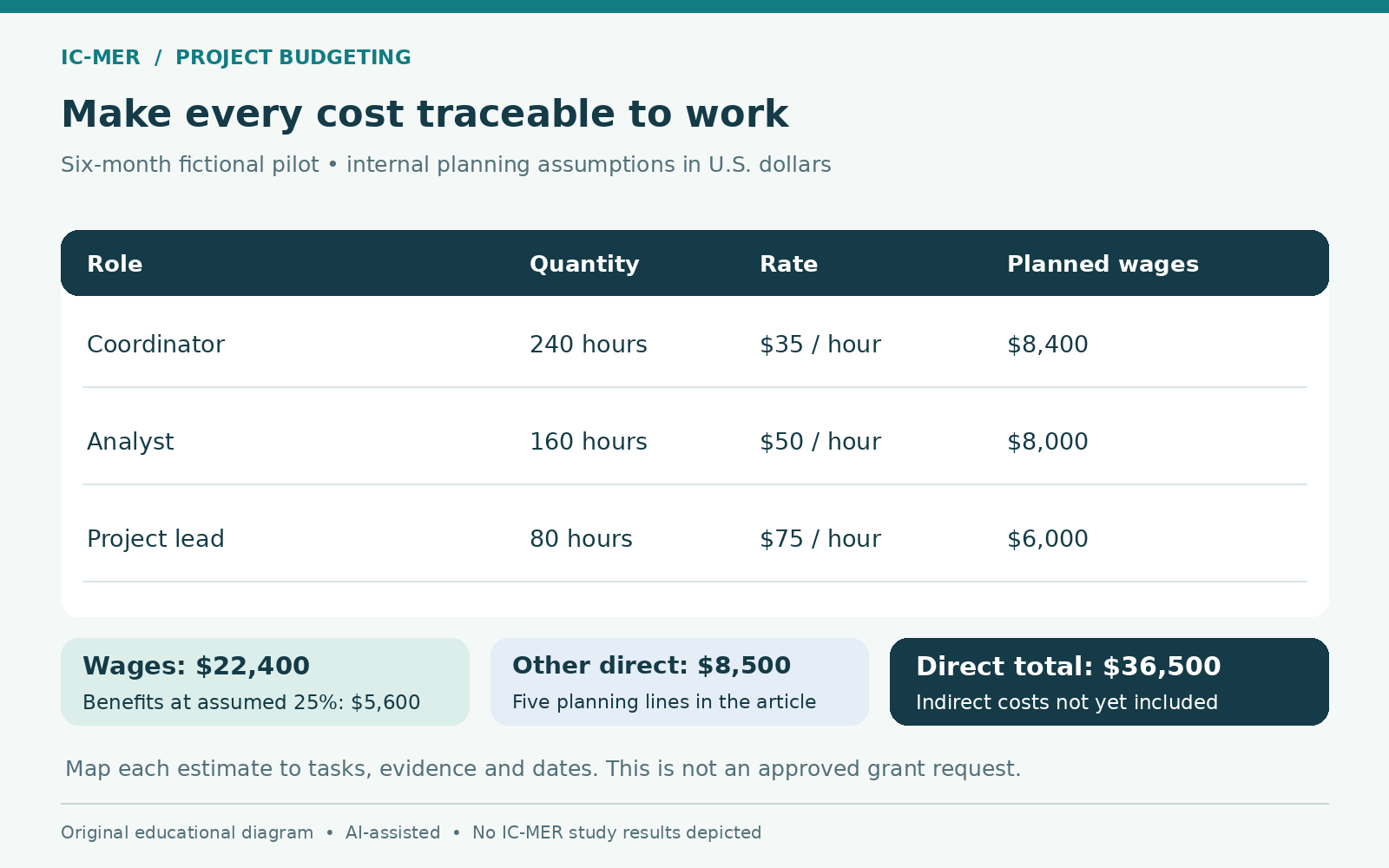
Imagine a six-month pilot whose team has defined the activities but has not yet chosen a funding opportunity. The following numbers are deliberately simple internal planning assumptions. They should not be treated as market rates or an indication that a funder would allow each item. Benefits are modeled separately from wages, and no indirect-cost request has yet been calculated.
The coordinator is estimated at 240 hours at $35 per hour, or $8,400. An analyst is estimated at 160 hours at $50 per hour, or $8,000. A project lead is estimated at 80 hours at $75 per hour, or $6,000. Wages therefore total $22,400. An assumed employer-benefit allocation of 25 percent of those wages adds $5,600.
The remaining planning lines are $3,000 for a defined data service, $1,500 for software, $2,000 for supplies, $1,200 for necessary travel, and $800 for report production. These five lines total $8,500. Adding wages, assumed benefits, and those other lines produces a base internal direct-cost estimate of $36,500.
Each number needs a work explanation. The analyst's 160 hours should map to tasks, while the data service should specify its deliverables and exclusions. Before calling this a grant request, the team must check category definitions, allocation, period, allowability, indirect costs, and any required approvals.
Put the cost estimate onto the project calendar
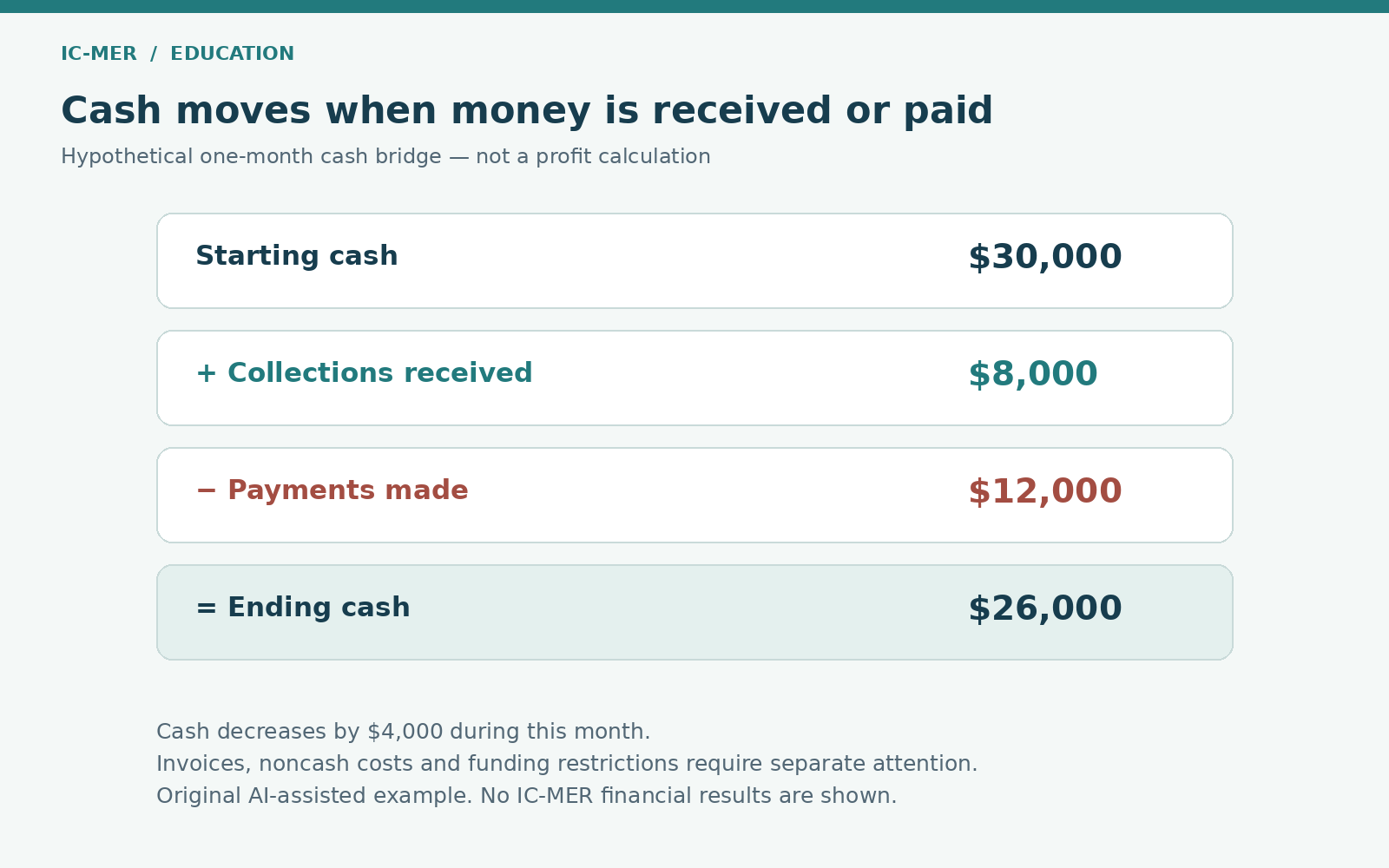
A project can be affordable in total and still encounter a cash shortage. Add a timing view showing when commitments are made, invoices are expected, payroll occurs, and funding is available under the actual arrangement. Do not assume that an award notice is the same as unrestricted cash arriving immediately.
For the fictional $36,500 direct-cost model, an illustrative monthly spending sequence of $4,500, $6,000, $8,000, $7,500, $6,000, and $4,500 reconciles to the total. These amounts do not predict any real project's cash flow. They demonstrate the need to reconcile the calendar view with the category view rather than building two contradictory budgets.
Distinguish a purchase commitment from its later payment. Ask who can authorize commitments and what happens if the start date shifts. Check the real payment and reporting terms before making promises to staff or suppliers. If a delay creates a financing gap, identify an authorized funding solution or change the plan before committing expenditure.
Test uncertainty without inventing an allowable reserve
Keep an internal uncertainty register describing the assumption, what might change, its estimated cost effect, and the action available. In the fictional pilot, 40 additional analyst hours at $50 add $2,000 in wages and, using the same illustrative 25 percent benefit assumption, $500 in benefits. A data-service quotation rising from $3,000 to $3,600 adds $600. Together these conditions produce a $39,600 direct-cost scenario, $3,100 above the base.
This scenario is a management test, not permission to charge an extra $3,100 to an award. Federal rules in section 200.433 distinguish documented contingency estimates accepted by the Federal agency that improve precision from excluded amounts for major scope changes, unforeseen risks, or extraordinary events. Actual expenditures still must satisfy applicable cost principles and be verifiable. Payments into a contingency reserve are generally unallowable, subject to the exceptions the rule specifies.
Do not add an unexplained percentage labeled 'contingency' and assume that it is eligible. Ask the funder's grants contact or institutional office how the specific uncertainty should be handled. Possible planning responses include obtaining a firmer quotation, reducing avoidable uncertainty, staging a decision, or identifying separately authorized organizational resources.
Sources: [4]
Check allowability separately from usefulness
A resource may be useful to the organization yet unsuitable for a particular award. For federal awards subject to the cited cost principles, section 200.403 addresses necessity, reasonableness, allocation, consistency, documentation, and award limitations. It also prohibits counting the same cost toward another federally financed program's cost or cost-sharing requirements. A line's appearance in an internal plan is therefore not sufficient evidence that it can be claimed.
Create a review column for every proposed expense: verified, conditional, or unresolved. Record the actual rule or award instruction that resolves it. If the line benefits several projects, ask how its share will be supported rather than allocating the entire expense to the project with the most remaining money.
Check the relevant period and any approval requirements before buying. An attractive discount can still be a poor decision if the expense falls outside permitted arrangements. When an unresolved line is essential to delivery, treat it as a decision blocker, not as a detail someone can explain after expenditure.
Sources: [2]
Write a justification that explains the work
A useful budget justification connects each major cost to an activity and explains how the quantity was estimated. For the fictional analyst line, describe the data-cleaning, analysis, and reporting tasks; identify the effort estimate; and state the source of the cost basis. Repeating '$8,000 for analysis' offers little additional information.
Explain unusual timing, substantial year-to-year changes, essential specialist services, and assumptions that a reviewer could reasonably question. Keep the narrative consistent with the research plan. If the methods promise twelve site visits but the budget funds four, the contradiction requires a scope or cost correction rather than more persuasive wording.
Be explicit about what is outside the estimate. For example, an internal model might exclude an optional expansion that the team has not yet designed. That exclusion helps prevent a preliminary estimate from being circulated later as if it covered a larger program. Version and date the budget and its narrative together.
Review the model before submission and during delivery
Ask a colleague who did not build the spreadsheet to trace a few major lines from deliverable to quantity, price, and total. Then check all arithmetic and category totals, confirm whether the opportunity's ceiling applies to direct or total costs, and resolve the treatment of shared expenses. Review the submitted narrative against the final version, not an earlier draft.
During delivery, compare actual expenditure and commitments with the amount still required to finish the agreed work. Being under budget can reflect delayed work rather than efficiency. Being over a single line may reflect timing, a mistaken assumption, or a genuine scope problem. Investigate the cause before moving money or changing activities.
Maintain a short decision log: what changed, why, who approved the action, and what sponsor permission was required or obtained. The budget then becomes a continuing record of delivery decisions. Its value is the ability to explain the next commitment with evidence, while keeping the project's purpose and funding conditions aligned.
Sources & further reading
- Develop Your BudgetChecked 2026-10-22
- 2 CFR 200.403 — Factors affecting allowability of costsChecked 2026-10-22
- 2 CFR 200.414 — Indirect costsChecked 2026-10-22
- 2 CFR 200.433 — Contingency provisionsChecked 2026-10-22
About this article
Prepared with AI assistance and an AI fact-checking pass against the sources listed above. No human clinical review is claimed. Evidence may change; consult appropriate qualified professionals for decisions about your circumstances.
Spotted a problem? Suggest a correction.