Medicine · 10 min read
How to read a medical study without getting lost
A practical reading method for medical papers: identify the question, inspect methods, interpret results and write a cautious evidence summary.
Educational research-literacy guide, not personal medical advice or a formal appraisal of a specific study. All examples and numbers are hypothetical. Prepared with AI assistance; no human clinical review is claimed.
Information may contain errors, omissions or outdated guidance. This article is general education, not individual medical or other professional advice. Verify important information before acting and consult an appropriately qualified professional. Never disregard medical advice, delay care or change treatment because of this article. See our accuracy disclaimer and terms.
Read with a question, not a verdict
A medical paper can be useful even when you cannot follow every statistical detail. Your first task is to identify what the researchers actually tested and what information would change your understanding. Trying to decide immediately whether a study is good or bad encourages shortcuts. A more productive starting point is a blank page with room for the question, the methods, the main result and the unanswered questions.
This guide proposes a reading workflow, not a validated scoring instrument. Work through it with one paper open beside you. Keep unfamiliar words in a separate list so that looking up one term does not interrupt every paragraph. Mark something as unclear when the report does not answer it. An honest gap is more informative than an assumption that quietly becomes a fact in your notes.
Start by distinguishing the research article from a press release, editorial or news story about it. Read the abstract for orientation, then find the full methods and results. NCCIH explains that the abstract summarizes a paper and that its discussion contains the authors’ interpretation. Record the publication date and whether a later correction or related report is available on the journal page. This is a reading habit, not a guarantee that every problem will be visible.
Turn the research question into a concrete sentence
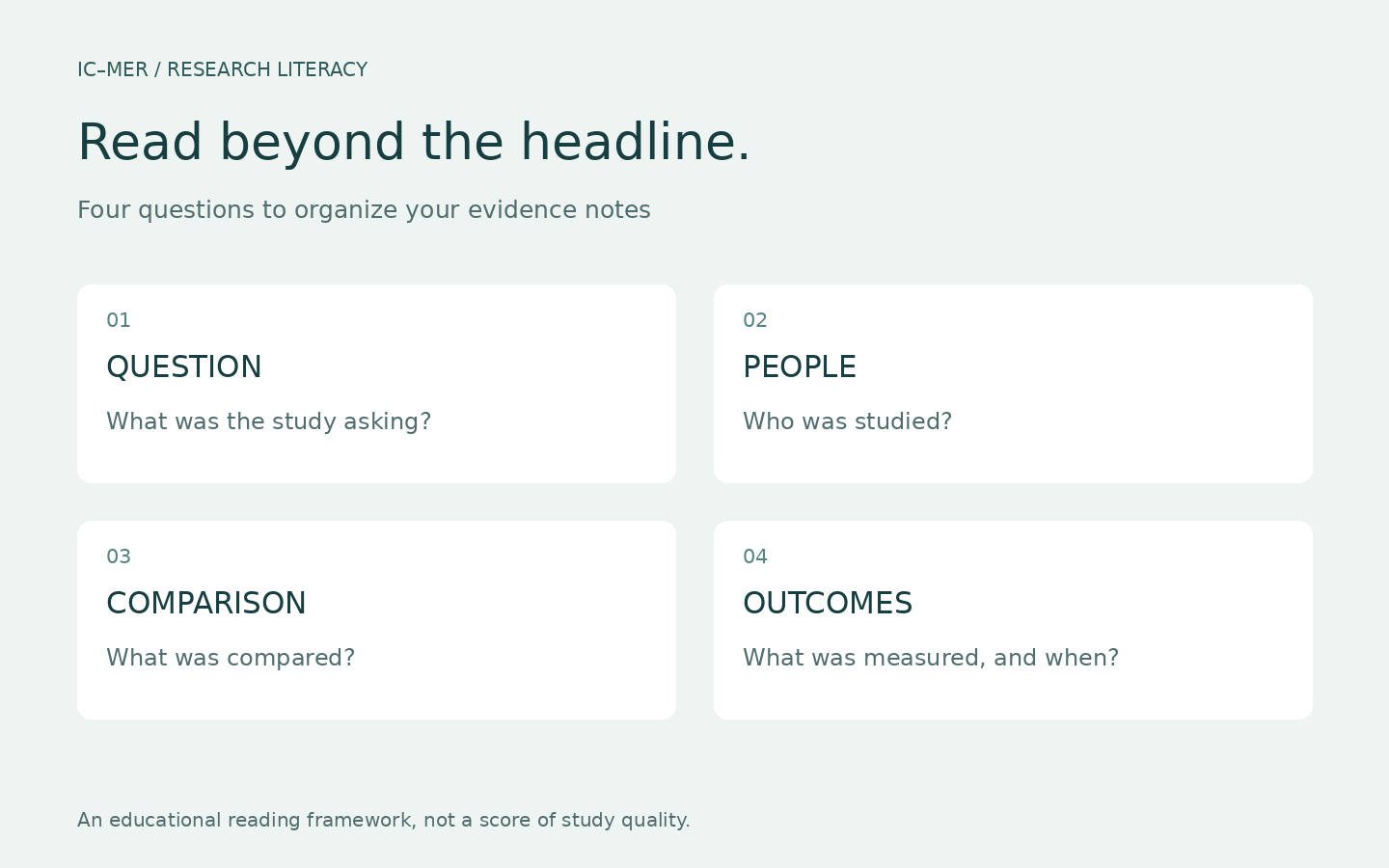
Write down who was studied, what intervention or exposure was considered, what it was compared with, which outcome was measured and over what period. For example: among adults enrolled at a rehabilitation clinic, did an added coaching program, compared with the clinic’s usual care, change reported activity limitations after twelve weeks? That is an invented example. It deliberately names the setting and the endpoint rather than asking whether coaching simply works.
Now underline words that could hide important differences. Adults is not the same as all adults. Usual care might involve frequent appointments at one center and little follow-up at another. Improvement could mean a symptom score, fewer hospital admissions or a laboratory measurement. These are different questions. If the headline says healthier patients but the study measured only attendance, your summary should use attendance.
Use the eligibility criteria to fill in the picture: recruitment setting, age range, condition severity, major exclusions and baseline treatment. Imagine a reader who does not resemble the enrolled group. Write what you would need to know before extending the finding to that reader. Do not announce that the result cannot apply elsewhere merely because a population differs; describe the uncertainty and the reason it matters.
Match the design to the claim
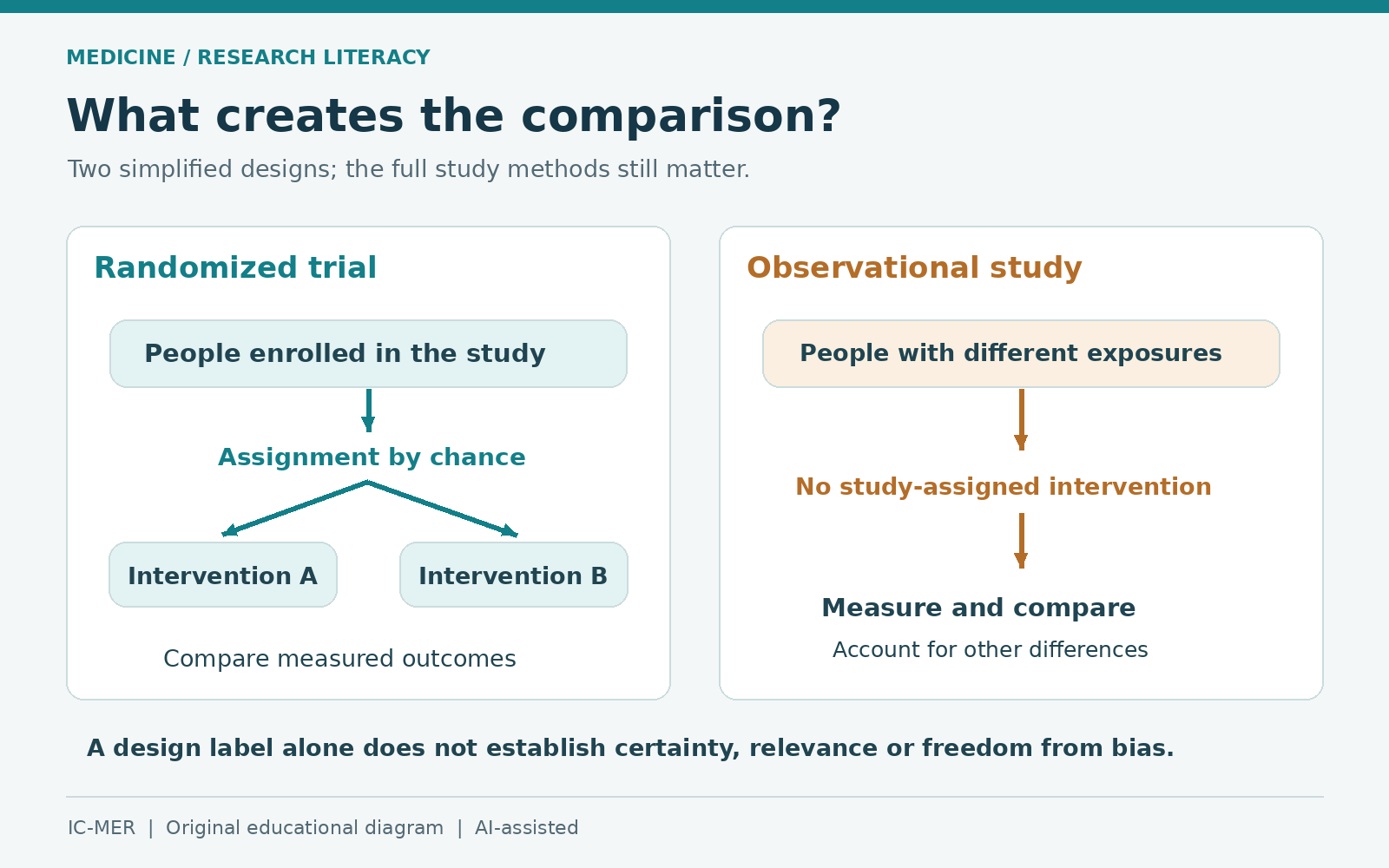
Methods tell you what kind of comparison the investigators created. A controlled trial compares an intervention group with a comparator. In a randomized trial, allocation is by chance. An observational comparison examines exposures or care that investigators did not assign for the study. The designs can answer valuable questions, but a causal claim requires attention to how alternative explanations were addressed. The label alone does not settle the reliability of the result.
In our coaching example, ask whether participants were randomly assigned or chose to attend. If volunteers chose coaching, they might also have had more time, transport or motivation. Those possibilities do not prove that coaching was ineffective. They explain why the difference between groups may not be caused entirely by the program. Put these alternatives into your notes as questions about the comparison, not as accusations about the researchers.
Also identify the comparator precisely. A new program added to usual care answers a different question from replacing usual care with that program. A waiting-list comparison differs from an equally intensive alternative program. If the article does not describe the comparator well enough to understand what people received, keep that limitation in the summary. A treatment name is not a complete description of a treatment experience.
Find the outcome before reading the authors’ interpretation
Locate the outcome the researchers designated as primary and the time at which they planned to assess it. Then distinguish additional outcomes and exploratory analyses. A study can produce many results; the most striking number is not automatically the result best suited to its original question. If a protocol or registration is linked, use it to clarify the original plan and note differences that need explanation.
For a personal reading exercise, make a two-column list headed measured and inferred. Put reported symptom scores, visits or test results in the first column. Put broad claims such as restores health or transforms care in the second unless the actual measurements support them. This simple separation can reveal when a discussion has moved beyond the outcome without requiring you to repeat the statistical analysis.
Read the table heading and footnotes before copying a value. Check units, follow-up time, whether higher scores are better or worse, and which group is listed first. A difference of two units has no useful meaning without the scale. If outcomes are combined into one endpoint, ask which components occurred most often and whether they matter similarly to patients. Treat that as a prompt for deeper appraisal, not an automatic reason to reject the study.
Track people through the study
The number enrolled is not necessarily the number included in every analysis. Look for a participant-flow figure and the denominators in the outcome tables. Note withdrawals, missing measurements and reasons for exclusion after enrollment. Ask whether losses differed between groups and whether the analysis explored assumptions about missing results. Missingness can introduce bias when it relates to outcomes, and a reassuring label does not make the problem disappear.
Suppose our fictional coaching trial enrolled two hundred people but reports the final activity score for only one hundred and fifty. You have not yet learned whether the missing fifty did poorly, improved, moved away or were unavailable for unrelated reasons. The correct note is that the missing outcomes need explanation. It would be wrong to count them all as failures, all as successes, or irrelevant without justification.
Sample size also affects how much information a study provides. A small study can be valuable but imprecise; more participants generally improve precision under comparable conditions. Large enrollment does not repair a systematically unfair comparison. Keep two separate questions in your margin: how much random uncertainty remains, and what might systematically distort this result? They need different answers.
Read the estimate and its uncertainty together
Find the effect estimate, its units and its confidence interval. For a difference, zero represents no difference; for a ratio, one represents no relative difference. A confidence interval describes statistical uncertainty under the analysis assumptions. Its width helps you see whether the result is precise enough to distinguish effects that would matter. It does not account for every possible source of bias or prove that the methods were sound.
A conventional 95% confidence interval refers to the long-run performance of the procedure: over repeated comparable studies, about 95% of intervals constructed that way would contain the true parameter, assuming the method’s conditions hold. It is not a statement that 95% of patients benefit. A p-value likewise is not the probability that the study’s explanation is true. Avoid translating either statistic into a promise to an individual.
Consider a fictional result described as an average improvement of three scale points, with substantial uncertainty around that estimate. Before celebrating, ask what a person notices as meaningful on that scale, what burdens accompany the program, and whether the interval includes effects that would lead to different decisions. If the paper cannot answer these questions, retain the estimate and the uncertainty instead of replacing them with a simple success label.
Sources: [10]
Give percentages a denominator and a time horizon
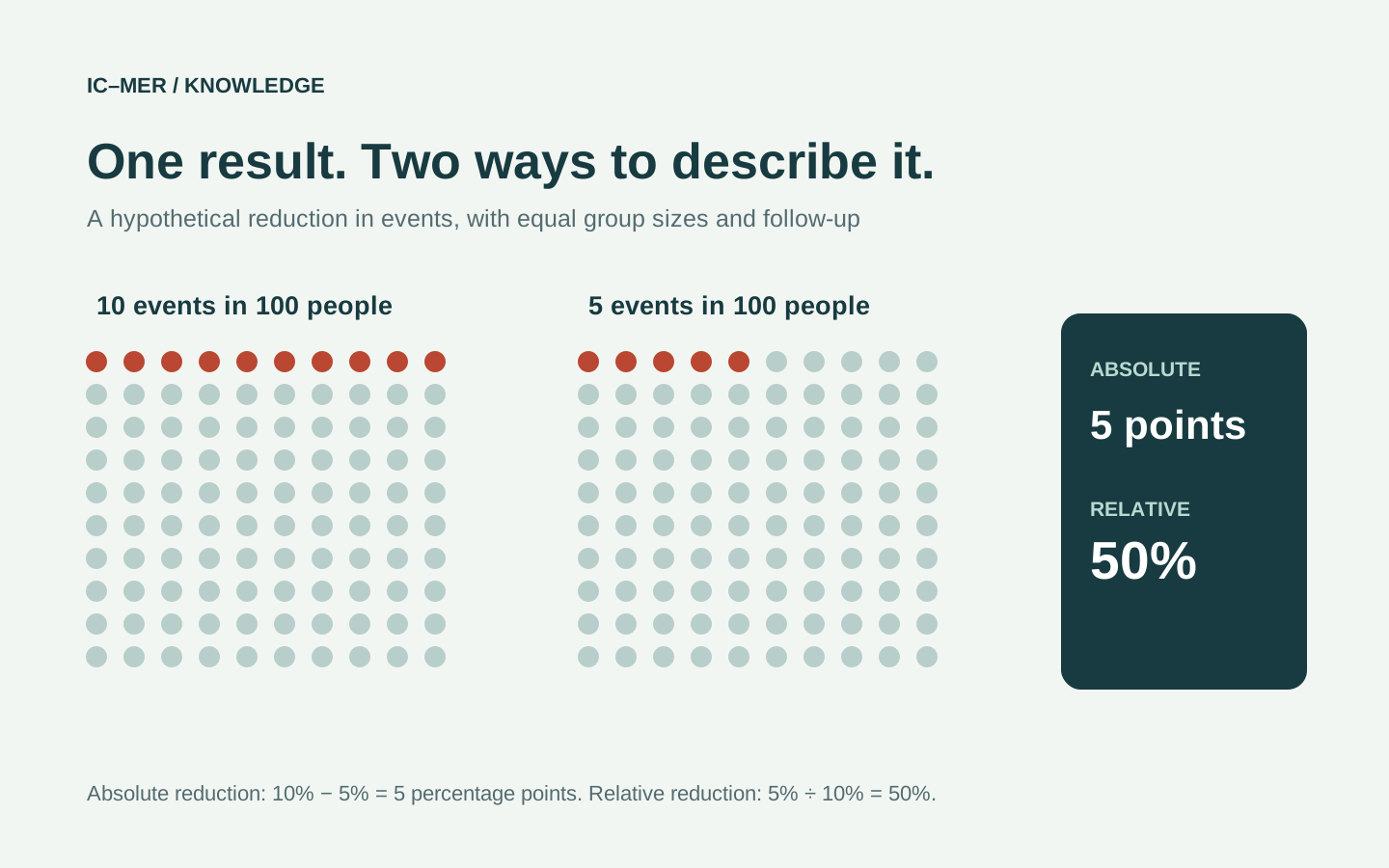
Imagine a completely separate hypothetical study with ten people experiencing at least one specified event among one hundred people in one group and six people experiencing at least one specified event among one hundred in the other over one year. The event risks are 10% and 6%. The absolute difference is four percentage points, and the relative reduction from the first group is 40%. Both calculations describe the same invented counts; neither tells you whether the underlying comparison was unbiased.
Write the event itself next to the numbers. Ten episodes of a minor transient symptom are different from ten deaths. Check whether the report counts people with an event or total events, because one person may experience multiple episodes. Keep the period attached: one-year risk should not be casually compared with a five-year estimate. If group sizes differ, raw event counts alone cannot tell you which group had the higher risk.
This exercise is about translation. A useful plain-language note could say four fewer people per hundred experienced the specified event over one year in this example. It should then add uncertainty, harms and study limitations from the actual paper. The arithmetic is a tool for understanding magnitude; it cannot convert a poorly designed study into reliable evidence or predict what will happen to a particular patient.
Look for protections against bias and relevant conflicts
Ask who knew the treatment assignments and who measured the outcomes. Blinding can reduce the influence of expectations, especially for subjective assessments. It is not possible in every study, and its absence requires context rather than an automatic verdict. NCCIH’s explanation of bias is a useful starting point for asking how researchers limited the influence of knowledge about treatment.
Read the funding and conflict disclosures. Record whether authors or sponsors had financial or reputational interests and what role the sponsor had in design, analysis or publication when reported. A disclosed relationship does not by itself prove that the result is wrong. It helps you identify safeguards and reporting details to examine. Conversely, the absence of a reported commercial sponsor does not establish that a study is free from bias.
Keep your language proportionate. Prefer the report does not explain who assessed the outcome to the researchers hid the outcome assessment. Prefer the sponsor’s analysis role needs clarification to the sponsor controlled the result. This distinction keeps a critical reading fair and makes your questions answerable. Criticism is most useful when someone can point to a method, table or document that resolves it.
Place the paper inside the wider evidence
A single paper is part of a developing evidence base. Look for relevant systematic reviews and current professional guidance, while checking that they address the same population, comparison and outcome. A newer publication may add information without overturning everything that came before. A review can also be out of date or include studies with serious limitations; its label alone is not a quality guarantee.
Cochrane uses the GRADE framework to consider certainty across a body of evidence for each outcome, including risk of bias, inconsistency, indirectness, imprecision and publication bias. You do not need to award your own formal grade to benefit from those questions. Ask why studies differ, whether the evidence fits the question, how precise the estimates are and whether missing studies could change the picture.
For your notes, separate disagreement about facts from disagreement about values. Two people may accept the same estimated benefit and still make different decisions because they weigh inconvenience, cost or side effects differently. A paper can inform those decisions without resolving them. When a decision is medical and personal, bring the paper and your questions to a qualified clinician rather than changing treatment from a headline.
Finish with a short, auditable evidence summary
Write a paragraph that another reader could trace back to the paper. Name the population and setting, the design, the comparison and the measured outcome. Add the effect in understandable units and its uncertainty. Finish with the most important limitation and what the study does not establish. Keep the citation beside the paragraph so that your future self can find the original report rather than a remembered headline.
Here is a fictional template: this study compared an added coaching program with usual care in a defined clinic population and measured activity limitations after twelve weeks. Its results should be interpreted alongside the reported uncertainty, missing outcomes and details of the comparator. It does not by itself establish lasting benefit in other populations. Replace each general phrase with the actual report’s information; do not fill missing fields with guesses.
Finally, list two or three questions that would most change your interpretation. Was the effect large enough to matter on this scale? Would the missing outcomes plausibly change the conclusion? Does a better comparison or a longer follow-up study exist? These questions make the next reading purposeful. Understanding a paper means knowing both what it contributes and which conclusions remain beyond its reach.
Sources & further reading
- NCCIH: Abstract and main sectionsChecked 2026-10-21
- NCCIH: Types of researchChecked 2026-10-21
- NCCIH: Design of the studyChecked 2026-10-21
- NCCIH: Size of the studyChecked 2026-10-21
- NCCIH: Minimizing biasChecked 2026-10-21
- NCCIH: ResultsChecked 2026-10-21
- NCCIH: Discussion and conclusionChecked 2026-10-21
- Cochrane Handbook chapter 8: Assessing risk of bias in a randomized trialChecked 2026-10-21
- Cochrane Handbook chapter 14: Certainty of evidenceChecked 2026-10-21
- Cochrane Handbook chapter 15: Interpreting resultsChecked 2026-10-21
- NCI Dictionary: Observational studyChecked 2026-10-21
About this article
Prepared with AI assistance and an AI fact-checking pass against the sources listed above. No human clinical review is claimed. Evidence may change; consult appropriate qualified professionals for decisions about your circumstances.
Spotted a problem? Suggest a correction.