Medicine · 10 min read
Randomized trials and observational studies: what each can tell us
A practical guide to study design, confounding, uncertainty and matching medical conclusions to the evidence.
General research education, not personal medical advice or a clinical appraisal of a specific treatment. All study scenarios and event counts are hypothetical. Prepared with AI assistance; no human clinical review is claimed.
Information may contain errors, omissions or outdated guidance. This article is general education, not individual medical or other professional advice. Verify important information before acting and consult an appropriately qualified professional. Never disregard medical advice, delay care or change treatment because of this article. See our accuracy disclaimer and terms.
Begin with the question, not the headline
A medical study can describe what happened, explore why it happened, or test whether changing care produces a different outcome. Those are different jobs. Before deciding how much confidence to place in a headline, write its question in plain language: which people, which intervention or exposure, compared with what, for which outcome, over what period? A report about short-term symptom scores cannot by itself answer a question about survival many years later.
This guide focuses on comparing interventions and exposures. It does not rank every kind of medical research on one universal ladder. Laboratory experiments, diagnostic accuracy studies, qualitative interviews and population surveys have other purposes. Even among studies of treatment effects, the actual design and conduct matter more than an impressive label. Cochrane recommends examining specific study features when evaluating non-randomized evidence.
The examples below are invented teaching exercises. They are not IC-MER research findings or recommendations to start or stop treatment. This article was prepared by the IC-MER Editorial Team with AI assistance.
Sources: [1]
What random assignment changes
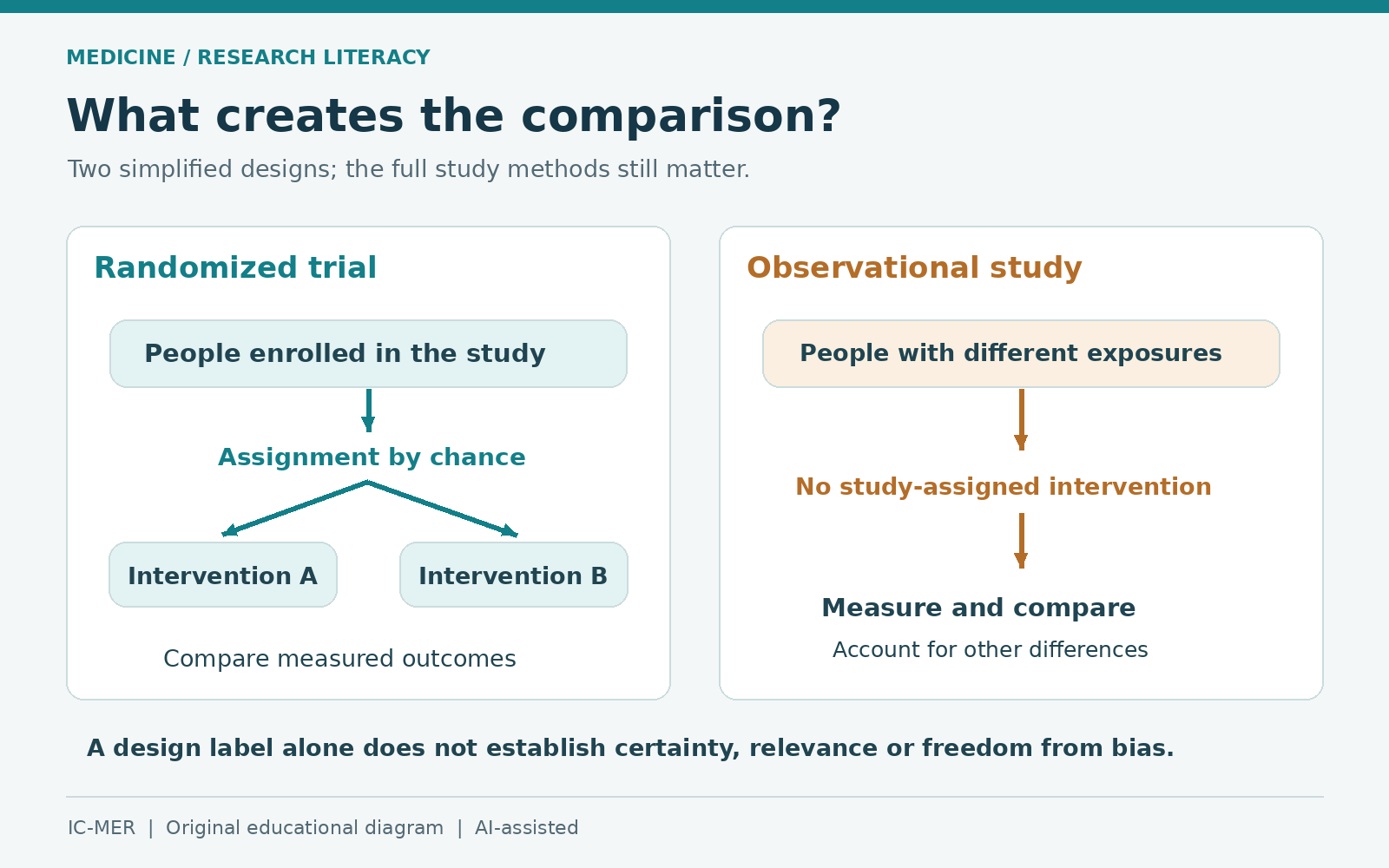
In a randomized trial, investigators assign eligible participants to study groups using a process containing chance. Assignment is different from recruitment: participants might volunteer from a limited set of clinics, even though assignment after enrollment is random. Random allocation therefore does not mean the study is a random sample of everyone who might eventually receive the treatment.
NCI explains that random assignment prevents clinicians or participants from choosing the trial arm according to health or preference. For example, deliberately giving a promising intervention to healthier people would create an unfair comparison. Randomization reduces that problem. Chance imbalances can still occur in a particular trial; it does not guarantee identical groups.
The comparison may be between two active treatments, a treatment and usual care, or another justified comparator. Do not assume that the control group receives no care. Read what each group actually receives, including support, follow-up and additional procedures. The difference being tested may be an entire care strategy, rather than one isolated ingredient.
Sources: [2]
Concealment, blinding and analysis have different jobs
Allocation concealment keeps the next assignment unknown until a participant has been enrolled and assigned. Blinding, when feasible, keeps people unaware of the assigned intervention afterward. Concealment protects the assignment process; blinding can reduce differences in subsequent care, behavior or outcome assessment. An unblinded trial can still have concealed randomization.
Randomization also needs appropriate follow-through. An intention-to-treat approach estimates the effect of assignment by keeping participants in their assigned groups. Missing outcomes still require careful handling. Simply removing people who discontinued treatment may undo the comparability created at enrollment, because discontinuation can relate to prognosis or side effects.
Cochrane examines several routes to bias, including randomization, deviations from intended interventions, missing outcomes, outcome measurement and selective reporting. The practical reader question is therefore not just “Was it randomized?” Ask which result was analyzed, who was missing, and whether the analysis answered the question originally posed.
Sources: [3]
Cohort studies follow a defined group
A cohort study compares outcomes among groups with different characteristics or exposures. Researchers may follow people forward from enrollment or reconstruct follow-up using existing records. The essential idea is to define the population and comparison, establish the relevant exposure or treatment history, and examine subsequent outcomes.
Imagine a fictional registry of adults choosing between two rehabilitation programs. A cohort analysis might compare later function among the groups. It should explain when follow-up began, how attendance was measured, and whether both programs had comparable outcome assessments. A calendar date printed on a chart does not itself establish that all relevant information was recorded accurately.
As a reading exercise, sketch three columns: entry into the study, exposure or treatment, and outcome assessment. Put the dates used by the investigators underneath. If you cannot identify a common starting point or tell whether the outcome happened before the exposure, pause before accepting the interpretation. This sketch is an editorial aid, not a validated quality-scoring instrument.
Sources: [4]
Case-control studies begin with the outcome
A case-control study selects people with an outcome or condition and a comparison group without it, then investigates earlier exposures or characteristics. NCI describes this as comparing histories to identify factors associated with disease. The direction of selection differs from starting with an exposed and unexposed cohort.
For a fictional investigation of an uncommon adverse event, researchers might identify affected patients and suitable controls, then examine previous treatment records. How controls were selected matters. A convenient group with very different access to healthcare could produce a misleading comparison. The study must make its comparison population understandable.
When reading such a study, write down the definition of a case, the reason a person could become a control, and how previous exposure was determined. Do not treat the investigator-selected fraction of cases in the study as the population’s disease frequency. If a sample deliberately contains equal numbers of cases and controls, that does not mean half of the underlying population has the disease.
Confounding: another explanation for a difference
Confounding occurs when factors that influence which intervention a person receives also influence the outcome. In clinical practice, people with more severe illness may preferentially receive a particular treatment. Worse outcomes in that group could partly reflect the illness that led to treatment, rather than harm from treatment itself.
Statistical adjustment attempts to account for relevant differences. Its credibility depends on what was measured, how well it was measured, and the assumptions behind the analysis. A statement that results were “adjusted” is not proof that every important difference was removed. Unmeasured factors, measurement errors and unsuitable comparisons can remain.
Other problems include selecting people in a way that distorts the comparison and measuring outcomes differently between groups. Distinguish these from applicability: an internally credible study in one population may still provide limited guidance for another. Bias concerns whether the estimate is distorted for the question studied; applicability concerns whether that question matches yours.
Sources: [6]
Why observational evidence still matters
Randomized trials are valuable for treatment comparisons, but some questions cannot ethically or practically be randomized. Some harms are rare or appear after the follow-up of available trials. Observational studies can contribute evidence in these settings, including information about longer-term use and populations less well represented in trials.
Cochrane cautions that non-randomized studies vary substantially in their susceptibility to bias. Their usefulness is not determined by sample size alone. A huge database can still compare groups that were different from the outset. Conversely, a carefully designed analysis can address an important gap without claiming that every uncertainty has disappeared.
For readers, the useful distinction is between rejecting an entire design and asking what that design can establish here. A safety signal may justify further investigation without proving a precise causal risk. A consistent pattern across complementary methods can be informative, but the methods and competing explanations still need inspection.
Sources: [1]
Pragmatic trials study choices in ordinary care
Pragmatic trials aim to help people choose between care options under conditions closer to routine practice. NIH’s research-methods guidance explains that they can use individual or group randomization. “Pragmatic” describes the purpose and practical orientation of the study; it is not a synonym for observational or poorly controlled.
For example, a fictional health system might randomize clinics to two appointment-support strategies. Assigning whole clinics could reduce mixing between strategies when staff deliver the intervention together. The analysis would need to respect that assignment structure. Counting every patient as an entirely independent randomized unit could misrepresent the amount of information.
Ask whether the setting resembles the decision you face. Who delivered the service? What resources were available? Was participation possible for patients with transportation or language barriers? These questions help interpret relevance. They do not automatically invalidate a study whose circumstances differ from your own.
Sources: [7]
Effect size and certainty answer different questions
A result needs an outcome definition, a time period and a measure of uncertainty. A difference can be precisely estimated yet too small to matter much to patients. A potentially important difference can also be uncertain. A P value alone does not tell you the clinical importance, and crossing a significance threshold is not a complete decision rule.
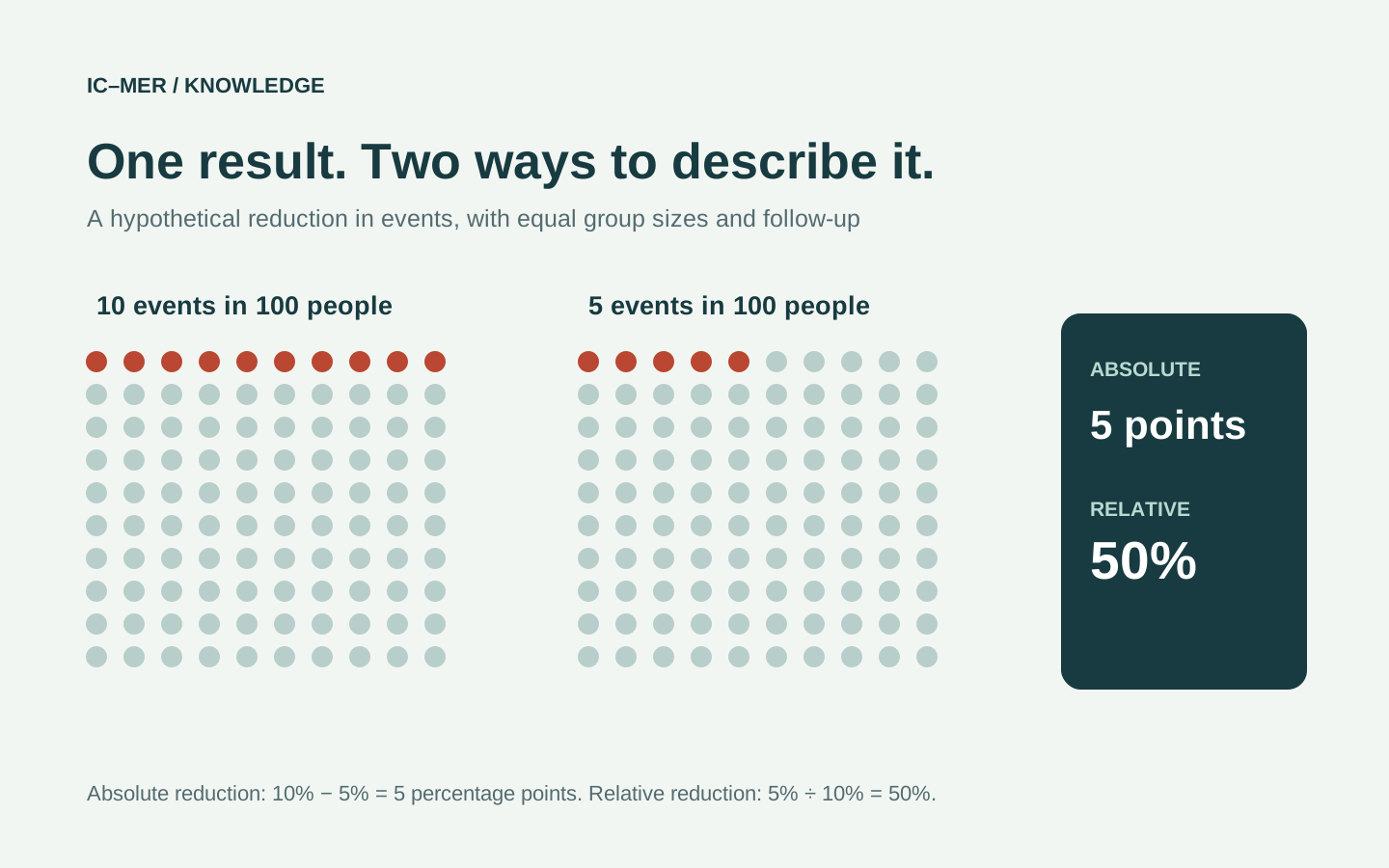
Consider a purely hypothetical comparison with 12 events per 100 people in one group and 9 per 100 in another over the same follow-up. The observed absolute difference is 3 percentage points. That arithmetic says nothing by itself about whether allocation was fair, whether missing data changed the result, or whether the difference would be reproduced. Effect size and study credibility must be evaluated separately.
Cochrane’s interpretation guidance emphasizes benefits, harms, uncertainty and the context of the decision. For a useful summary, record both the numerical estimate and the main limitation in the same sentence. Avoid replacing a nuanced result with “works” or “does not work.”
Sources: [8]
One study is part of a body of evidence
Confidence in a conclusion depends on more than a single study’s design. Cochrane uses the GRADE framework, which considers risk of bias, inconsistency, indirectness, imprecision and publication bias when evaluating a body of evidence for a particular outcome. Confidence may differ between outcomes in the same review.
A treatment might have fairly convincing evidence for symptom improvement but uncertain evidence for an uncommon harm. Likewise, a review may include several studies that all address a different population from the one in your question. Adding them together does not automatically solve that mismatch.
When two reports seem to disagree, compare their questions before deciding which one is wrong. They may involve different doses, comparison treatments, follow-up periods or outcome definitions. A review that explains these differences can be more useful than selecting whichever individual study supports a preferred conclusion.
Sources: [9]
A worked reading exercise
Imagine a headline claiming that a fictional digital coaching program “cuts hospital visits.” First, replace the headline with a question: among which patients, compared with which service, over how many months? Next, identify the assignment mechanism. Did a research team randomize access, or did participants choose whether to subscribe? Those situations require different interpretations.
In the self-selected version, ask whether subscribers had different baseline health, resources or motivation. In the randomized version, ask whether participants stayed in the analysis after canceling their subscription and whether hospital visits were captured for everyone. In either version, ask whether the outcome includes emergency visits, planned admissions, or both.
Then read the size of the difference and uncertainty. A relative reduction without the original event rates is incomplete. Finally, examine what the program required: equipment, staff time, internet access and extra appointments could affect whether another service can reproduce the intervention.
Your eventual note might read: “This study compared access to the program with usual support for a defined population over a stated period; the outcome estimate favored the program, but incomplete follow-up limits confidence.” That sentence makes the evidence reviewable. It does not claim the fictional intervention is effective, and it gives the next reader a specific uncertainty to investigate.
Questions to keep beside the paper
Use a small evidence note rather than trying to memorize every technical term. Write the population and setting, the assigned or observed exposure, the comparison, the outcome, the follow-up period, the effect estimate and the main uncertainty. Add the study’s funding and any disclosed competing interests so they are visible during interpretation, without assuming that funding alone determines validity.
Ask what information would change your conclusion. Perhaps the missing item is the full protocol, a clear account of excluded participants, a longer follow-up report, or evidence in a population closer to yours. If the report cannot answer that question, record the gap explicitly. Acknowledging a gap is more useful than filling it with a confident guess.
A useful discussion can begin with a modest request: help me understand the comparison before discussing the conclusion. That puts the methods in view and makes disagreement easier to examine. Readers can then identify whether they disagree about the evidence, its relevance, or the values attached to possible outcomes.
For personal treatment decisions, bring the paper and your questions to a qualified healthcare professional. The aim of research literacy is to understand what the evidence supports and where uncertainty remains, while keeping the patient’s circumstances and goals in the decision.
Sources & further reading
- Cochrane Handbook chapter 24: Including non-randomized studies on intervention effectsChecked 2026-10-21
- NCI: How Do Clinical Trials Work?Checked 2026-10-21
- Cochrane Handbook chapter 8: Assessing risk of bias in a randomized trialChecked 2026-10-21
- NCI Dictionary: Cohort studyChecked 2026-10-21
- NCI Dictionary: Case-control studyChecked 2026-10-21
- Cochrane Handbook chapter 25: Assessing risk of bias in a non-randomized studyChecked 2026-10-21
- NIH Research Methods Resources: Frequently Asked QuestionsChecked 2026-10-21
- Cochrane Handbook chapter 15: Interpreting results and drawing conclusionsChecked 2026-10-21
- Cochrane Handbook chapter 14: Summary of findings and certainty of evidenceChecked 2026-10-21
About this article
Prepared with AI assistance and an AI fact-checking pass against the sources listed above. No human clinical review is claimed. Evidence may change; consult appropriate qualified professionals for decisions about your circumstances.
Spotted a problem? Suggest a correction.