Medicine · 7 min read
Informed consent in clinical research: a participant’s guide
A practical participant guide to understanding a research study, asking useful questions and making a voluntary decision.
General US research-participation education, not individualized medical or legal advice, consent-form approval, or a guarantee of study safety. Ask the actual research team and treating clinician about your circumstances. Prepared with AI assistance; no human clinical or legal review is claimed.
Information may contain errors, omissions or outdated guidance. This article is general education, not individual medical or other professional advice. Verify important information before acting and consult an appropriately qualified professional. Never disregard medical advice, delay care or change treatment because of this article. See our accuracy disclaimer and terms.
Consent is a conversation you can continue
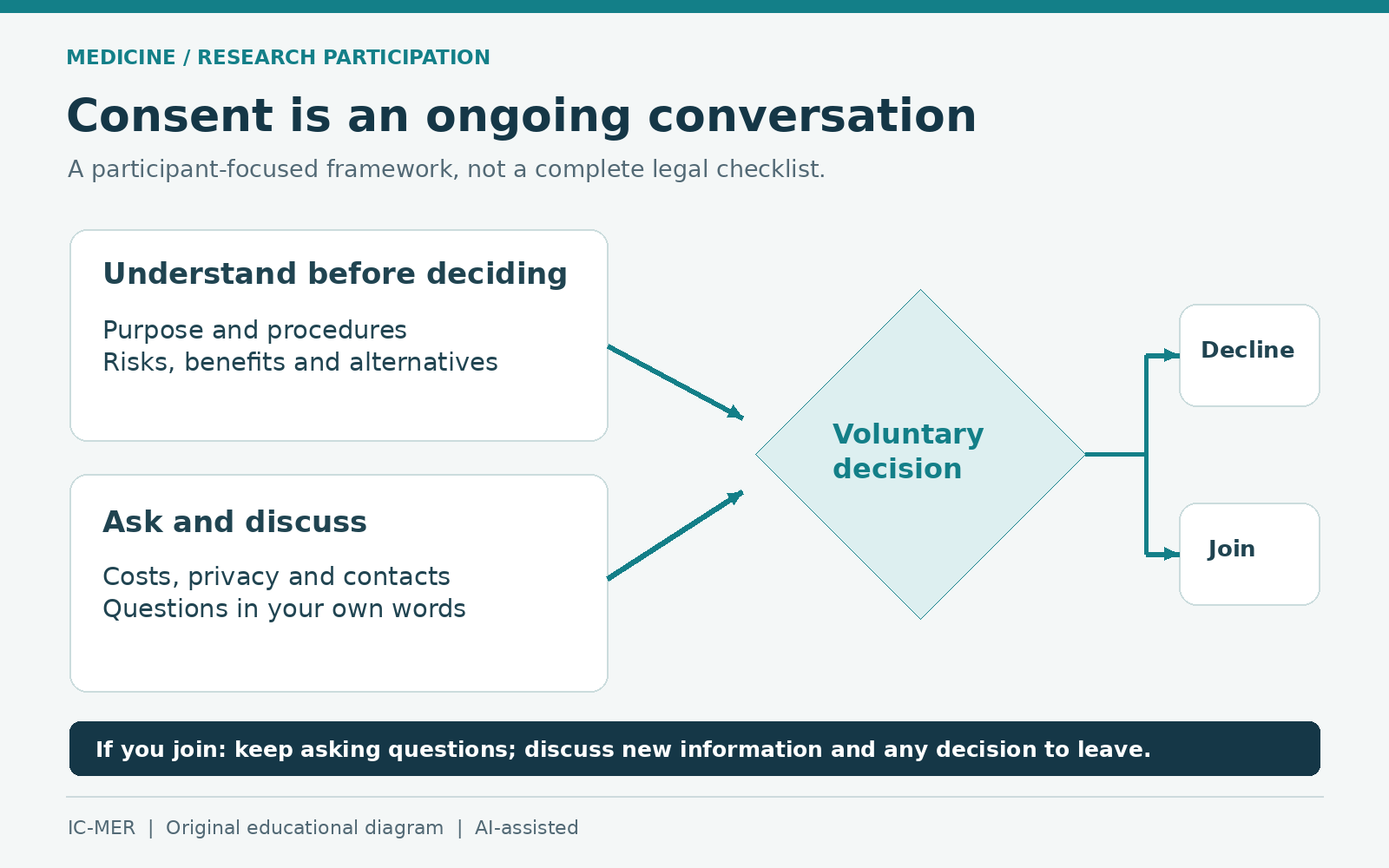
Informed consent helps you decide whether participating in research fits your values and circumstances. A signature records a decision; it does not replace understanding. The research team should explain the study, allow questions and support a voluntary choice. NCI emphasizes that this conversation continues after enrollment as information changes.
This guide focuses on adults considering ordinary prospective clinical research in the United States. Rules depend on the study, jurisdiction and applicable oversight. Special provisions can apply to emergency research, children, adults who cannot provide consent and certain other studies. It is not a complete statement of every legal requirement.
The IC-MER Editorial Team prepared this educational guide with AI assistance. It is intended to help you prepare a discussion with a research team, not to approve a consent form or decide whether a particular trial is suitable for you.
Separate research goals from your care goals
Research aims to answer a question. Your medical care aims to address your individual needs. A study may offer possible personal benefit, but participation does not guarantee improvement. Some procedures may be performed to collect knowledge rather than to guide your treatment. Ask the team to identify those procedures clearly.
Try this question: “Which parts would happen if I did not join, and which happen only because this is research?” Then ask what is known already and what remains uncertain. If there are several study groups, request an explanation of how assignment works and whether you or your clinician can choose a group.
NCI describes informed consent and independent protocol review as protections for participants. Those protections do not remove every risk. A study can be responsibly designed and still involve substantial uncertainty. Your decision can reasonably depend on both the possible benefits and the burdens you are willing to accept.
Sources: [2]
Understand the plan in everyday terms
The consent discussion should make the purpose, duration, procedures and experimental elements understandable. FDA describes these as basic consent information for clinical investigations under its rules. Ask for a plain-language explanation of unfamiliar terms before agreeing.
Create your own visit calendar. For each visit, write where it occurs, approximately how long it lasts, what preparation is needed and whether someone must accompany you. Include remote check-ins, questionnaires and medication instructions. This is a practical planning exercise; the actual study schedule must come from the research team.
Ask how changes to the plan will be communicated. Keep a copy of the consent information and the team’s contact details. If someone explains the study verbally in a way that seems inconsistent with the written form, ask them to resolve the difference. Your notes should clarify the study, not become a substitute for its approved instructions.
Sources: [3]
Discuss risks, benefits and alternatives separately
Ask which risks are known, which are uncertain, and which symptoms or events need prompt reporting. Request an explanation that distinguishes how often a problem may occur from how serious it could be. An uncommon severe problem and a common mild problem can matter in different ways.
The FDA consent framework includes reasonably foreseeable risks, possible benefits and appropriate alternatives. The alternative may be standard treatment or another suitable course of care. Discuss your options with your treating clinician as well as the research team, especially if the investigator also provides your usual care.
A useful personal worksheet has three columns: possible benefit to me, possible benefit to future patients, and burdens or risks to me. Do not count a hope as a promised benefit. For example, wanting closer follow-up is understandable, but ask exactly what monitoring is offered and whether the study provides care for unrelated problems.
A voluntary decision includes the option to decline
You should have a meaningful opportunity to consider participation without inappropriate pressure. OHRP notes that pressure can be subtle, including feeling obligated because the invitation comes from a physician. Its consent FAQ predates the revised Common Rule and carries that caveat; the broad principles of understanding and voluntary choice remain useful here.
You can say that you need another discussion, an interpreter or other communication support, or time to consider the information with someone you trust. Ask what decision deadline exists and why. A study’s scheduling needs do not make your questions unimportant.
An original way to check your understanding is to explain the study back in your own words: “I understand the goal is this, these procedures are extra, these benefits are uncertain, and these are my alternatives.” Invite the team to correct misunderstandings. This exercise is not a legal test of capacity or a substitute for the actual consent process.
Sources: [5]
What withdrawal does—and does not—mean
You may decide to stop participating. Tell the research team so you can discuss safe discontinuation of a study intervention and the care you will need afterward. FDA guidance explains that withdrawal procedures should address relevant safety consequences. Do not interpret the right to leave as an instruction to stop a medication abruptly without medical guidance.
Leaving does not necessarily erase information already collected. OHRP’s withdrawal guidance states that investigators may retain and analyze previously collected data in the research covered by that guidance. FDA’s guidance says data collected before withdrawal in studies under an investigational new drug application or investigational device exemption remain in the study database.
Ask what withdrawing would mean for future visits, access to medical records, samples and follow-up contact. Stopping an intervention and agreeing to some follow-up can be different decisions. The answer should be specific to the study and applicable rules. This article cannot promise deletion of data or samples after withdrawal.
Make privacy and financial questions concrete
Ask who can access identifiable study information, what will be shared, and what privacy protections and limits apply. FDA guidance discusses disclosure of access by research and oversight entities. If samples or data may be used in future work, ask which choices are available and whether those choices affect participation in the main study.
Costs need their own conversation. NCI distinguishes routine patient-care costs from research-specific costs and notes that coverage may involve the sponsor, insurance and the participant. Travel, parking, lodging, caregiving and time away from work can also matter. Do not assume that “research” means every expense is free.
Before committing, request a written explanation of expected charges and reimbursements, and confirm relevant coverage with the insurer or financial counselor. Keep payment for participation separate from reimbursement of expenses and from any medical benefit. Ask what happens to payment if you leave early. No amount quoted in this article applies to a real study.
Know whom to contact before you need help
Keep separate contacts for everyday study questions, urgent medical concerns and questions about participant rights. Ask whether there is an after-hours number and what to do if it is unanswered. A research coordinator’s email inbox should not be treated as an emergency service.
For studies involving more than minimal risk, FDA’s consent framework addresses information about compensation and medical treatment if a research-related injury occurs. That disclosure is not a guarantee that all care will be paid for. Ask who evaluates a possible study-related injury, where care is obtained and who might receive the bill.
You can also ask how the research team will share significant new information that might affect willingness to continue. Keep your contact information current if you remain enrolled. If a new form arrives, compare what changed and ask about its practical consequences rather than assuming it is routine paperwork.
Prepare a one-page decision note
Consider a fictional participant who is comfortable with the scientific question but uncertain about frequent weekday visits. Their next step need not be immediate acceptance or rejection. They could request the exact schedule, discuss transportation and clarify which visits are mandatory. That information might reveal a manageable commitment or a burden incompatible with work and caregiving.
Your note can record the study name, what you understand, what matters most to you, and unanswered questions. Add the date and the person who answered each question. If answers change, keep the older note so you can see what changed. These are organizational suggestions, not evidence that the study is safe or appropriate.
Before deciding, ask yourself whether you can explain the purpose, what will happen, important uncertainties, available alternatives, expected costs, privacy limits and how to leave. You do not have to become a research specialist. You do need enough understandable information to make your own choice, and a reliable way to continue asking questions afterward.
Sources & further reading
- NCI: Understanding Informed Consent FormsChecked 2026-10-21
- NCI: Are Clinical Trials Safe?Checked 2026-10-21
- FDA: IDE Informed ConsentChecked 2026-10-21
- FDA: Informed Consent Guidance for IRBs, Clinical Investigators, and Sponsors, August 2023Checked 2026-10-21
- HHS OHRP: Informed Consent FAQs (older guidance with current applicability caveat)Checked 2026-10-21
- HHS OHRP: Withdrawal of Subjects from Research Guidance (2010; applicability caveat)Checked 2026-10-21
- NCI: Who Pays for Clinical Trials?Checked 2026-10-21
About this article
Prepared with AI assistance and an AI fact-checking pass against the sources listed above. No human clinical review is claimed. Evidence may change; consult appropriate qualified professionals for decisions about your circumstances.
Spotted a problem? Suggest a correction.