Medicine · 4 min read
Reading food labels for useful everyday choices
A useful label check starts with the amount you will actually eat, then focuses on the information that matters to you.
Educational information about U.S. food labels, prepared with AI assistance and reviewed by AI. It is not individualized nutrition or allergy advice. Follow your clinician’s plan for medical dietary restrictions.
Information may contain errors, omissions or outdated guidance. This article is general education, not individual medical or other professional advice. Verify important information before acting and consult an appropriately qualified professional. Never disregard medical advice, delay care or change treatment because of this article. See our accuracy disclaimer and terms.
A small routine beats reading every number
Standing in a supermarket aisle, you do not need to turn every purchase into a nutrition examination. A repeatable sequence can make the decision easier: check the serving amount, compare one or two relevant nutrients, and review ingredients for anything you must avoid. This guide describes U.S. packaged-food labels; other countries use different formats.
Start with a food you buy regularly rather than auditing the whole shopping cart. Comparing two breakfast cereals or two soups is usually more useful than trying to rank a cereal against an avocado. Price, taste, preparation time and whether the household will actually eat it also belong in the decision.
Sources: [1]
Check what the numbers describe
The stated serving is based on amounts people typically consume, not a personalized recommendation. A package can contain several servings. Some labels have separate columns for one serving and the whole container, so check the heading before doing arithmetic.
If a hypothetical soup lists 300 milligrams of sodium per serving and you eat two servings, you consume 600 milligrams. This is an invented teaching example, not a product recommendation. The same scaling applies to calories and other nutrient amounts. Your bowl may hold more or less than the label's household measure; the gram amount can help when the comparison is unclear.
Sources: [2]
Compare like quantities
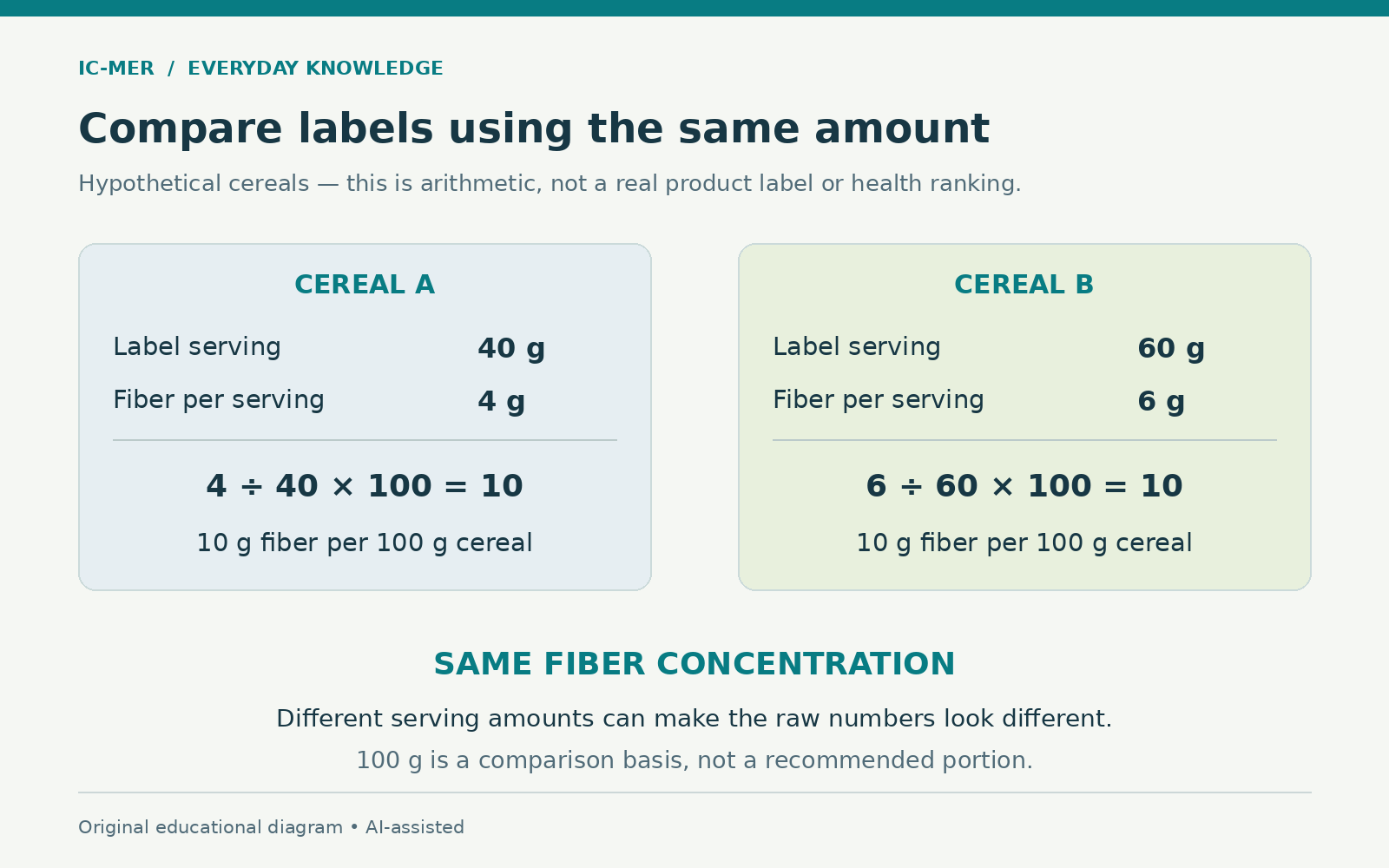
Imagine cereal A provides 4 grams of fiber in a 40-gram serving, while cereal B provides 6 grams in a 60-gram serving. Both contain 10 grams of fiber per 100 grams: 4 divided by 40, multiplied by 100, and 6 divided by 60, multiplied by 100. The larger printed fiber number alone does not mean B has a higher fiber concentration.
These fictional values illustrate the cover diagram. A 100-gram comparison is a calculation tool, not a suggested portion and not a field required on every U.S. label. You could instead compare the same 40-gram amount of both cereals. This single comparison also says nothing about their sugar, sodium, cost or suitability for an allergy.
Sources: [2]
Use percent Daily Value as a shortcut
Percent Daily Value describes how much a serving contributes toward a daily reference amount for a nutrient. FDA's general guide is 5% or less for a low amount and 20% or more for a high amount. The percentages belong to individual nutrients; the column is not meant to add up to 100%.
For many people, comparing similar foods for more fiber and less sodium, saturated fat or added sugars is useful. High is not automatically good and low is not automatically bad: which nutrient you are looking at matters. The reference values are not a prescription for your medical needs. A person following a kidney-disease or other individualized eating plan may have different priorities.
Keep sugar and ingredient questions separate
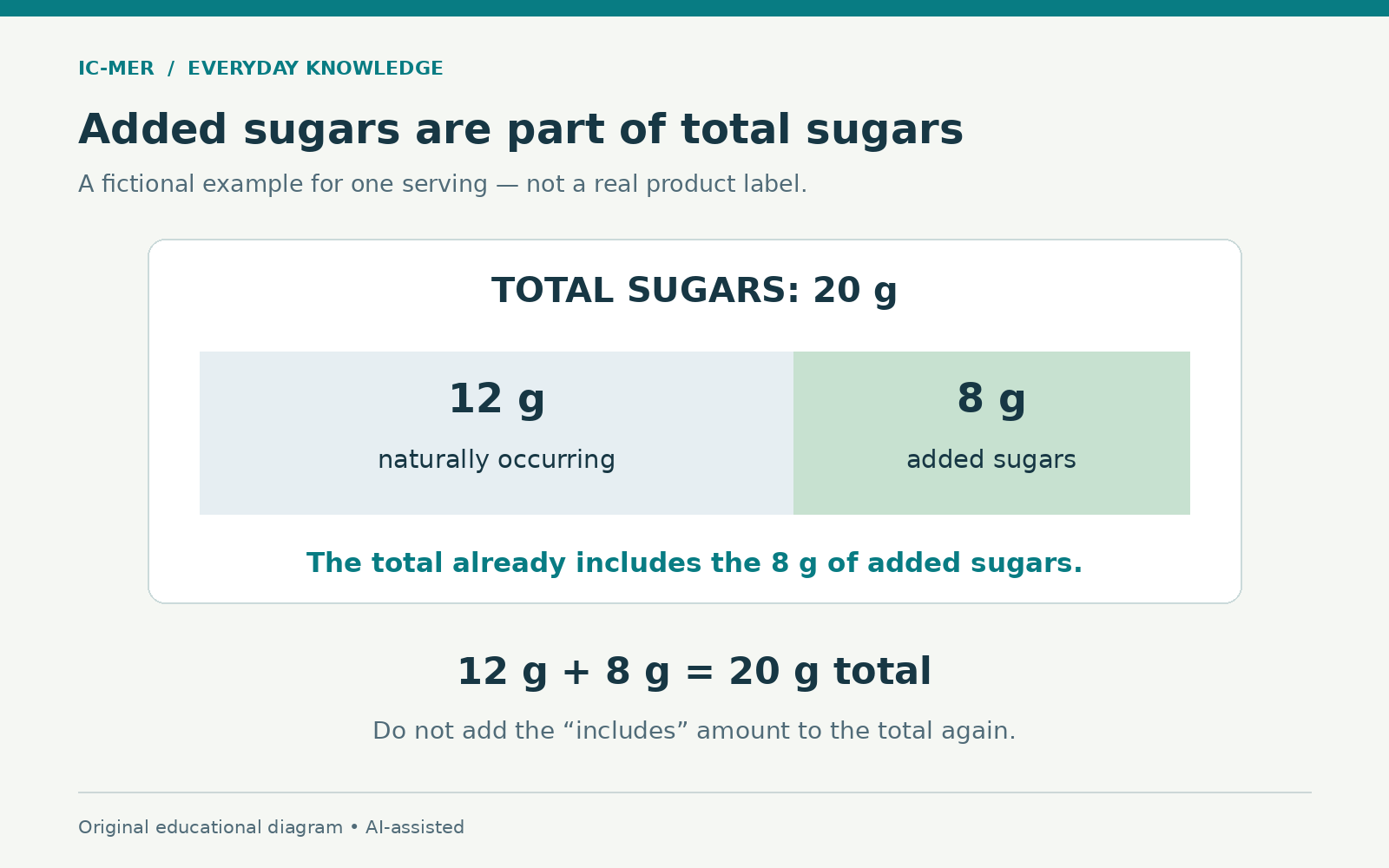
Total sugars includes both naturally occurring and added sugars. The added-sugars amount is included within the total, so do not add the two lines together. Plain milk or fruit can contain sugar without that sugar having been added during manufacture.
The ingredient list answers a different question from the nutrient panel: what is in the food? A front-of-package slogan cannot replace either check. Nor does a long ingredient name, by itself, establish that a food is dangerous. Choose a specific question, such as whether a familiar snack contains your allergen, rather than trying to sort all ingredients into good and bad categories.
Sources: [1]
For allergies, read the whole relevant label every time
Do not rely solely on a separate Contains statement. FDA explains that major allergens may instead be identified within the ingredients. Recipes and labeling can change, so a previous safe purchase does not remove the need to check the current package.
Precautionary wording such as may contain is different from the required identification of ingredients. Its absence is not a guarantee against cross-contact. If information is unclear, do not guess; contact the manufacturer and follow the allergy plan agreed with your clinician. Label-reading advice cannot make an unsuitable food safe.
Sources: [4]
Make one useful change
At your next shop, choose two products serving the same purpose. Align their serving quantities, compare the nutrient most relevant to your goal, and check the price for the amount you will use. Keep whichever choice fits your needs rather than chasing a perfect label.
If counting and comparing makes eating distressing or excessively restrictive, simplify the routine and discuss that concern with a qualified professional. A label should help you make a practical choice, not become a test of personal virtue.
Sources & further reading
- FDA: How to Understand and Use the Nutrition Facts LabelChecked 2026-10-23
- FDA: Serving Size on the Nutrition Facts LabelChecked 2026-10-23
- FDA: The Lows and Highs of Percent Daily ValueChecked 2026-10-23
- FDA: Have Food Allergies? Read the LabelChecked 2026-10-23
About this article
Prepared with AI assistance and an AI fact-checking pass against the sources listed above. No human clinical review is claimed. Evidence may change; consult appropriate qualified professionals for decisions about your circumstances.
Spotted a problem? Suggest a correction.