Medicine · 9 min read
Systematic reviews and meta-analyses: a reader’s guide
A pooled estimate is useful only when the question, studies, methods and uncertainty deserve confidence. Here is how to read the evidence behind the headline.
General educational information, developed with AI assistance and AI review. Not individual medical advice, a diagnostic interpretation, or a human clinical review. Discuss personal testing and treatment decisions with a qualified healthcare professional.
Information may contain errors, omissions or outdated guidance. This article is general education, not individual medical or other professional advice. Verify important information before acting and consult an appropriately qualified professional. Never disregard medical advice, delay care or change treatment because of this article. See our accuracy disclaimer and terms.
Start with the review question, not the headline
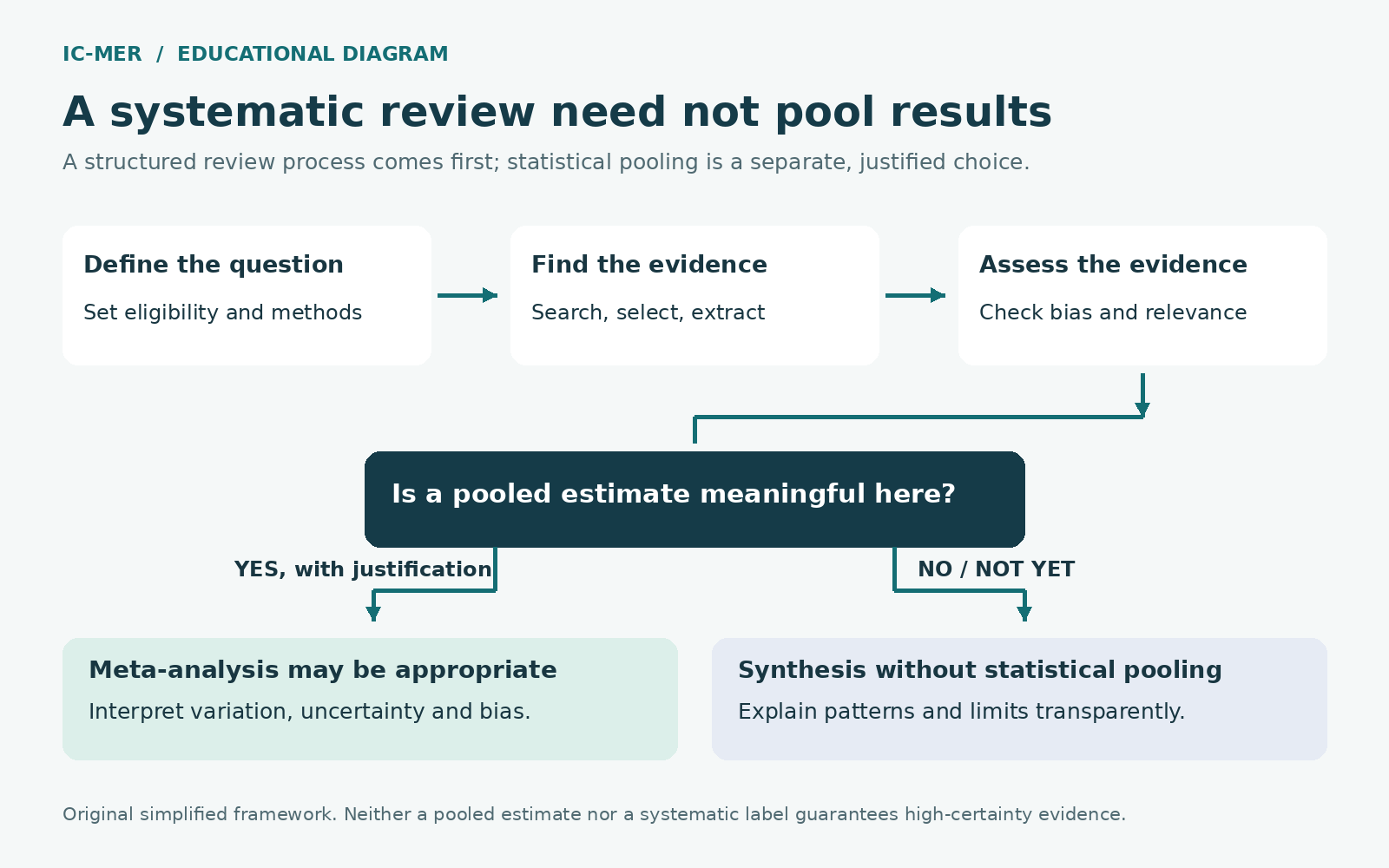
A systematic review uses explicit methods to find, select, assess, and summarize research addressing a defined question. A meta-analysis is a statistical combination of study results. A review can be systematic without combining results into one number, and a combined number does not establish that the underlying review was conducted well. Cochrane emphasizes planning methods in a protocol so that decisions are not quietly chosen to suit attractive findings.
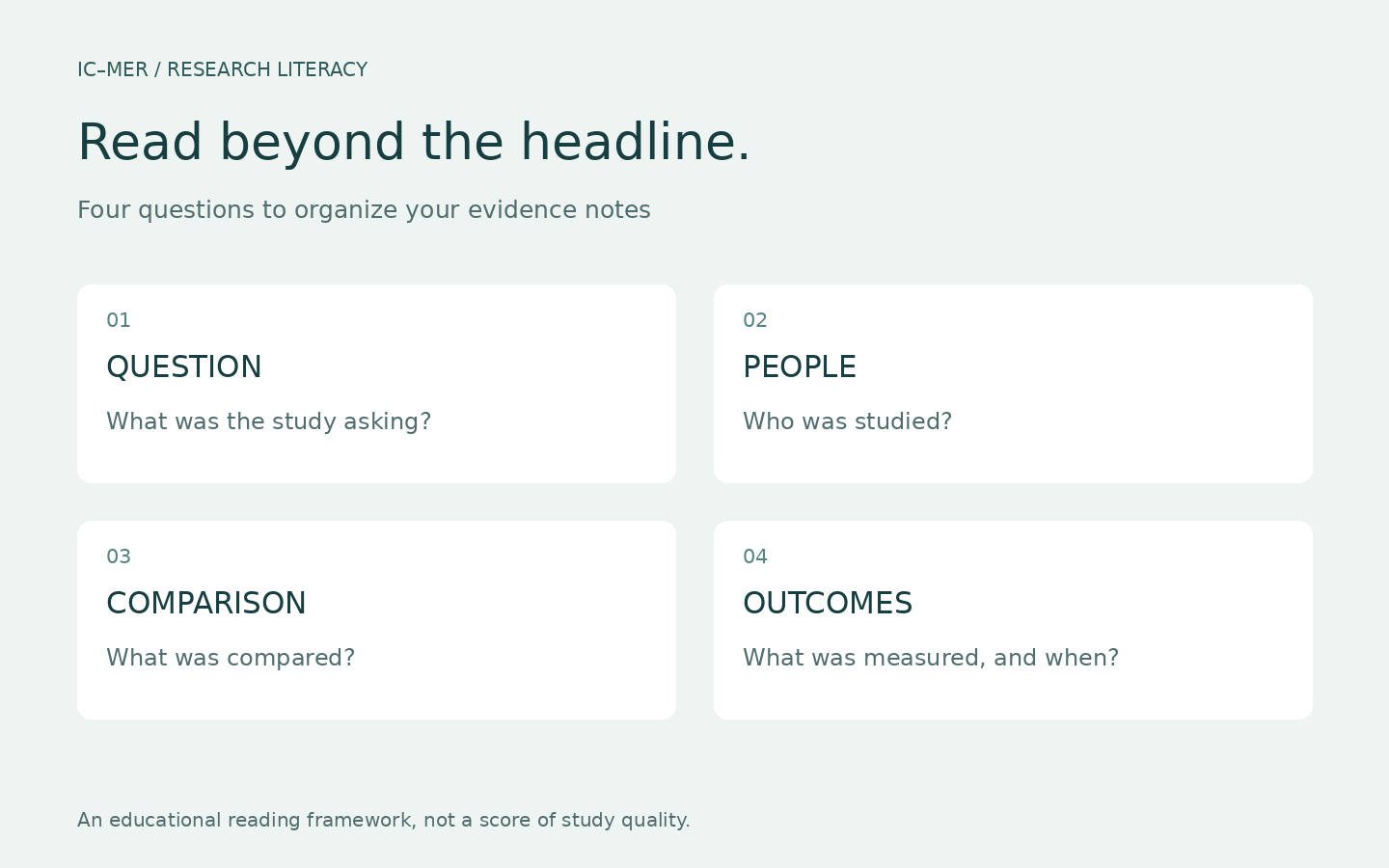
For a reader, the first task is practical: write down what decision you hoped the review would help with. Are you comparing two treatments, exploring harms, or asking whether a service improves access? Then compare your question with the review's actual question. A beautifully executed review of the wrong comparison will not answer your problem.
This guide focuses on intervention reviews. Diagnostic-accuracy reviews, qualitative syntheses, and other designs require additional methods. It teaches a reading process, not a complete manual for conducting a review or a substitute for professional interpretation of treatment evidence.
Translate the scope into a concrete comparison
The PICO framework organizes a question around population, intervention, comparator, and outcomes. Cochrane also stresses choosing appropriate study designs and planning synthesis groups. Check these elements in the methods, including follow-up duration and setting. An intervention's name alone is rarely enough: intensity, delivery, and accompanying care can matter.
Consider a fictional review of appointment reminders. You want to know whether a low-cost text message reduces missed visits in an adult community clinic. The review might instead include telephone calls, children's clinics, and several different reminder schedules. That is not automatically a flaw, but you need to know which part actually addresses your proposed service.
Make a one-line scope note: “Adults attending routine appointments; text reminder versus existing practice; missed visits over six months.” This is an original teaching example, not a real review question or evidence of effectiveness. If the paper measures satisfaction rather than attendance, keep those outcomes separate. A favorable satisfaction result cannot silently become proof that fewer appointments were missed.
Inspect how the evidence was found
Look for named databases, reproducible searches, search dates, selection procedures, and reasons for excluding full reports. Cochrane's search guidance includes trial registries and other sources beyond journal databases. Multiple papers can describe one study; counting papers as independent studies can duplicate evidence. A search's date also matters: the publication date of the review may be substantially later than its evidence search.
In the reminder example, imagine finding twelve papers but only eight distinct studies. Four papers could be follow-up reports or secondary analyses. Your evidence note should say eight studies, with the relevant outcomes traced to each. Ask whether unpublished or ongoing work was sought and whether language restrictions were explained.
You need not rerun the whole search to notice a reporting gap. Record “search strategy not available in the material I read” when appropriate. That is more defensible than concluding either that the search was complete or that the authors definitely omitted inconvenient evidence. Transparent uncertainty is part of careful reading.
Separate study limitations from reporting polish
Risk of bias concerns ways study design, conduct, or analysis can systematically distort an estimated effect. It is not the same as whether a paper is clearly written. Cochrane recommends considering bias within studies and in the synthesis, and examining funding and conflicts of interest. Larger samples can improve precision without repairing a systematic flaw.
For the fictional appointment project, ask who knew the allocated reminder type, how missed visits were recorded, and whether records were complete. These questions are prompts for examining the actual methods, not a declaration that a particular design is biased. A simple score out of ten would conceal which limitation could affect the outcome you care about.
Try writing a conditional sentence: “If follow-up records are missing differently between groups, the attendance comparison may be distorted.” Then see whether the review investigated that issue. This habit makes the concern testable and avoids dismissing a study merely because it is small, unfamiliar, or commercially funded.
Sources: [3]
Identify the number being combined
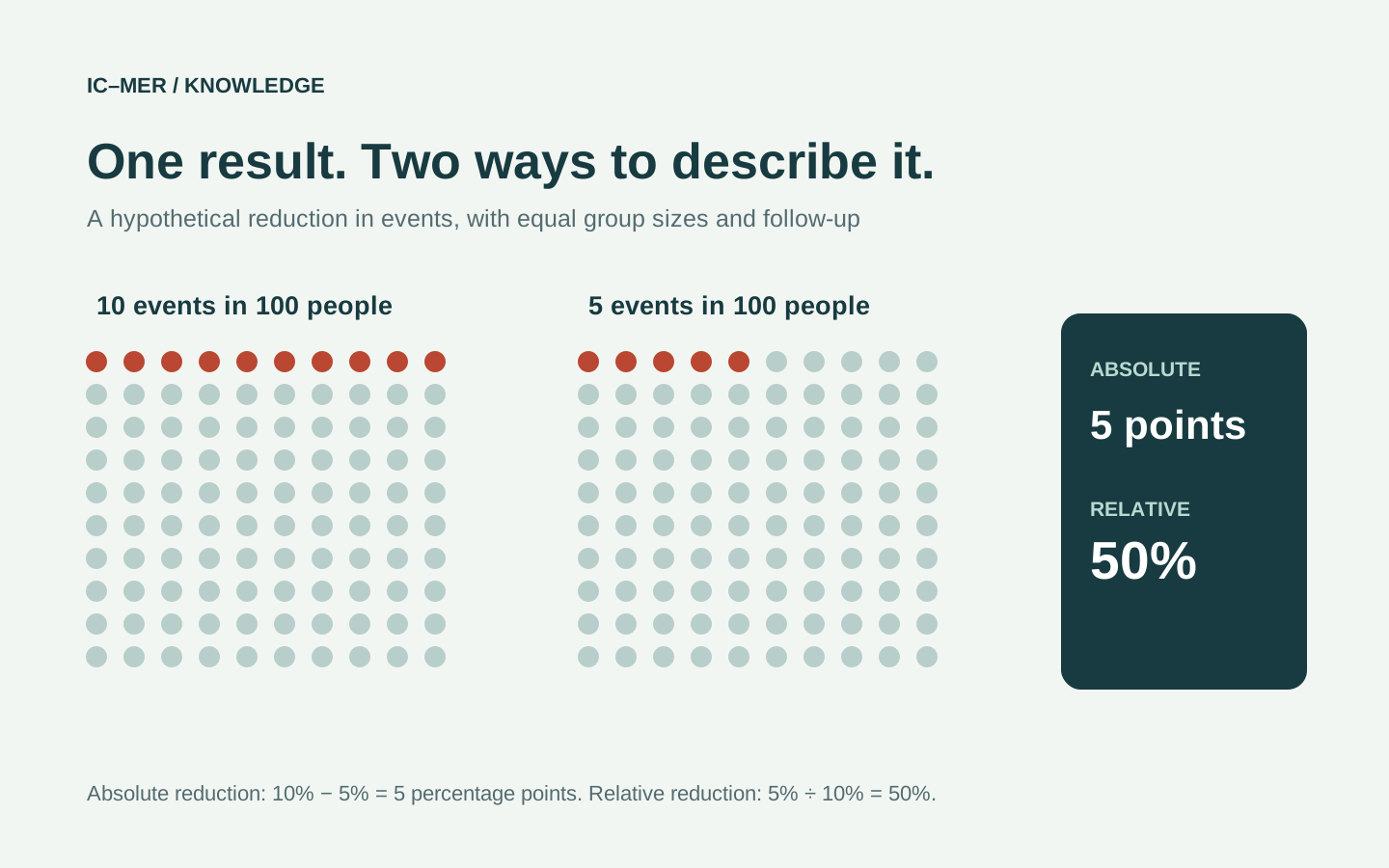
Different outcomes need different effect measures. A risk ratio compares event risks; a risk difference subtracts them. A mean difference compares measurements on a shared scale. A standardized mean difference expresses a difference in standard-deviation units, not directly in the original clinical units. Cochrane distinguishes ratio measures, with a no-difference value of one, from difference measures, with a no-difference value of zero.
Suppose a hypothetical service reduces missed visits from 20 per 100 appointments to 15 per 100. The risk ratio is 0.75 and the risk difference is minus five percentage points. These are two descriptions of the same invented comparison. Neither is a pooled estimate, and neither includes uncertainty because no actual study data are being supplied.
Write the outcome beside every number. “0.75” alone does not say whether the outcome is beneficial or harmful, or whether the statistic is a risk ratio, odds ratio, or something else. Also note whether the denominator is people or appointments; repeated appointments from the same person are not automatically independent observations.
Sources: [2]
Understand what pooling adds and what it cannot repair
Most conventional meta-analysis methods use a weighted combination of study estimates. Weights reflect the analysis method and information in the studies; the pooled result is not usually a simple average of percentages. Cochrane warns that pooling can mislead when bias, study differences, and reporting problems are overlooked. Sensitivity analyses explore how findings change under defensible alternative decisions.
For the reminder example, imagine one very precise study and three small imprecise studies. Counting favorable studies gives every study one vote, regardless of information. Pooling uses a different calculation. Neither approach can justify merging fundamentally different questions just to create an impressive total sample.
A useful request is: show the individual results as well as the summary. If a pooled estimate is presented without a clear account of its contributing studies, you cannot tell what the average summarizes. Read the methods before treating the largest number in the abstract as the most reliable piece of evidence.
Sources: [4]
Read a forest plot as a map of estimates
A typical forest plot displays a point estimate for each study and a horizontal confidence interval. A pooled estimate may appear as a diamond. First read the axis, effect measure, outcome, and direction labels; left and right do not have universal meanings. For a ratio measure, the no-difference line is one; for a difference measure, it is zero.
Use three passes. First identify the comparison. Next look across individual estimates and intervals. Finally inspect the summary and its uncertainty. This reading order discourages focusing on the diamond before understanding its ingredients. A neat graphic is a display, not evidence that the selection or analysis was sound.
If you cannot find the interval or do not know whether the outcome favors higher or lower values, stop the interpretation there. Ask for the missing context. The appropriate response to an unfamiliar plot is a precise question, not a confident statement that a result “proves” benefit.
Treat differences between studies as information
Studies may differ in participants, interventions, methods, and estimated effects. Random-effects models allow underlying effects to vary; their average and confidence interval do not describe all between-study variation. Cochrane notes that a prediction interval can help communicate that variation, and that few studies often limit investigations of its causes. A random-effects analysis does not automatically solve incompatibility.
Imagine reminders working differently in clinics with different baseline attendance patterns. Before inventing a biological explanation, check mundane possibilities: were the interventions actually delivered, were appointment types comparable, and were outcomes defined in the same way? These are questions to examine, not explanations established by the hypothetical example.
Avoid treating a single heterogeneity statistic as a pass-or-fail mark. Write the substantive differences alongside the statistical result. If only a few studies are available, an apparently tidy average may leave considerable uncertainty about a new setting.
Sources: [4]
When not pooling is a useful finding
A systematic review may use structured tables and other synthesis methods when a conventional meta-analysis is not possible or appropriate. Cochrane asks authors to describe what they actually did rather than merely label the synthesis “narrative.” Counting studies according to whether they pass a statistical-significance threshold is not an adequate substitute.
In the reminder example, suppose two studies report six-month attendance and another reports only satisfaction after one visit. A useful review can show these separately and explain what is missing. Producing no single pooled number can be more informative than producing a number whose meaning is unclear.
As a reader, ask whether every eligible study has a visible place in the account. A review that discusses only the most striking result may leave you unable to judge the rest. The goal is a transparent summary of the available evidence, with a method that fits the data.
Sources: [5]
Ask what evidence might be absent
An entire study or a particular outcome can be missing because its findings were considered disappointing or inconvenient. Cochrane describes how selective availability can bias a synthesis. Funnel-plot asymmetry has several possible explanations, so it is not by itself proof of publication bias. Searching widely helps but cannot guarantee that all relevant results become available.
For your reading note, distinguish “no study found” from “a study was identified but its relevant result was unavailable.” The second situation is especially important when a registry or protocol promised an outcome that the final report did not provide. Do not replace missing evidence with a guess about its direction.
An author statement that no reporting bias was detected should be read alongside the methods and amount of evidence. An inability to demonstrate a problem is not necessarily evidence that it is absent. Ask how the review's conclusion would change if important unavailable results differed from the published ones.
Sources: [6]
Read certainty separately for each outcome
GRADE uses four certainty levels: high, moderate, low, and very low. Cochrane describes assessments across risk of bias, inconsistency, indirectness, imprecision, and publication bias. The certainty judgment applies to a body of evidence for an outcome, rather than conferring one universal grade on the entire paper. Summary-of-findings tables bring effects, evidence quantity, and certainty together.
Imagine the reminder review has reasonably informative attendance evidence but sparse evidence about privacy concerns. You cannot transfer confidence in attendance to the less-studied outcome. Likewise, a precise result from a setting unlike your own raises an applicability question even if the arithmetic is impeccable.
Read the footnotes explaining certainty judgments. “Low certainty because the interval includes materially different effects” tells you something different from “low certainty because studies were poorly conducted.” Both may limit confidence, but they suggest different needs for future research. Recording the reason is more useful than memorizing the label.
Sources: [7]
Bring the review back to the decision
Cochrane's interpretation guidance stresses effects, uncertainty, benefits, harms, and the circumstances in which evidence will be used. A statistical threshold alone does not determine clinical importance. A review can inform a decision without resolving affordability, feasibility, personal preferences, or the best choice for an individual patient.
For the fictional clinic, finish with a short decision memo: what the review directly addresses, what remains uncertain, what local information is missing, and which outcome matters most. Perhaps staff capacity and patient contact preferences need checking before a pilot. That is an implementation question prompted by the evidence, not an effect demonstrated by it.
A practical reading sheet can contain eight entries: question, last search date, eligible studies, key limitations, effect measure, estimated effect and interval, certainty by outcome, and applicability. Leave an entry explicitly unknown when necessary. This is an original educational worksheet, not a validated scoring tool. It keeps the evidence visible while preventing a headline or a pooled number from making the whole decision for you.
Sources: [8]
Sources & further reading
- Cochrane Handbook, chapter 1: Starting a reviewChecked 2026-10-21
- Cochrane Handbook, chapter 6: Choosing effect measuresChecked 2026-10-21
- Cochrane Handbook, chapter 7: Considering bias and conflicts of interestChecked 2026-10-21
- Cochrane Handbook, chapter 10: Analysing data and undertaking meta-analysesChecked 2026-10-21
- Cochrane Handbook, chapter 12: Synthesizing findings using other methodsChecked 2026-10-21
- Cochrane Handbook, chapter 13: Assessing bias due to missing evidenceChecked 2026-10-21
- Cochrane Handbook, chapter 14: Summary of findings and certainty of evidenceChecked 2026-10-21
- Cochrane Handbook, chapter 15: Interpreting results and drawing conclusionsChecked 2026-10-21
- Cochrane MECIR: Setting eligibility criteria (C5-C13)Checked 2026-10-21
- Cochrane MECIR: Searching for studies (C24-C38)Checked 2026-10-21
- Cochrane MECIR: Selecting studies (C39-C42)Checked 2026-10-21
- Cochrane Handbook chapter III: Reporting the review (updated July 2026)Checked 2026-10-21
About this article
Prepared with AI assistance and an AI fact-checking pass against the sources listed above. No human clinical review is claimed. Evidence may change; consult appropriate qualified professionals for decisions about your circumstances.
Spotted a problem? Suggest a correction.