Business · 7 min read
Avoiding hidden costs in subscriptions and software
A small monthly price can hide a larger commitment. Use a practical checklist for seats, add-ons, trials, renewals, access and an eventual exit.
AI-assisted general business education, not individualized legal, tax, financial or cybersecurity advice. Prices and calculations are fictional examples. Verify current provider terms and seek qualified advice for material commitments or sensitive data.
Information may contain errors, omissions or outdated guidance. This article is general education, not individual medical or other professional advice. Verify important information before acting and consult an appropriately qualified professional. Never disregard medical advice, delay care or change treatment because of this article. See our accuracy disclaimer and terms.
Start with the job you need done
A software subscription often arrives as a small decision: one person needs to schedule appointments, send invoices, edit a document, or share a file. The price on the sign-up screen may look modest. The useful question is whether the complete arrangement fits your business, including the work required to start using it, keep it working, and eventually leave.
The SBA recommends identifying the assets a business actually needs before deciding how to acquire them. Apply that starting point to software by writing one sentence about the task: “We need two people to prepare estimates and export a monthly customer list.” Separate essential functions from interesting extras. That sentence gives you something concrete to test.
The following checklist is a practical decision aid, not a claim that every provider charges the same fees. Use the current quote and agreement for the exact product, plan, country, billing currency, and number of users you are considering.
Sources: [2]
Turn the headline price into a complete estimate
Create a short comparison sheet with a separate line for each possible charge. Ask whether the advertised price applies per user, per business, per location, or per unit of activity. Find out which users count as paid seats. A colleague who only approves invoices may be priced differently from someone who creates them, or may require the same license.
Ask about setup, importing old records, training, support, storage, extra messages, payment processing, and connections to other services. These are questions to investigate, not fees you should assume exist. Mark each item included, extra, not needed, or unknown. An unanswered question should stay visible rather than becoming a zero in your calculation.
Use one common comparison period and specify the assumptions beside it. For a seasonal business, a year may include several quiet months; for a short project, an annual commitment may extend beyond the work. Keep taxes, currency conversion, and financing costs visible where relevant instead of comparing one tax-inclusive offer with another offer before tax.
Sources: [2]
Work through a fictional example
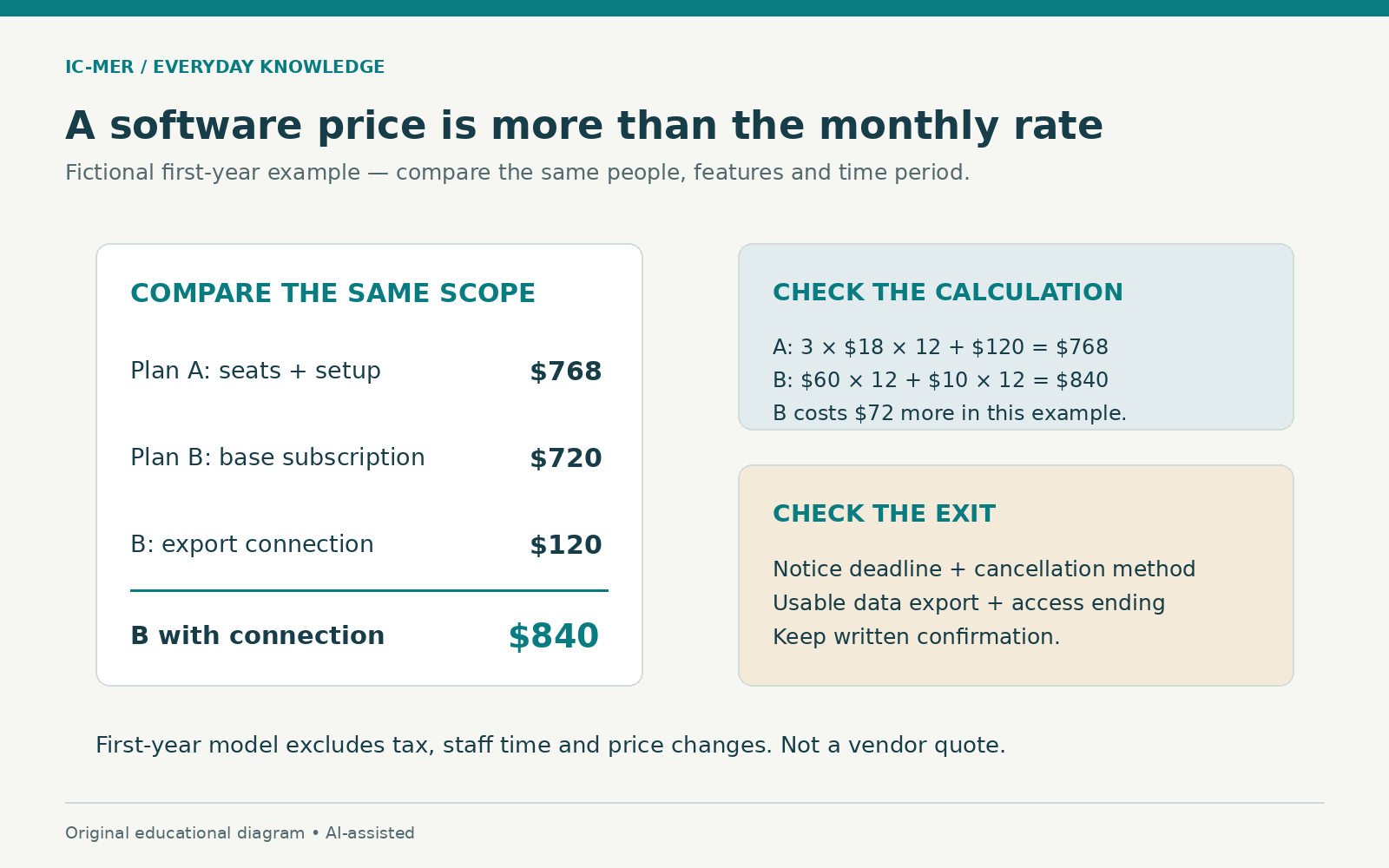
Imagine two offers that both meet a three-person team’s stated needs. Plan A costs $18 per person per month and has a $120 setup charge. At the same price for all twelve months, its first-year vendor charges would be 3 × $18 × 12 + $120 = $768. Plan B costs $60 per month for the team, with no setup charge, giving $720 for twelve months. On those assumptions, B costs $48 less in year one.
Now imagine Plan B requires a separate $10 monthly connection to export the records the team needs. Its total becomes $840, which is $72 more than A. These are invented prices, not market quotations or a recommendation. The example excludes tax, staff time, price changes, and any other charges. It shows why a required extra belongs in the comparison.
Also write down when payment is due. A provider might collect an annual amount upfront even when advertising an equivalent monthly figure. A lower annual total does not automatically make that cash payment manageable. Compare the commitment and payment timing as well as the calculated total.
Sources: [2]
Give a trial a purpose and an end date
The FTC’s consumer guidance warns that trials can become paid subscriptions and introductory prices can change at renewal. Before entering payment details, check the trial’s duration, the amount that follows, and the cancellation method. This article uses those practical cautions without assuming that consumer remedies apply to a business purchase.
Choose a small test using invented or appropriately approved information. For the estimating example, the test might be to create one estimate, revise it, export it, and ask the second user to find it. Record what works and what needs paid features. A successful demonstration should resemble the task your team actually performs.
Assign a person to make the keep-or-cancel decision before the deadline. Leave enough time to complete the required process and resolve a failed cancellation attempt. Save the offer, agreed terms, and confirmation rather than relying on a calendar reminder alone.
Sources: [1]
Read the commitment behind the billing interval
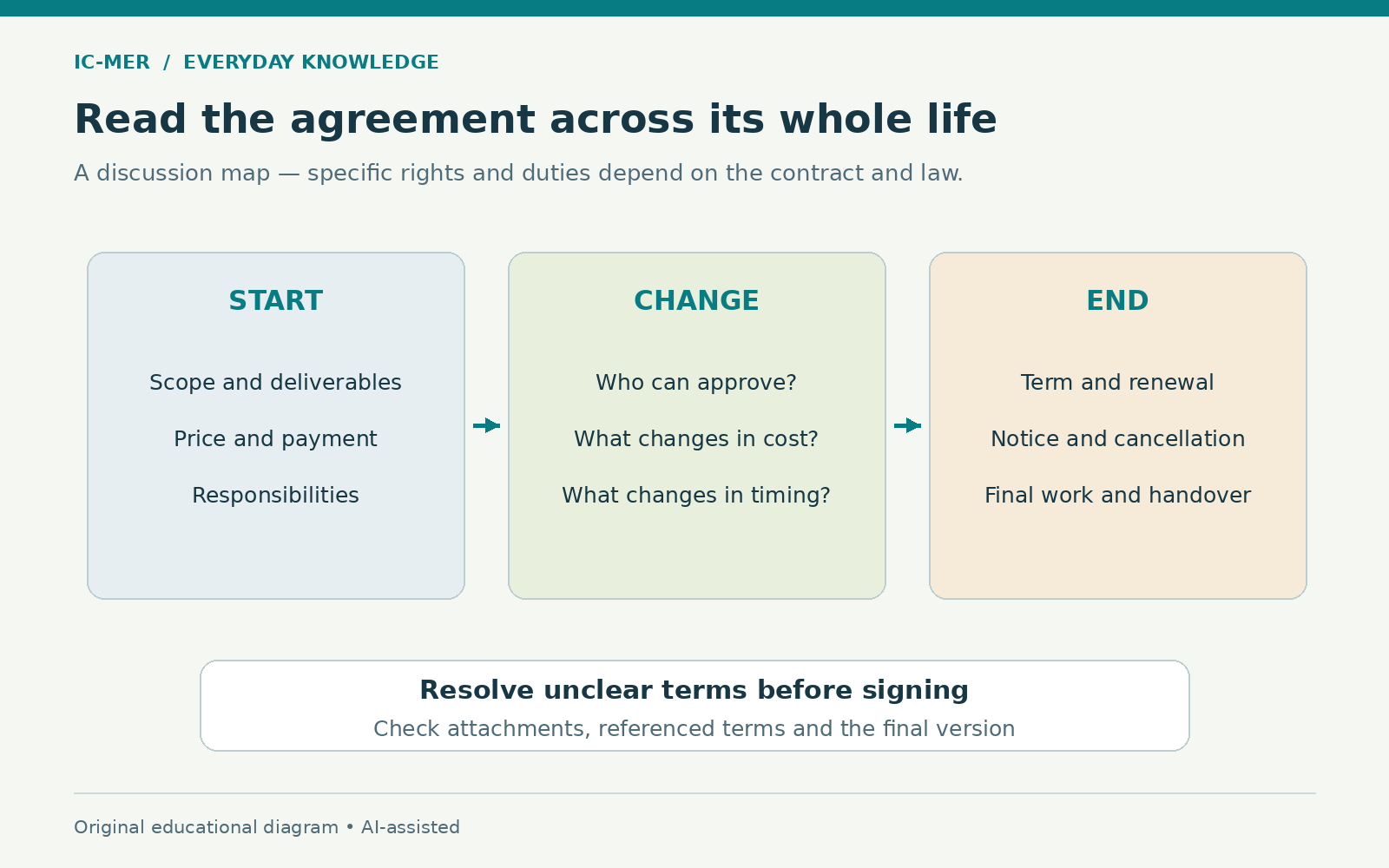
A monthly charge and a month-to-month agreement are different questions. Look for the initial term, renewal term, required notice, cancellation channel, and any remaining-payment or termination provisions. Ask for unclear wording to be explained in writing before signing. Do not infer a right to a refund from the fact that you stopped using the service.
Check what happens if you reduce users or downgrade. Make a note of when the change takes effect, what features or records become unavailable, and whether the provider adjusts an already-paid amount. Distinguish canceling future renewal from immediately closing the account; the practical consequences may differ.
For a substantial commitment, obtain qualified advice about unclear terms. Rights depend on the agreement and applicable law. A general article cannot establish that a particular business subscription must offer one-click cancellation, a cooling-off period, or a specific refund.
Include the work of running the software
Ask the person who will use the service to estimate the effort needed to move existing work, learn the process, and maintain it. Keep those hours separate from cash charges. An hour saved is useful capacity, but it does not necessarily produce an hour of additional paid work or an immediate reduction in payroll.
For example, a proposed change might require four hours to clean a customer list and two hours to teach the new process. Those six hours are planning estimates until tested. Name the person who will do the work and the other tasks that will wait. Repeat this exercise for a busy week, when support and simple recovery may matter more than extra features.
Identify overlap with tools you already pay for. Test whether an existing service can meet the essential requirement before adding another subscription. Conversely, do not remove a tool solely because two products have similarly named features; check the actual workflow and any records or connections that depend on it.
Sources: [2]
Treat account access as part of the purchase
NIST describes least privilege as limiting access to what a task requires. For a small team, that means deciding who needs to administer the account, who needs to edit work, and who only needs to view it. A lower price is not a reason to share one powerful administrator login among everyone.
The UK National Cyber Security Centre’s technical guidance for online software supports strong authentication, limited administrative access, and permissions matched to responsibilities. These are security principles, not a statement of US legal requirements. Ask which controls are available in the plan you are pricing and who will configure them.
Before connecting an app to your email, calendar, or file storage, examine the permissions requested. Confirm that the connection is needed for your chosen task. If sensitive customer or business information is involved, seek appropriate security and privacy advice before uploading it. A trial should not become an accidental commitment of confidential data.
Plan how you would leave
Before moving essential work, ask for a demonstration of the export process. Identify which records, attachments, dates, and history you need. Download a small approved sample and check whether you can open and understand it in a suitable alternative. “Export available” is not enough detail for your own exit plan.
Ask how long access remains after cancellation, what assistance costs, and what the provider says about retention and deletion. Keep a copy of the answers with the agreement. Plan for any required recordkeeping and privacy obligations before deleting information; canceling a subscription is not itself a complete records-management decision.
Write a short handover note: who owns the account, where the approved export is stored, which integrations need review, and who will confirm the replacement works. These are suggested operational steps, not a guarantee that every provider supports the same transfer process.
Sources: [4]
Keep renewals and invoices under control
Maintain a simple subscription register listing the service, business purpose, responsible person, payment method, commitment, renewal deadline, and cancellation instructions. Review it alongside actual charges. For each renewal, ask whether the service still solves the original problem, how many people use it, and whether the agreed plan has changed.
The FTC warns businesses about fake invoices and messages that create urgency. Match a renewal request to your own register and agreement before paying. Reach the provider through contact details you already trust, rather than a link or phone number in an unexpected demand. Clear purchase approval procedures help staff know when to pause.
When you cancel, keep confirmation and check subsequent statements. If a charge is unexpected, contact the provider and payment issuer promptly through verified channels; applicable dispute options and deadlines vary. A useful subscription decision ends with a named owner, an understood cost, and a practical next review date—not simply a completed sign-up screen.
Sources & further reading
- FTC: Getting In and Out of Free Trials, Auto-Renewals, and Negative Option SubscriptionsChecked 2026-10-25
- SBA: Buy assets and equipmentChecked 2026-10-25
- NIST: Least privilegeChecked 2026-10-25
- UK National Cyber Security Centre: Using Software as a Service securelyChecked 2026-10-25
- FTC: Scams and Your Small BusinessChecked 2026-10-25
About this article
Prepared with AI assistance and an AI fact-checking pass against the sources listed above. No human clinical review is claimed. Evidence may change; consult appropriate qualified professionals for decisions about your circumstances.
Spotted a problem? Suggest a correction.