Business · 10 min read
Reading a service contract before signing
The price is only one part of a service agreement. Use a structured reading process to discover what you are buying, what you owe and what happens if plans change.
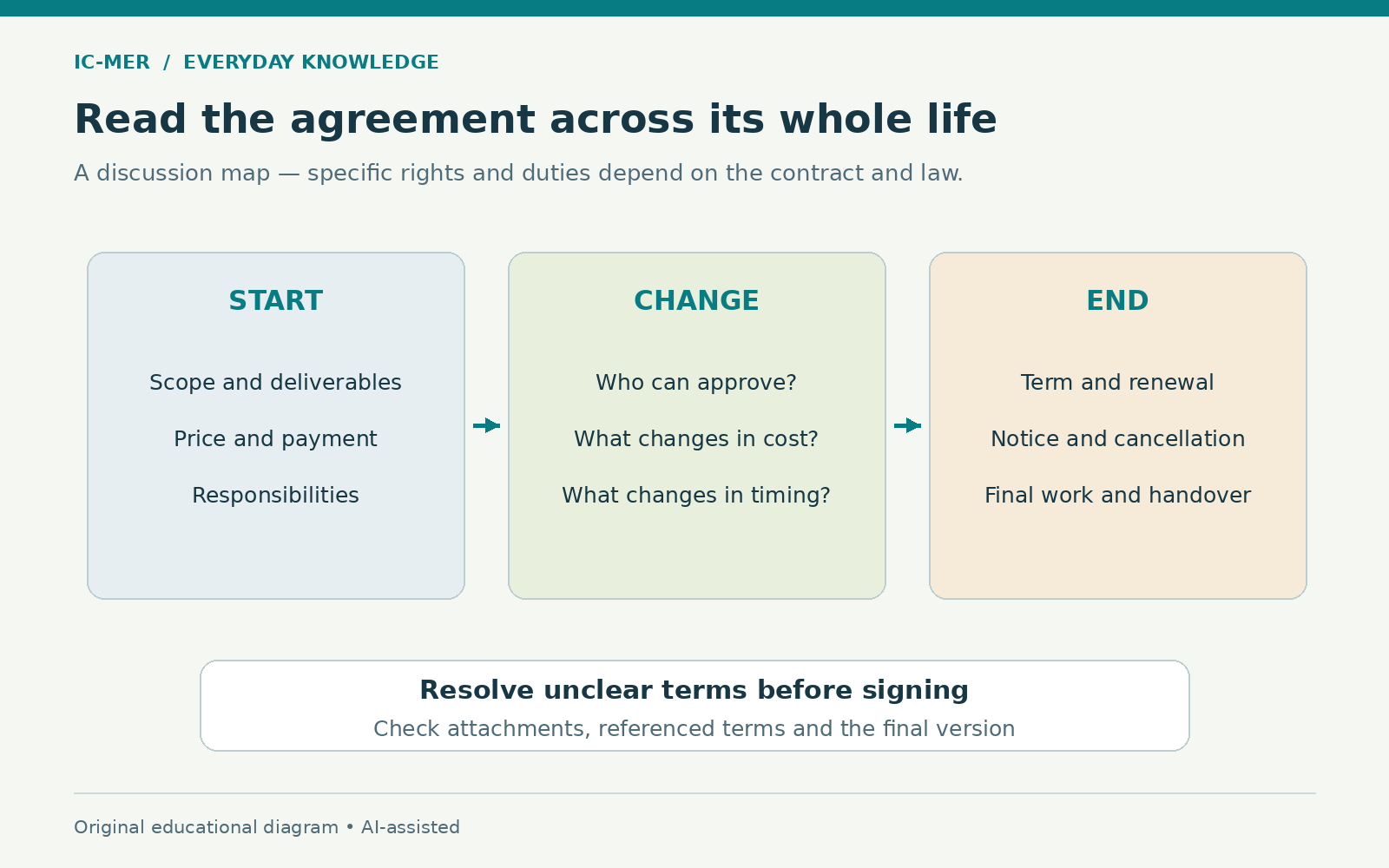
Prepared by the IC-MER Editorial Team with AI assistance. General education, not legal advice or a contract template. Examples and review questions are illustrative. A qualified lawyer must assess your agreement, jurisdiction, rights and obligations.
Information may contain errors, omissions or outdated guidance. This article is general education, not individual medical or other professional advice. Verify important information before acting and consult an appropriately qualified professional. Never disregard medical advice, delay care or change treatment because of this article. See our accuracy disclaimer and terms.
Start with the decision the contract is supposed to serve
A service contract may arrive after you have already decided that a supplier seems helpful. The demonstration went well, the price looks manageable and you want to get started. That is precisely when it helps to slow down. The agreement may address months of payments, access to business information or the cost of ending a relationship that no longer works.
Start by writing a plain-language sentence about what you want: for example, “I need someone to maintain our website and help us recover it if something breaks.” Then compare that goal with the proposed service description. The exercise is a practical reading aid, not a test of enforceability. A contract can contain details that require professional interpretation even when its headline sounds simple.
This guide offers an editorial review workflow for everyday service purchases. It does not supply clauses to copy or tell you which provisions a court would enforce. Use it to organize questions before signing. Seek a lawyer's advice when you do not understand the agreement or when a mistake could expose your business, home, livelihood or sensitive information to significant loss.
Collect every document that forms the deal
Ask for the complete proposed agreement, including schedules, order forms, price lists and documents incorporated by reference. If the cover page points to terms on a website, open those terms rather than assuming the first page contains everything important. Save a dated copy of the material you are reviewing so that later discussions refer to the same version.
Make a short document list and check whether it matches the pages you received. For example, a proposal may promise monthly support while a separate service schedule defines support more narrowly. Flag any conflict and ask which document controls. Do not resolve the conflict simply by choosing the interpretation you prefer; request a clear answer in the agreed final paperwork.
Treat the sales conversation as the beginning of a clarification process. If a promise matters to your purchase, ask how it will be reflected in the agreement. Keep correspondence, but do not assume an informal assurance will override the signed wording. Ask counsel about the effect of clauses addressing the entire agreement, amendments or reliance on earlier representations.
Check who is promising to do what
Identify the legal names of the parties and the contact responsible for the work. If a familiar brand appears at the top, check which entity actually provides the service and receives payment. For a business purchase, establish who has authority to approve the agreement on your side. A person handling scheduling may not be the person authorized to make contractual commitments.
Ask whether work can be subcontracted and, if so, how you will know who has access to your premises, accounts or information. Consider whether you need particular qualifications or licenses for the activity involved, and verify those through the relevant official source. A polished website or an insurance logo is not an independent check of the supplier's suitability.
These are due-diligence questions rather than universal conditions that every agreement must contain. A one-time cleaning visit and a complex payroll service have different risks. Focus on what would matter if the named contact left, the supplier changed ownership or another worker arrived to carry out the job.
Translate the scope into observable work
Highlight the description of the service. Can you tell what will be delivered, how often, to whom and in what form? Replace vague expectations in your own notes with questions. If the agreement says “ongoing support,” ask whether that means answering questions, fixing defects, performing updates or all three. Ask what is excluded and how an excluded task would be priced.
For work with a finish point, ask how completion will be demonstrated and how you can raise a concern. A useful discussion might cover a review period, the person authorized to accept the work and the process for correcting a missed requirement. The appropriate arrangement depends on the project; this is not a recommendation to use a particular acceptance clause.
Also identify what the supplier needs from you. You may have to provide content, access, decisions or suitable working conditions. Record realistic responsibilities and ask what happens when either side is late. A timetable that ignores your own approval workload is not a reliable planning tool, however attractive the proposed delivery date sounds.
Work out the cost over the intended period
Do more than circle the monthly price. List setup charges, recurring fees, usage-based charges, required extras and possible exit costs. Ask whether quoted figures include applicable taxes and which costs are estimates. If pricing depends on hours, users or transactions, work through a plausible busy month and ask how you will be warned before spending increases.
Consider a fictional service with a $240 setup fee and a $95 monthly charge for twelve months. Its stated base cost for that period is $1,380: $240 plus twelve payments of $95. That calculation excludes any taxes, optional work or other charges not specified in the example. It is a comparison exercise, not a claim about an actual supplier or a recommendation to accept those terms.
Compare alternatives using the same time period and assumptions. An apparently cheaper monthly plan may have a longer commitment or a separate onboarding charge. Ask how price changes are communicated and whether they affect your ability to leave. Do not assume a verbal promise that prices “usually stay the same” answers the written price-change provision.
Find the start, renewal and exit provisions
Locate the service start date, initial term and any renewal mechanism. Ask whether the arrangement ends automatically, continues until cancelled or renews for another fixed period. Note any deadline for giving notice and the required method. An email to your usual contact may not be the method the agreement specifies; clarify the process before you need to use it.
Read what happens if you want to end early, if the supplier fails to perform or if circumstances make the service unnecessary. Ask about charges, deposits, unfinished work and return of materials. Distinguish your preferred outcome from an established right. A clause labeled “cancellation” does not by itself show that every customer can leave without cost.
Do not count on a universal three-day escape period. The FTC's Cooling-Off Rule covers certain sales and has substantial exclusions, including transactions made entirely online, by mail or by telephone. Coverage also depends on the purchase and setting. Florida's Bar likewise cautions against assuming an automatic right to cancel. Obtain advice about the exact transaction promptly if cancellation becomes necessary.
Understand the risk clauses before you need them
Set aside any passage you cannot explain in ordinary language, particularly provisions dealing with liability, indemnity, warranties, guarantees or remedies. Instead of guessing, ask a lawyer what practical exposure it creates for you. Consider a concrete scenario: the service is unavailable on a busy day, a worker damages equipment or a deliverable does not do what was expected. Which provisions would matter?
Ask whether a proposed limit or exclusion would leave you carrying a loss your business could not absorb. If insurance is relevant, ask an appropriate professional how the actual coverage and contractual obligations fit together. A certificate or policy reference does not answer every coverage question. Avoid treating a promise to carry insurance as a guarantee that a particular claim will be paid.
The Florida Bar explains that contractual wording can affect available remedies, legal costs and dispute procedures. That is a reason to obtain interpretation before accepting unfamiliar terms, not a reason to assume every harsh-looking provision is invalid. A supplier's willingness to explain a clause can be useful, but their explanation is not independent legal advice about your interests.
Sources: [1]
Read the dispute process as part of the price
Find the provisions about how disagreements are handled. The contract may discuss notice, negotiation, mediation, arbitration or court proceedings. The Florida Bar notes that agreements can address the forum, jury rights and allocation of attorney fees. A lawyer can explain what the particular wording would mean in your situation and whether any exceptions or legal restrictions apply.
For your own planning, ask where a dispute would take place, what steps come first and what records you would need. Consider whether travel, technical expertise or time away from work would make a relatively small disagreement costly to pursue. These practical questions can affect the value of the arrangement even before there is a dispute.
Do not sign on the assumption that you will sort out the dispute clause later. Nor should you decide that a clause is harmless because it appears in small print or is described as standard. If the agreement is already signed and trouble develops, seek advice promptly; this article does not establish a deadline for taking action.
Sources: [1]
Protect information and access throughout the relationship
Some service providers need access to customer records, financial systems or administrative accounts. Ask what information is actually needed, who can access it and how access will be removed when the work ends. For a limited task, question whether the provider needs ongoing administrator privileges or a full copy of every customer record.
The FTC advises businesses to examine providers' security practices, put security expectations into contracts and verify performance. Its guidance also calls for notification of security incidents. Use those principles to start a specific conversation about your service rather than relying on a vague assurance that the provider takes security seriously.
Ask who handles backups, exports, incident contact and return or disposal of information. Identify any sector-specific obligations with qualified advisers. For example, a routine office service and a service handling regulated health or financial information may raise different requirements. Signing a confidentiality paragraph alone is not proof that the overall arrangement meets every applicable privacy or security rule.
Sources: [3]
Check ownership, handover and continuity
If the service creates something you will need later, ask what you will receive when the relationship ends. Depending on the project, that might include final documents, editable files, account access, manuals or a data export. Ask about ownership and permitted use instead of assuming that payment automatically gives you every right you expect.
Work through a practical handover scenario. If you change suppliers, can you obtain your records in a usable format? Who controls a domain registration or important account? Is transition assistance included or priced separately? These questions are particularly useful when a service becomes part of everyday operations and replacing it would be disruptive.
For example, a fictional shop owner hiring a website maintainer might request an explanation of who holds the hosting account, how backups can be restored and how access is transferred. That is a proposed discussion checklist, not a model legal clause. A qualified adviser can help translate the answers into an arrangement suited to the actual work.
Use a question log and compare the final version
Keep a simple review log with the page or clause, your question, the supplier's response and whether the final document resolves it. Separate issues that determine whether you can proceed from preferences you might negotiate. A missing definition of the service may be essential; a preferred meeting day may be flexible. Deciding this in advance makes the discussion more focused.
When a revised agreement arrives, compare it with the version you reviewed. Check more than the paragraph you asked to change: dates, prices, attachments and cross-references can also move. Make sure blanks are appropriately completed and that the package you are asked to accept is the package you intended to accept. Retain an exact copy of the final agreement.
If you use a digital summarization tool, treat its output as a reading aid. It can omit an exception or misread a cross-reference. Do not upload confidential material to a service unless you have established that doing so is appropriate, and do not replace qualified legal advice with a generated summary. The important decision rests on the actual agreement.
Turn the signed agreement into a usable operating record
After signing, put the agreement where the person administering the service can retrieve it. Record renewal and notice dates, named contacts, payment milestones and agreed responsibilities. Limit access to sensitive material appropriately. A contract that nobody can find when a question arises is much less useful as an operating record.
Schedule a practical review before major decision points, leaving time to seek advice or compare alternatives. If the service changes, ask how the change should be documented rather than assuming a new routine has rewritten the agreement. Keep approved amendments and relevant correspondence connected to the original record.
A useful final check is whether you can explain the purchase to someone else: what you are getting, what you will pay, what you must provide, what happens if performance disappoints and how the relationship ends. Any unanswered question is worth addressing before you commit. Understanding those practical points does not guarantee a good outcome, but it gives you a clearer basis for deciding whether to proceed.
Sources & further reading
- The Florida Bar: Legal and Binding ContractsChecked 2026-10-24
- FTC: Buyer’s Remorse — The Cooling-Off Rule May HelpChecked 2026-10-24
- FTC: Protecting Personal Information — A Guide for BusinessChecked 2026-10-24
About this article
Prepared with AI assistance and an AI fact-checking pass against the sources listed above. No human clinical review is claimed. Evidence may change; consult appropriate qualified professionals for decisions about your circumstances.
Spotted a problem? Suggest a correction.