Business · 7 min read
Managing a small-business purchase: compare total costs
A cheaper machine or software plan may cost more to use. Build a fair comparison before making the commitment.
AI-assisted educational content, not individualized financial, accounting, tax or legal advice. All cost examples are fictional. Obtain current written terms and qualified advice for your business before committing.
Information may contain errors, omissions or outdated guidance. This article is general education, not individual medical or other professional advice. Verify important information before acting and consult an appropriately qualified professional. Never disregard medical advice, delay care or change treatment because of this article. See our accuracy disclaimer and terms.
Start with the job the purchase must do
A low advertised price can make a business purchase feel straightforward. Then come delivery, setup, training, replacement supplies and a subscription needed to use a key feature. Before choosing a machine, computer system or paid service, describe what the business needs it to accomplish and what successful use would look like.
Write down the required capacity, the tasks it must handle and any compatibility or safety requirements. A small shop might need to print a particular number of labels each week using its existing order system. A faster machine is not automatically better if it adds complexity without solving a real constraint.
SBA recommends identifying the assets a business needs before deciding how to acquire them. Turn that into a short purchasing brief that can be sent to each potential supplier. Keep optional features separate from essential ones so an attractive demonstration does not quietly rewrite the purpose of the purchase.
Sources: [1]
Compare the same period and the same level of service
Choose a period that makes sense for the decision, then use it consistently across options. A two-year comparison can be useful for a short commitment, but it is not the full lifetime cost of equipment expected to last much longer. Label the horizon plainly and note any commitments or useful life extending beyond it.
Ask each supplier what is included. Does installation mean delivery to the door or a working system? Is training included for everyone who needs it? Does the quoted software price cover the number of users, transactions or locations you expect? Record exclusions as visibly as included services.
Use identical assumptions where the options are genuinely comparable, such as workload and operating hours. Where they differ, show the difference explicitly. A cheaper offer without necessary support should not be treated as equivalent to one with support simply because both have the same product category on the invoice.
Build the cost list from arrival to retirement
Organize the comparison into getting started, regular use, occasional expenses and exit. Getting started might include freight, installation, electrical work, data migration and staff training. Regular use might involve energy, consumables, subscriptions and scheduled servicing. Occasional expenses may include replacement parts or call-out charges.
At the end, consider removal, disposal, return freight, data export or a final buyout payment. A possible resale value belongs in a separate, clearly labeled estimate; do not treat it as guaranteed money. Ask whether a quote expires or a recurring price can change during your chosen comparison period.
The Department of Energy's life-cycle-cost guidance includes equipment and installation, energy, maintenance and disposal. Its purchasing requirements apply to federal buyers, rather than automatically to an ordinary small business. The underlying comparison principle is useful more broadly: the purchase price is only one part of what a product costs to own and use.
Sources: [2]
A fictional comparison where the lower sticker price loses
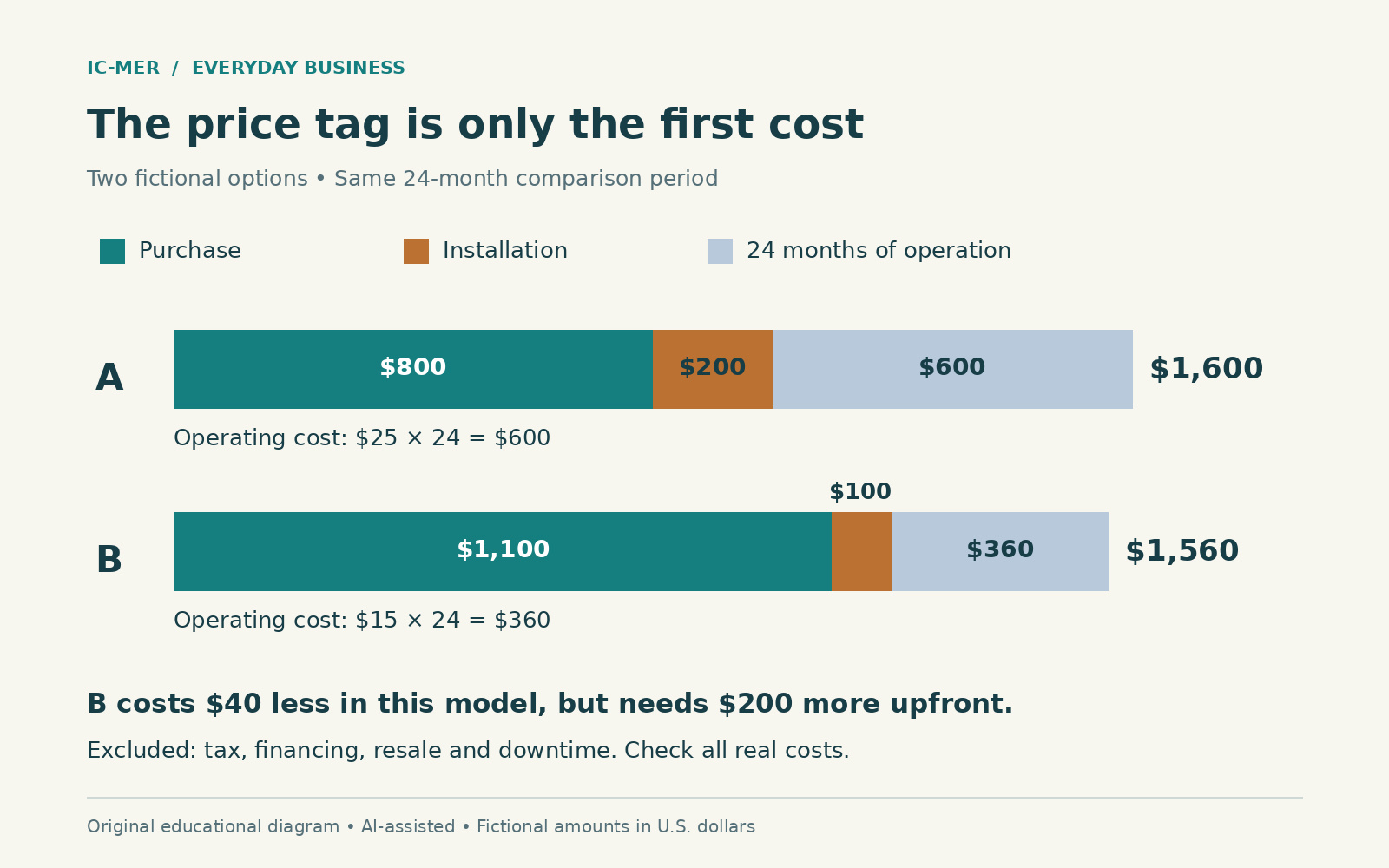
Consider two invented equipment offers for the same workload over 24 months. Option A costs $800 to buy, $200 to install and an estimated $25 a month to operate. Its simplified total is $800 + $200 + (24 × $25), or $1,600.
Option B costs $1,100 to buy, $100 to install and an estimated $15 a month to operate. Its simplified total is $1,100 + $100 + (24 × $15), or $1,560. In this example, B costs $40 less over two years, although its upfront purchase-and-installation cost is $200 higher.
These are fictional arithmetic examples, not quotations or predictions. They exclude taxes, financing, resale and downtime; a real comparison must add relevant differences. The monthly figures are assumptions. If workload or running costs change, the result can change. A $40 modeled advantage is too small to justify ignoring uncertainty, service quality or the business's immediate ability to pay.
Check what happens when an assumption is wrong
Ask which uncertain figure could reverse the decision. If the comparison depends on using equipment every working day, calculate a quieter case as well. If savings depend on a particular supply price, ask whether compatible supplies are available from more than one source and how frequently they are replaced.
For a subscription, look beyond the introductory rate. Price the number of users and volume you actually expect, including any required add-ons. Ask about renewal pricing, minimum terms, cancellation notice and what happens to your records when the service ends. Get important answers in writing.
Do not give speculative benefits the same certainty as an invoice. A supplier's claim that a tool saves several hours each week needs testing against your workflow. If a demonstration is available, use a representative task and record the result. Separate observed performance, supplier claims and your own estimates on the comparison sheet.
Consider reliability and the cost of interruption
Ask what happens if the purchase cannot do its job on a busy day. Find out how repairs are requested, who pays transport, what the service arrangement actually promises and whether replacement equipment is available. A response target is not necessarily a promise that the equipment will be working by that time.
Document the practical fallback. Could work be done manually, rented equipment used, or orders sent to another provider? Price a realistic alternative if possible. You need not invent a precise cost for every possible failure; a clear unresolved risk is better than a confident but unsupported number.
Include the time needed to learn and maintain the system. A modestly priced product can demand substantial staff attention, while a more capable product may be difficult to operate consistently. Ask the people who will use it to try the relevant tasks. Their feedback can reveal costs that are absent from the supplier's price list.
Keep affordability separate from total cost
The least expensive option over a chosen period may still be unaffordable at the moment of purchase. Put the deposit, delivery payment and first recurring charges on the business's payment calendar. Check them against existing commitments and genuinely available funds before assuming the comparison's winner is a workable choice.
If borrowing is involved, compare the actual financing terms, including interest, fees, payment dates and any final payment. SBA notes that financing can spread the cost while adding fees and interest. Obtain the full schedule rather than evaluating the arrangement only by its monthly payment.
Avoid counting the same purchase twice. In a cost comparison, do not add both the full purchase price and the principal portions of loan repayments as if they were separate costs. A cash-flow schedule may instead track the actual deposit and repayments over time, with any remaining debt clearly shown. Ask an accountant for help if the comparison becomes complicated.
Sources: [1]
Evaluate leasing as its own offer
A lease or rental can make sense when needs are uncertain or equipment is needed temporarily, but compare its actual obligations with buying. Ask what happens at the end: return, renewal, purchase option or another arrangement. Include required return condition, collection costs and any charges for exceeding agreed use.
SBA points out that lease details vary, maintenance may be included and leaving early can bring penalties. Read the specific offer. Do not assume that every lease includes repairs or that a low payment means the business can stop using and paying for the equipment whenever it wants.
Keep tax claims out of the initial sales comparison until they have been checked for your circumstances. The IRS explains that an equipment agreement's treatment can depend on whether it is a lease or a conditional sale, judged from the agreement and circumstances. A label on a brochure does not settle that question. Seek qualified advice before relying on an advertised deduction.
Make the decision easy to explain later
Keep a short decision record with the need, alternatives, comparison period, cost assumptions and reason for choosing. If you select a higher-cost offer because it provides necessary compatibility or more dependable support, say so. The purpose is a reasoned decision, not forcing every useful difference into an artificial dollar figure.
Before committing, confirm the exact product or service version, delivery date, acceptance process, warranty terms, return conditions and responsibilities for setup. Save the written quotation and final agreement together. For a substantial or unfamiliar commitment, have appropriate technical, accounting or legal help review the parts outside your expertise.
After installation, compare actual use and bills with the assumptions. Cancel optional extras only under their applicable terms and document problems while they can still be addressed. This follow-through turns one purchase into useful experience for the next: what the business needed, what it paid and which promised benefits actually appeared.
Sources & further reading
- SBA: Buy assets and equipmentChecked 2026-10-24
- U.S. Department of Energy: Take Five—Life Cycle Costs for AcquisitionChecked 2026-10-24
- IRS: Income & Expenses 7—Equipment leases and conditional salesChecked 2026-10-24
About this article
Prepared with AI assistance and an AI fact-checking pass against the sources listed above. No human clinical review is claimed. Evidence may change; consult appropriate qualified professionals for decisions about your circumstances.
Spotted a problem? Suggest a correction.