Business · 7 min read
Building an emergency reserve for a small business
Give your reserve a specific job: keeping essential business operations funded when an unexpected interruption arrives.
AI-assisted educational content, not individualized financial, tax, legal or insurance advice. Examples are fictional planning exercises. Verify account terms and business-specific obligations with qualified professionals.
Information may contain errors, omissions or outdated guidance. This article is general education, not individual medical or other professional advice. Verify important information before acting and consult an appropriately qualified professional. Never disregard medical advice, delay care or change treatment because of this article. See our accuracy disclaimer and terms.
Give the reserve a job before choosing a number
A broken machine, an unexpected closure or a major customer paying late can interrupt a business that normally operates comfortably. An emergency reserve is money deliberately kept available for such disruptions. Its usefulness comes from what it can pay for, how quickly it can be accessed and the decisions it allows you to make.
Start with a sentence: this reserve will help us keep essential commitments while we recover from a named interruption. That is more useful than copying another owner's savings target. A mobile service, an online shop and a premises-based business may have very different recovery needs.
This article focuses on the business's continuity, rather than the owner's household budget. The planning exercises are suggestions, and the numbers are fictional. They do not establish a required reserve amount or promise that saving alone can protect a business from every loss.
Sources: [1]
Choose a disruption you can describe
Identify two or three plausible events. For example, a specialist printer could fail just before a busy period, a storm could make the premises inaccessible, or one large customer could delay payment while smaller orders continue. Name what stops, what can continue and how long you would need to investigate or arrange a workaround.
SBA's emergency-preparation guidance begins with assessing a business's particular vulnerabilities and building a response plan around its operations. Apply that idea to money: connect a possible disruption to actual payments instead of selecting a round savings amount without an explanation.
Separate an interruption from a predictable cost. An annual license renewal or a regularly quiet trading season belongs in the ordinary plan. Equipment that is nearing the end of its expected life deserves a replacement budget. If every foreseeable bill becomes an emergency, the reserve will never have a clear purpose.
Sources: [1]
List the payments that keep the business viable
For each scenario, list obligations by due date. Include premises costs, necessary utilities, required debt payments, insurance, essential supplier commitments and applicable payroll obligations. Check what actually continues during a closure. Some purchasing may stop, while other costs remain even when the business is unable to serve customers.
Then add the expenses of getting back to work. You might need a repair assessment, temporary equipment, a safe alternative workspace or a delivery arrangement. Ask for current estimates when possible. Label an unsupported guess clearly so you know which figure needs attention first.
Keep legal and contractual commitments separate from optional spending. This exercise does not authorize withholding wages, skipping payments or cancelling agreements without consequences. If you are unsure what can be changed, get appropriate advice. A realistic reserve plan reflects obligations as they stand, with any negotiated change counted only after it is confirmed.
Sources: [1]
Work through one fictional funding gap
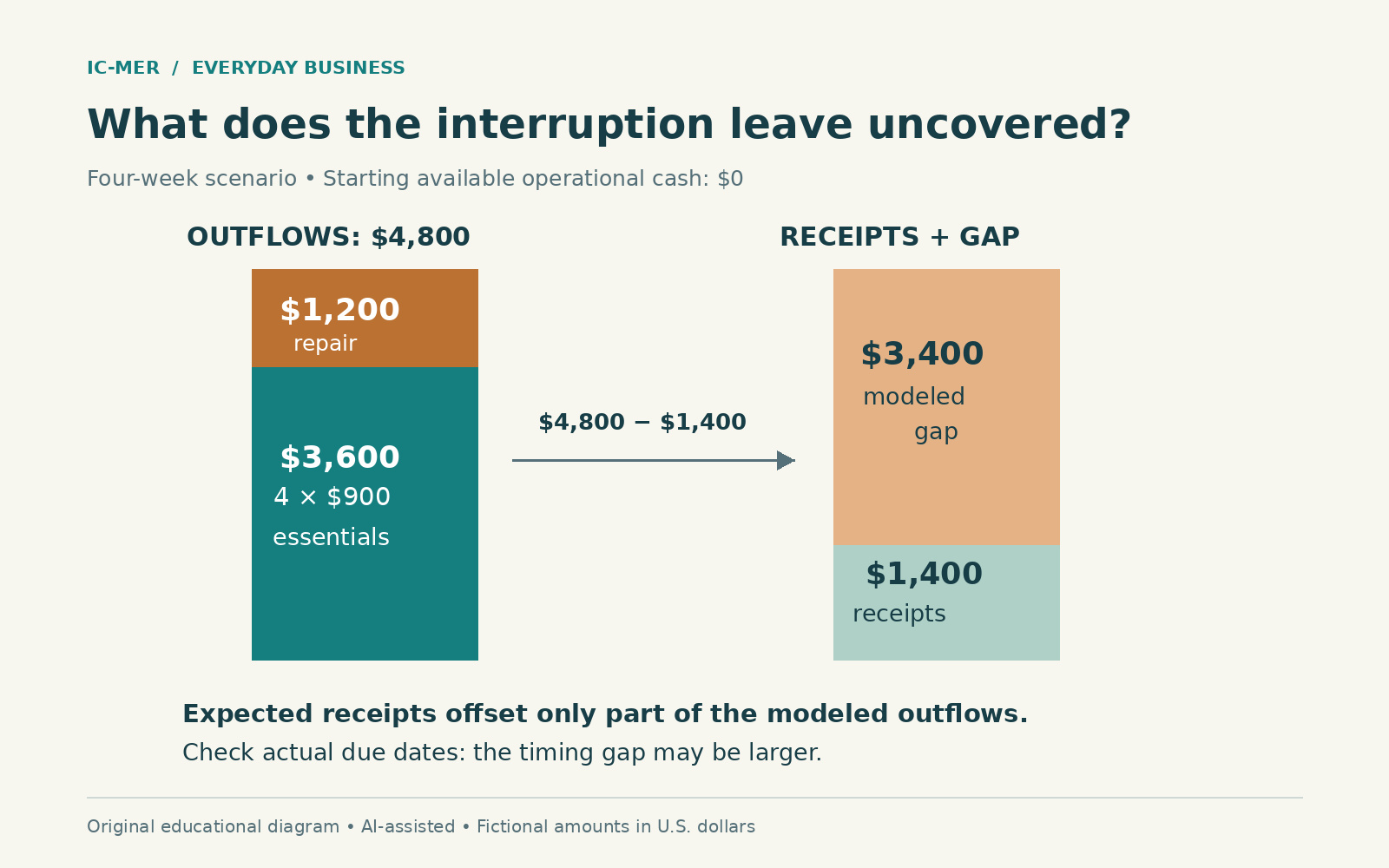
Imagine a small service business planning for a four-week interruption. Its essential payments total $900 each week, or $3,600 across four weeks. It also estimates a one-time repair cost of $1,200. Total modeled outflows are therefore $4,800. These invented figures illustrate a method; they are not typical costs or recommended targets.
The owner expects $1,400 of receipts during that period. For this simplified exercise, assume there is no uncommitted opening operating cash outside the emergency reserve. Subtracting $1,400 from $4,800 produces a modeled funding gap of $3,400. If there were genuinely available opening cash, it would reduce that gap; money already committed elsewhere would not.
The timing still matters. If the repair and several bills fall due before the receipts arrive, the largest temporary shortfall could exceed $3,400. Place the transactions in date order and find the lowest projected balance. Also calculate a case in which the expected receipt arrives later. The end-of-period total alone cannot tell you how much is needed on a particular day.
Count each available dollar once
Reconcile the bank balance with your records before deciding what is available. Money reserved for tax payments, amounts needed to fulfill prepaid orders and funds subject to contractual restrictions should not silently become an emergency cushion. Their treatment depends on the actual obligation; an accountant can help clarify uncertain items.
Use a simple record showing the amount assigned to each purpose and the amount unassigned. A separate reserve account may make the boundary easier to see, but separate account names do not create extra money. Moving $500 from checking to savings increases the designated reserve by $500 while reducing checking by the same amount.
Keep hoped-for help outside the cash total. A potential loan, a possible insurance payment or an application for assistance is not money currently available. You can include these in a separate scenario with conditions and expected timing, while retaining a version of the plan that does not depend on them.
Make access and protection part of the decision
Ask practical questions about where the reserve will sit: how soon can money reach the operating account, what fees or withdrawal conditions apply, and who can make an authorized transfer if the usual person is unavailable? Confirm the answers with the institution before an emergency. Higher advertised interest is only one consideration.
For U.S. bank deposits, check the institution's FDIC status and your actual coverage. FDIC's guidance explains that separate purpose accounts belonging to the same corporation, partnership or unincorporated association at one bank are combined, subject to its coverage rules and $250,000 limit. A sole proprietor's business deposits are combined with that person's other single accounts at the same insured bank.
Do not assume every product sold by a bank is an insured deposit. FDIC distinguishes eligible deposit accounts from investments such as stocks, mutual funds and crypto assets, which it does not insure. Use its coverage resources for your ownership situation, particularly when balances or account arrangements change.
Sources: [2]
Build toward a useful first milestone
If the modeled gap is larger than anything you can save now, identify a smaller, concrete first milestone. It might be the cost of an urgent assessment and a temporary equipment rental. Record both the first milestone and the larger scenario amount so a modest start is not confused with complete preparedness.
Choose contributions the actual business can support after its obligations are considered. An owner might review available funds after collecting a project payment or after the monthly accounts are updated. There is no universal percentage that suits every business, and an automatic transfer should not create an avoidable shortfall in the operating account.
Look for changes that reduce the disruption itself. Identifying a backup supplier, locating compatible rental equipment or documenting a recovery procedure may reduce the cash needed. Compare the cost and practicality of those options. Saving and preparation can support each other; neither requires pretending that unlimited spare cash is available.
Sources: [1]
Decide when to use it and when to rebuild
Write a short reserve-use rule while the business is operating normally. State what kinds of interruption qualify, who authorizes spending, which records are kept and when the decision will be reviewed. An owner-operated business can use a one-page note; organizations with governing documents should follow their own approval requirements.
For a proposed withdrawal, record the event, amount, purpose and expected effect on remaining obligations. Ask whether this purchase restores essential capacity or merely postpones an unresolved problem. That question is especially useful when repeated withdrawals support ordinary operations rather than a distinct disruption.
After using the reserve, set a review date and a proposed rebuilding plan based on available cash. Do not promise an unrealistic replenishment deadline. If losses continue, investigate demand, pricing, costs and commitments with qualified help. A reserve can provide decision time, but its balance does not prove that the underlying business model is sustainable.
Keep the recovery paperwork usable
Money is easier to deploy when essential information is accessible. Keep supplier contacts, account records, policy documents and equipment details in a secure arrangement that does not depend entirely on access to the premises. Maintain appropriate access controls and a recovery method for authorized people.
The IRS recommends including financial records in emergency preparations, keeping important documents safe, creating electronic copies where useful and documenting valuables. Its examples include bank statements, tax returns and insurance policies. It also recommends an annual review of the preparedness plan.
Add a short reserve review to that routine and revisit it after a meaningful change, such as a new lease, staff member or essential machine. Update the interruption assumptions, payment dates and current balance. Begin today with one scenario and its first unavoidable bill; a clearly assigned next step is more useful than an unexplained target.
Sources: [3]
Sources & further reading
- SBA: Prepare for emergenciesChecked 2026-10-24
- FDIC: Electronic Deposit Insurance Estimator FAQsChecked 2026-10-24
- IRS: Business owners—include financial records in emergency preparedness plansChecked 2026-10-24
About this article
Prepared with AI assistance and an AI fact-checking pass against the sources listed above. No human clinical review is claimed. Evidence may change; consult appropriate qualified professionals for decisions about your circumstances.
Spotted a problem? Suggest a correction.