Business · 7 min read
Choosing a supplier you can depend on
A low quote is only part of a good supplier relationship. Define what you need, test the fit and track what actually arrives.
AI-assisted educational information for general small-business planning, not individualized legal, financial or procurement advice. Requirements depend on the product, contract and jurisdiction; obtain qualified advice for significant or regulated purchases.
Information may contain errors, omissions or outdated guidance. This article is general education, not individual medical or other professional advice. Verify important information before acting and consult an appropriately qualified professional. Never disregard medical advice, delay care or change treatment because of this article. See our accuracy disclaimer and terms.
Start with what a dependable supplier means for your business
A delivery that arrives after your busiest day can be a poor purchase even when the price looks excellent. The same is true of a cleaning service that misses agreed visits or a printer that supplies the wrong labels. Choosing a supplier means deciding whether another business can help you keep your promises to customers, repeatedly and under realistic conditions.
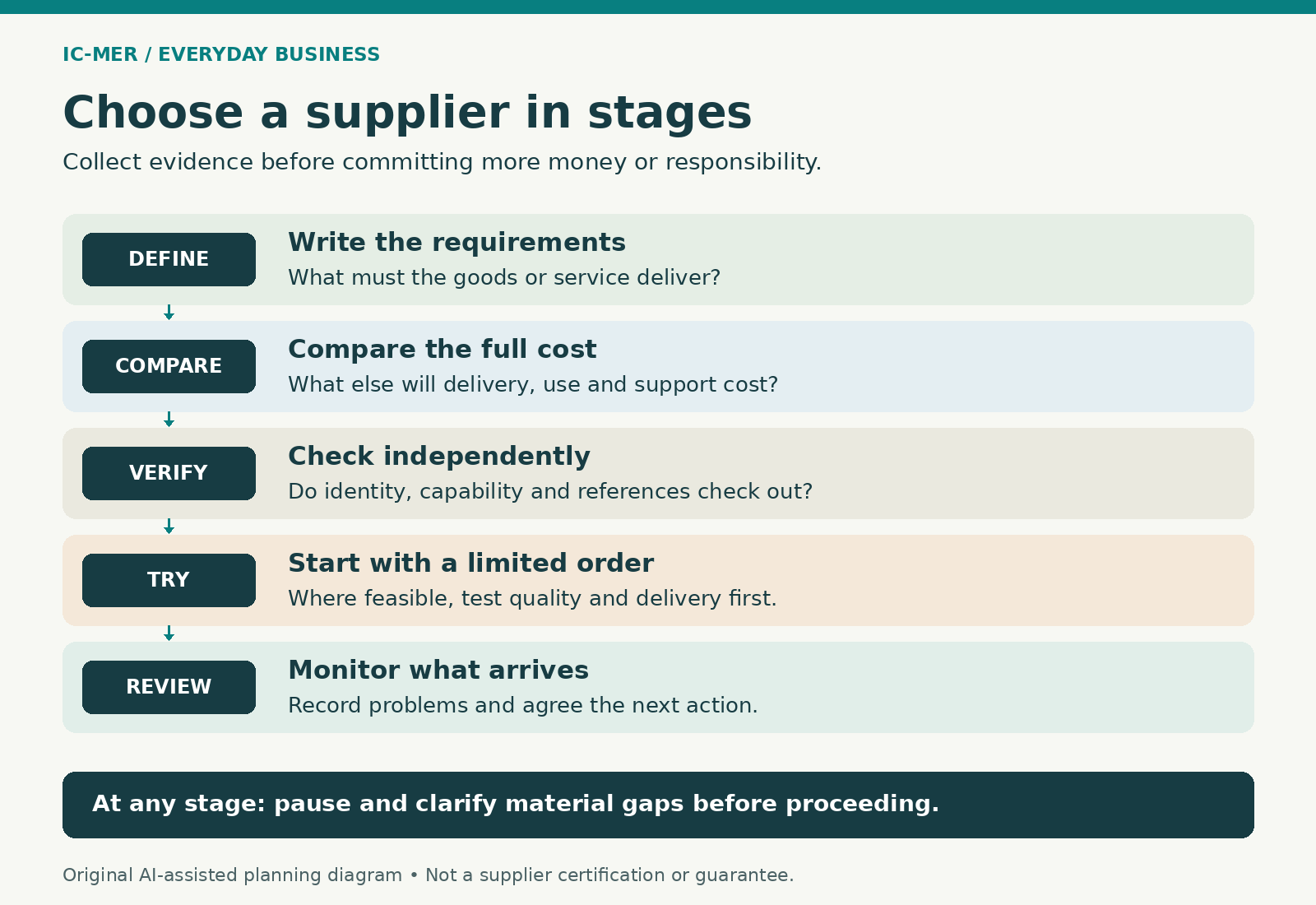
Begin with a short description of what must go right. What exactly do you need, when must it arrive, and what would make it unusable? Separate essential requirements from preferences. For a neighborhood shop, a reliable small delivery may matter more than a bulk discount. For a designer ordering packaging, consistent dimensions may matter more than having many colors available.
The Australian government’s supplier guidance recommends weighing reliability and quality alongside price. Its general business principles are useful elsewhere, but its Australian registration and legal references do not establish U.S. requirements. This guide uses that practical framework together with U.S. fraud-prevention advice; it does not recommend a particular company.
Sources: [1]
Give every candidate the same practical brief
Prepare one page that you can send to each potential supplier. Describe the item or service, the quantity you expect to use, the delivery location, the required date and how you will judge acceptable work. If you do not know the right specification, say so and ask what information the supplier needs. A vague request can produce quotes that sound comparable but cover different things.
For example, imagine a small event organizer seeking printed signs. “Twenty signs” leaves questions unanswered. A more useful brief specifies size, indoor or outdoor use, the artwork supplied, whether stands are needed, and when the finished signs must be ready. Ask each bidder to list exclusions and any assumptions about artwork corrections. This is a hypothetical planning example, not a required purchasing format.
Ask how the supplier would handle your ordinary order and an unusually busy week. Who confirms the order? When does the delivery clock start? Can substitutions occur without your agreement? Write down answers rather than relying on the impression that someone was friendly. A salesperson who identifies a limitation early gives you something useful to plan around.
Sources: [1]
Compare usable delivery, not just the quoted unit price
Make a simple comparison sheet with a column for each supplier. Include the quoted product or service, minimum order, delivery charge, expected arrival, payment timing and what happens if the order is wrong. Mark an unanswered question as unknown. Do not quietly count an unknown fee as zero or an unconfirmed arrival date as guaranteed.
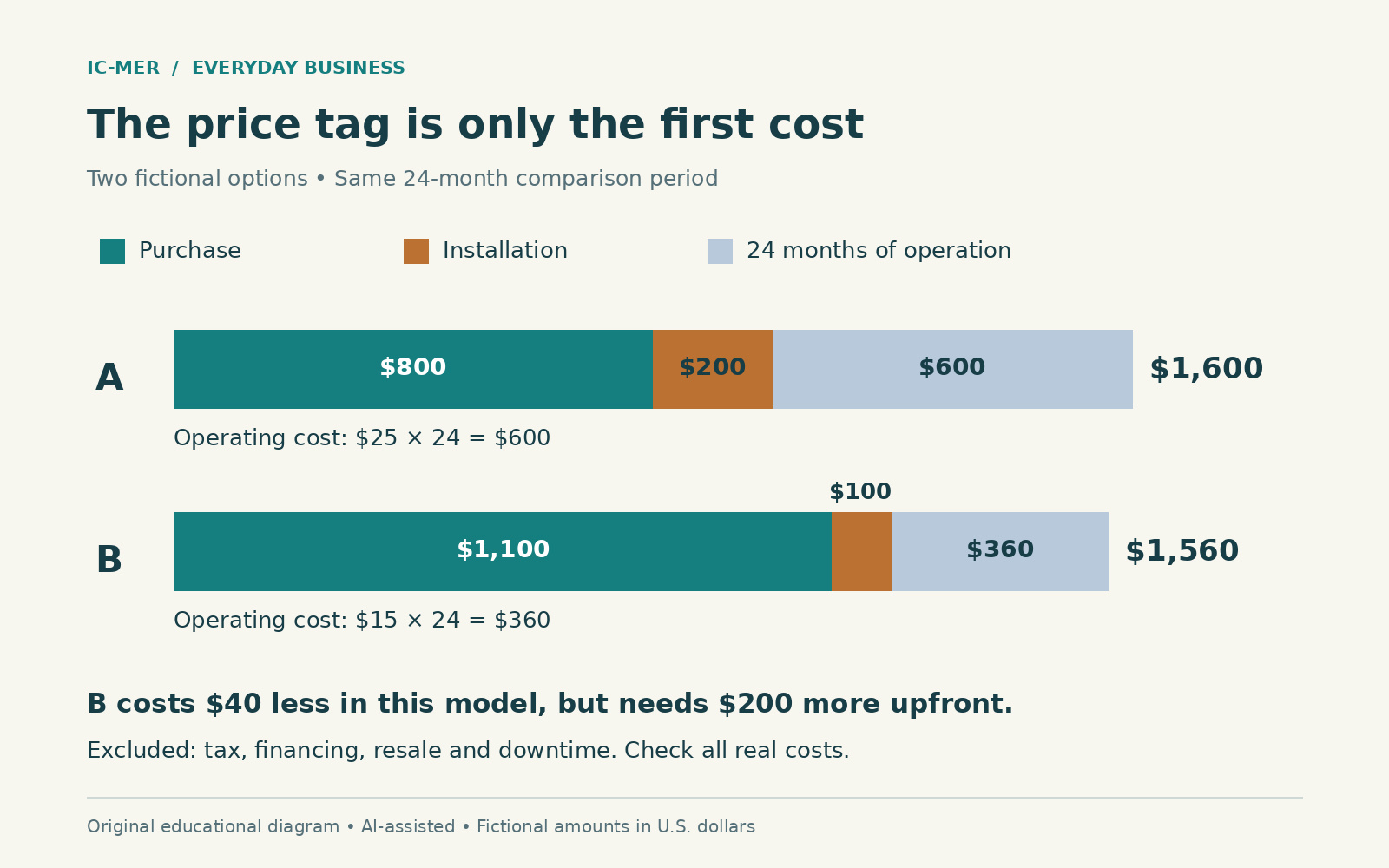
Consider this invented example: supplier A quotes $120 for an order plus $30 delivery; supplier B quotes $145 with delivery included. Before tax and any other charges, the totals are $150 and $145. That calculation is only the starting point. If B cannot meet the date you need, its lower total may not solve your problem. Conversely, paying more does not by itself establish reliability.
For repeat purchases, ask what could change the price and how much warning you would receive. Think through storage and unused stock before agreeing to a larger order. The goal is not to produce a sophisticated score that disguises uncertainty. It is to make the tradeoffs visible and identify which supplier can meet your essentials at a cost you understand.
Check the business behind the promise
Ask for references relevant to the kind of order you plan to place. A supplier experienced with large factories may work differently with a small store. Ask a reference what was ordered, whether delivery matched the agreement and how the supplier responded when something went wrong. Treat these accounts as useful evidence, not a guarantee that your experience will match.
The Federal Trade Commission recommends searching a new company’s name with words such as “scam” or “complaint” and seeking recommendations from trusted people. Read the substance of complaints and responses rather than relying on a star average alone. A lack of search results is not proof of trustworthiness; a complaint also needs context. Resolve unexplained differences in the company name or contact details before paying.
Claims such as “certified” or “environmentally friendly” need more detail. Ask what product or activity the claim covers, who assessed it, and what documentation is available. Where a credential is important to your purchase, check it with the issuing organization. Do not assume that a logo on a quote establishes product safety, suitability or compliance for your particular use.
Use a small trial to answer a specific question
When practical, start with a sample or limited order before depending on a new supplier for a critical job. Define what you want to learn: whether a label fits, whether an item survives normal handling, or whether the supplier follows delivery instructions. Agree on the trial’s cost and scope first. Do not assume that a sample or trial is free; confirm any charges and conditions in advance.
Inspect the result against the original brief and keep notes. Did the order arrive on the agreed day? Were quantities and specifications correct? Was a problem acknowledged clearly? For a service, record what was actually completed rather than treating an attendance message as evidence of finished work. These are suggested checks you can adapt, not a formal certification process.
One successful sample cannot establish how every future order will perform. A useful follow-up is to ask whether routine orders use the same materials, process and fulfillment location as the sample. If your needs involve food safety, regulated equipment or sensitive data, a basic trial is not a substitute for appropriate specialist checks.
Put the working arrangement in writing
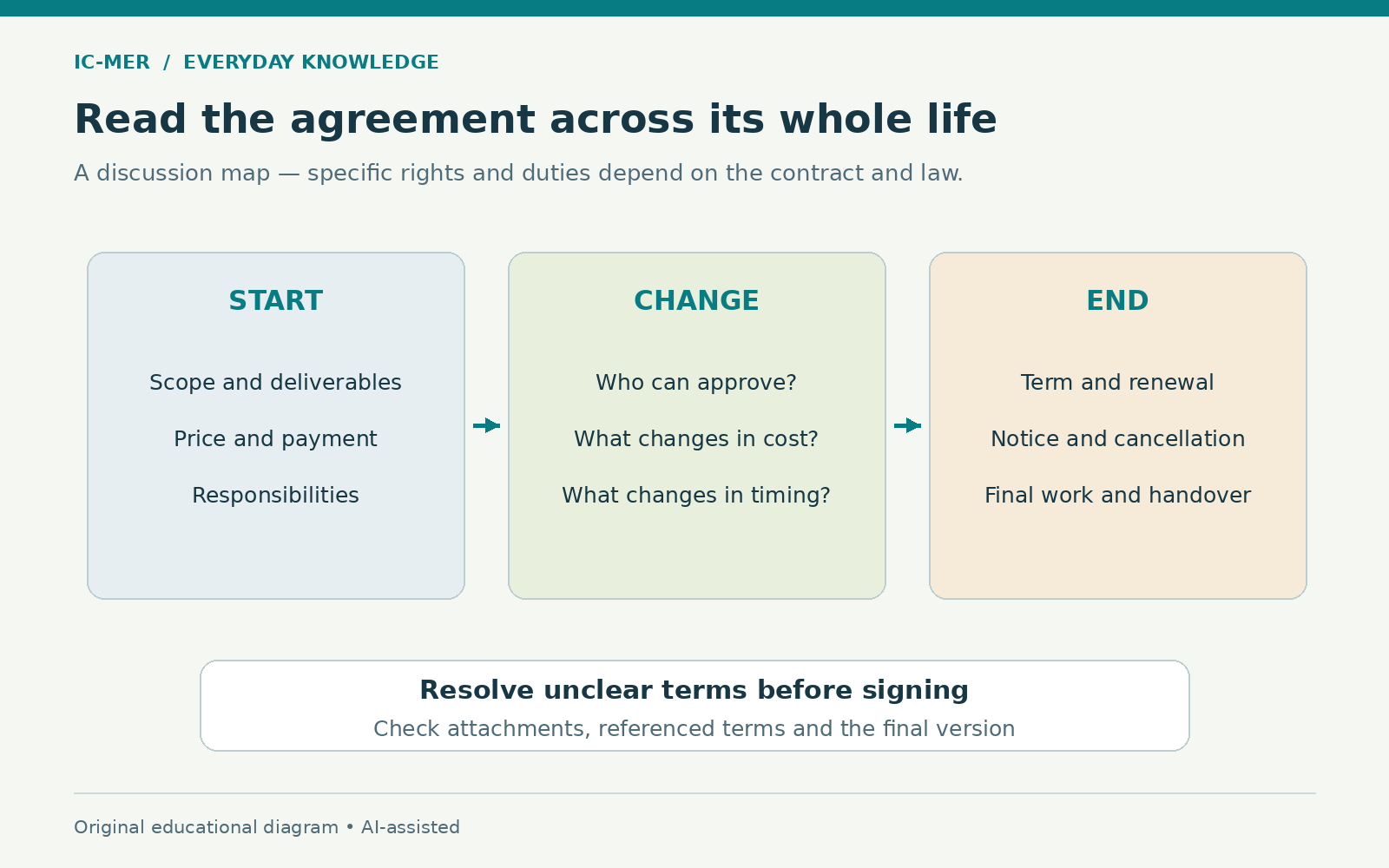
Before committing, clarify order approval, specifications, delivery expectations, payment terms, defect reporting and how the arrangement can end. Identify who handles problems on each side. For important commitments, get qualified legal advice about the actual agreement and applicable jurisdiction; a checklist is not a conclusion about whether terms are enforceable.
Consider asking a concrete question: “If the shipment is incomplete on the agreed day, who do I contact, and what happens next?” Compare the response with the written terms. If the sales discussion and paperwork differ, ask for the discrepancy to be resolved before signing. Do not depend on an assurance that a restrictive clause is merely standard and will never be used.
Keep the accepted quote, relevant specifications and final agreement together so that someone else can find them if you are away. Where a supplier needs access to customer information or business systems, make that a separate decision with appropriate security advice. Buying a routine service does not mean granting unrestricted access to everything your business holds.
Sources: [2]
Protect payments even after trust develops
The FTC warns that businesses receive fake invoices and pressure to pay quickly. Set a clear rule for who may approve orders and invoices. Before paying, compare the invoice with the authorized order and what was received. An unfamiliar charge should prompt a check, not an automatic payment merely because the document looks professional.
The FBI’s Internet Crime Complaint Center advises using a separate channel to verify requested changes to account information. If a supplier emails new bank details, confirm through a trusted contact method already established independently of that message. Simply replying to the same email does not provide an independent check. A familiar supplier name or email thread is not enough to approve a change.
Build that pause into your normal routine so an urgent request does not require someone to invent a new process under pressure. In a very small business, the owner might perform the independent confirmation; with a team, assign responsibility clearly. Keep a record of the confirmation without sharing passwords or unnecessary banking information.
Review performance and keep a realistic backup
Supplier selection continues after the first order. A lightweight delivery log can record the promised date, actual arrival, any discrepancy and whether it was resolved. Review recurring problems with the supplier using specific examples. Distinguish a one-off disruption from a pattern, and give the supplier a clear account of what you need to change.
Business Queensland recommends maintaining supplier relationships and considering alternatives if a supplier cannot deliver. A backup plan does not require buying everything twice. For a critical item, it might mean knowing an alternative source, its normal lead time and whether you have checked its suitability. Two sellers that rely on the same unavailable product may not provide much practical resilience.
Make your first step manageable: choose one important supply, write its essential requirements, and identify the biggest unanswered question about your current arrangement. Resolve that question before expanding the commitment. Dependability is something to assess through clear expectations and observed performance, with room to revise your choice when the evidence changes.
Sources: [2]
Sources & further reading
- Australian Government: SuppliersChecked 2026-10-25
- Business Queensland: Finding and working with suppliersChecked 2026-10-25
- FTC: Scams and Your Small BusinessChecked 2026-10-25
- FBI IC3: Business Email CompromiseChecked 2026-10-25
About this article
Prepared with AI assistance and an AI fact-checking pass against the sources listed above. No human clinical review is claimed. Evidence may change; consult appropriate qualified professionals for decisions about your circumstances.
Spotted a problem? Suggest a correction.