Medicine · 7 min read
Everyday stress: practical ways to support your wellbeing
A useful stress plan starts with the pressures you actually face and one manageable next step.

General adult health education, prepared with AI assistance. This is not a diagnosis, individual treatment plan or human clinical review. Seek professional care for persistent or severe symptoms and urgent help for immediate danger.
Information may contain errors, omissions or outdated guidance. This article is general education, not individual medical or other professional advice. Verify important information before acting and consult an appropriately qualified professional. Never disregard medical advice, delay care or change treatment because of this article. See our accuracy disclaimer and terms.
Start with the pressure you are facing
A crowded week can make every demand feel equally urgent: a bill, a work deadline, an appointment and someone else’s request all arrive before you have finished breakfast. A useful response begins by naming the pressure. You do not need to become perfectly calm before making a small, practical decision about it.
WHO describes stress as a natural response to difficult circumstances. It can affect both mind and body, and people respond differently. Feeling strained after a major disruption does not mean you have failed at coping. At the same time, ordinary language such as “just stress” should not be used to dismiss symptoms that are persistent, severe or interfering with daily life.
This guide offers a starting framework for adults managing everyday pressures. It is not a promise that routines will remove financial hardship, caregiving demands or unsafe working conditions. Sometimes the most useful step is additional support or a change in the situation itself.
Sources: [1]
Notice your own warning signs
CDC lists possible stress effects including trouble concentrating, disturbed sleep, changes in appetite, headaches and increased substance use. Those symptoms are not specific enough to diagnose stress. If a physical symptom is new, worrying or severe, seek medical assessment rather than deciding its cause from an article.
For a few days, consider a short note with three entries: what happened, what you noticed and what you needed next. For example: “Three requests arrived at once; I kept rereading the same message; I needed to clarify which deadline mattered.” This is an optional planning aid, not a symptom score or medical test.
Avoid turning observation into another demanding project. One sentence may be enough. You can keep the note on paper, leave out private details and stop if the exercise makes you more preoccupied. Its purpose is to reveal a practical pattern, such as repeatedly skipping a break or agreeing to tasks before checking your calendar.
Sources: [2]
Separate a next action from an unsolved problem
An entire problem may be too large to settle today. A next action can still be small and specific. Instead of “sort out everything with the house,” an illustrative next step might be “find the repair estimate and write down the question I need answered.” Completing that step does not guarantee a result; it makes the following conversation more focused.
Try making three short groups: something to act on, something needing another person, and something that cannot be resolved today. Pick one action from the first group. For the second, identify the person or service with the relevant responsibility. For the third, decide when you will revisit it rather than promising yourself you will solve it before bed.
At work, a concrete boundary might sound like: “I can complete the invoice today or the stock check today; which should come first?” At home, it might be: “I can help after lunch, but I cannot take that on this morning.” These are original communication examples, not scripts that fit every relationship. Use them only where it is safe to do so.
Protect a few ordinary routines
NIMH recommends regular activity, meals, sleep and supportive connections as parts of mental-health self-care. You do not have to start all of them at once. Choose the routine most likely to be squeezed out of your day, then make a version that fits your circumstances.
For a fictional caregiver, the first change could be arranging a brief handover so lunch is not continually interrupted. For an office worker, it could be putting a short walk between the final meeting and the journey home. Someone working changing shifts may need a plan that follows their sleep period rather than a conventional evening schedule.
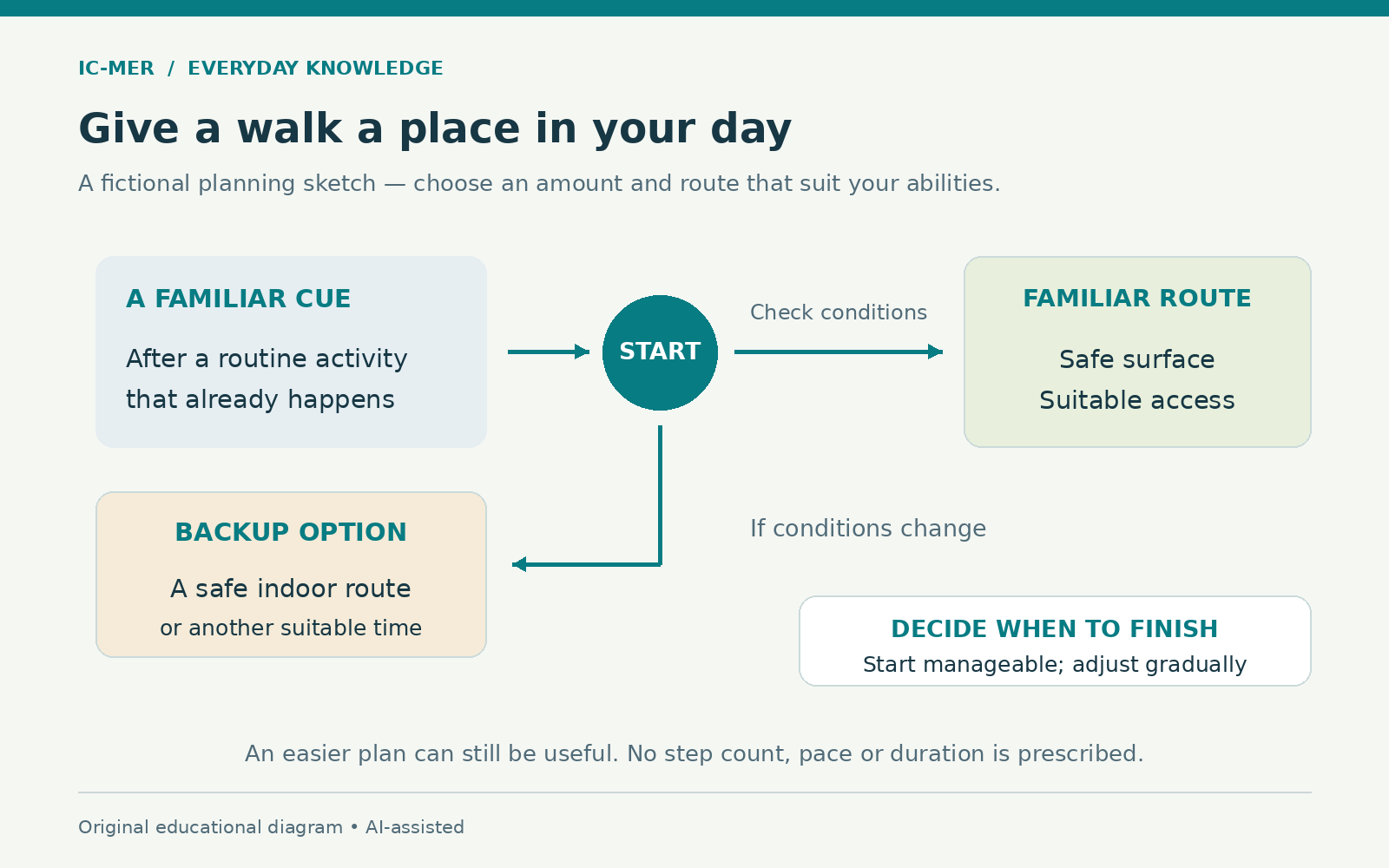
Write a backup version too. If the outdoor walk is impractical, what comfortable movement is available indoors? If cooking falls through, what simple meal can you assemble? A backup is useful because the hardest day is often the day when an elaborate routine is least realistic. Treat it as a practical arrangement, not a measure of personal discipline.
Sources: [3]
Try relaxation without demanding an instant result
NCCIH describes relaxation practices such as breathing exercises and muscle relaxation, while noting that evidence differs across techniques and conditions. They may be useful tools, but they are not substitutes for needed medical or mental-health care. A practice that helps one person may not suit someone else.
An optional starting point is to sit comfortably and let your breathing settle without forcing deep breaths or holding your breath. You might instead listen to familiar music or spend a quiet moment looking outside. There is no requirement to empty your mind. If a breathing or relaxation exercise causes dizziness, distress or discomfort, stop and return to an ordinary comfortable activity.
Choose a setting in which you can safely pause. Do not attempt an attention-demanding relaxation exercise while driving or operating equipment. If inward-focused exercises bring up frightening experiences or worsen symptoms, discuss alternatives with a qualified professional. More effort is not automatically the answer to a technique that feels wrong for you.
Sources: [4]
Make support specific and manageable
WHO recommends keeping contact with trusted people. Support can include company, listening or concrete assistance; it does not have to mean recounting every detail. Think about what would make the next day more workable and who might reasonably help.
An illustrative request is: “Could you sit with me while I organize these papers?” Another is: “I need someone to listen for ten minutes; I am not asking you to fix it.” A person offering help could ask whether listening or a practical task would be more useful. Neither person needs to pretend they have expertise they do not have.
If your usual circle is unavailable, consider an appropriate community resource, a healthcare professional or a workplace support service. Check what a service offers and what privacy arrangements apply before sharing sensitive information. Not every acquaintance is the right person for every concern, and a strained relationship may call for support outside that relationship.
Sources: [1]
Reduce avoidable demands on your attention
CDC suggests breaks from news and social media when repeated exposure is upsetting. Staying informed does not require a continuous stream of alerts. A practical experiment is to choose a time to check a reliable source and silence nonessential notifications during another activity.
Keep genuinely necessary alerts available, such as local emergency information. The aim is to distinguish useful information from repetition. Before reopening an app, ask what you are trying to find out and whether another refresh is likely to answer it. This is an attention-management suggestion, not a treatment for an anxiety disorder.
You can also simplify the environment around a task. Open the document you need, put unrelated papers aside and write down the first question. If you are sharing a space, agree on a short period without interruptions where possible. These small arrangements cannot remove every pressure, but they can make a specific task easier to approach.
Sources: [2]
Know when everyday coping is not enough
NIMH distinguishes stress linked to an outside demand from anxiety that can continue without an immediate threat. Professional help is appropriate when symptoms persist, cause avoidance or interfere with normal activities. You do not need to identify the correct diagnosis before asking for an appointment.
NIMH also advises seeking help for severe or distressing symptoms lasting two weeks or more, including sleep difficulty, loss of interest and inability to complete usual tasks. Two weeks is not a rule to wait when symptoms are severe or safety is at risk. If there is immediate danger, seek emergency help now.
For a routine appointment, bring a short description of the symptoms, their timing, how they affect daily life and any medicines or substances you use. Avoid stopping prescribed treatment on your own. To begin this week, choose one manageable routine, one specific support request and one sign that would prompt professional help. Review whether the plan is useful rather than whether you followed it perfectly.
Sources & further reading
- Stress — WHOChecked 2026-10-24
- Managing Stress — CDCChecked 2026-10-24
- Caring for Your Mental Health — NIMHChecked 2026-10-24
- Relaxation Techniques: What You Need To Know — NCCIHChecked 2026-10-24
- I’m So Stressed Out! — NIMHChecked 2026-10-24
About this article
Prepared with AI assistance and an AI fact-checking pass against the sources listed above. No human clinical review is claimed. Evidence may change; consult appropriate qualified professionals for decisions about your circumstances.
Spotted a problem? Suggest a correction.