Business · 7 min read
Handling a customer complaint fairly and effectively
Turn a complaint into a clear next step with factual notes, realistic commitments and a respectful response.
AI-assisted general business education, not individualized legal advice or a determination of customer rights. Requirements vary by jurisdiction and industry; seek qualified help for regulated services, safety incidents and legal disputes.
Information may contain errors, omissions or outdated guidance. This article is general education, not individual medical or other professional advice. Verify important information before acting and consult an appropriately qualified professional. Never disregard medical advice, delay care or change treatment because of this article. See our accuracy disclaimer and terms.
A complaint needs a clear next step
A customer says an order is wrong, a visit was missed or a bill makes no sense. For a small-business owner, the first temptation may be to defend the work immediately. A more useful starting point is to find out what happened and what the customer needs now. You do not have to settle every disputed fact in the first conversation to give the issue a clear owner and next step.
Consider a hypothetical neighborhood print shop. A customer arrives to collect invitations and says the event date is wrong. The owner remembers receiving approved artwork. The customer remembers requesting a correction. Both may be sincerely describing what they recall. Starting with an argument about who is careless will not establish which file was printed or whether there is time to replace the invitations.
The suggestions below are a practical workflow, not a promise that every complaint will end happily. Australian government business resources support listening, documenting commitments and following up; their references to Australian consumer law are not statements of U.S. law. Your actual duties depend on the transaction, location and industry.
Sources: [1]
Listen first, then check that you understood
Give the customer space to explain the issue before proposing a solution. In the print-shop example, the most useful opening questions concern the incorrect date, the event deadline and the version the customer expected. Ask what outcome would help. A replacement tomorrow may be useless for an event tonight, even if replacement would normally be your preferred response.
Try a short summary in ordinary language: “You expected the corrected date, these copies have the old date, and you need usable invitations today. Have I understood that?” This is an invented example of wording, not a script that must be used. It invites the customer to correct your understanding without requiring either side to accept blame prematurely.
Acknowledge the specific inconvenience rather than making a vague promise that everything will be fine. If you need to check records, say what you will check and when you can provide an update. Avoid saying “I will call shortly” when you already know you cannot look at the job until tomorrow. Set a realistic expectation you can actually track.
Sources: [1]
Separate what is known from what still needs checking
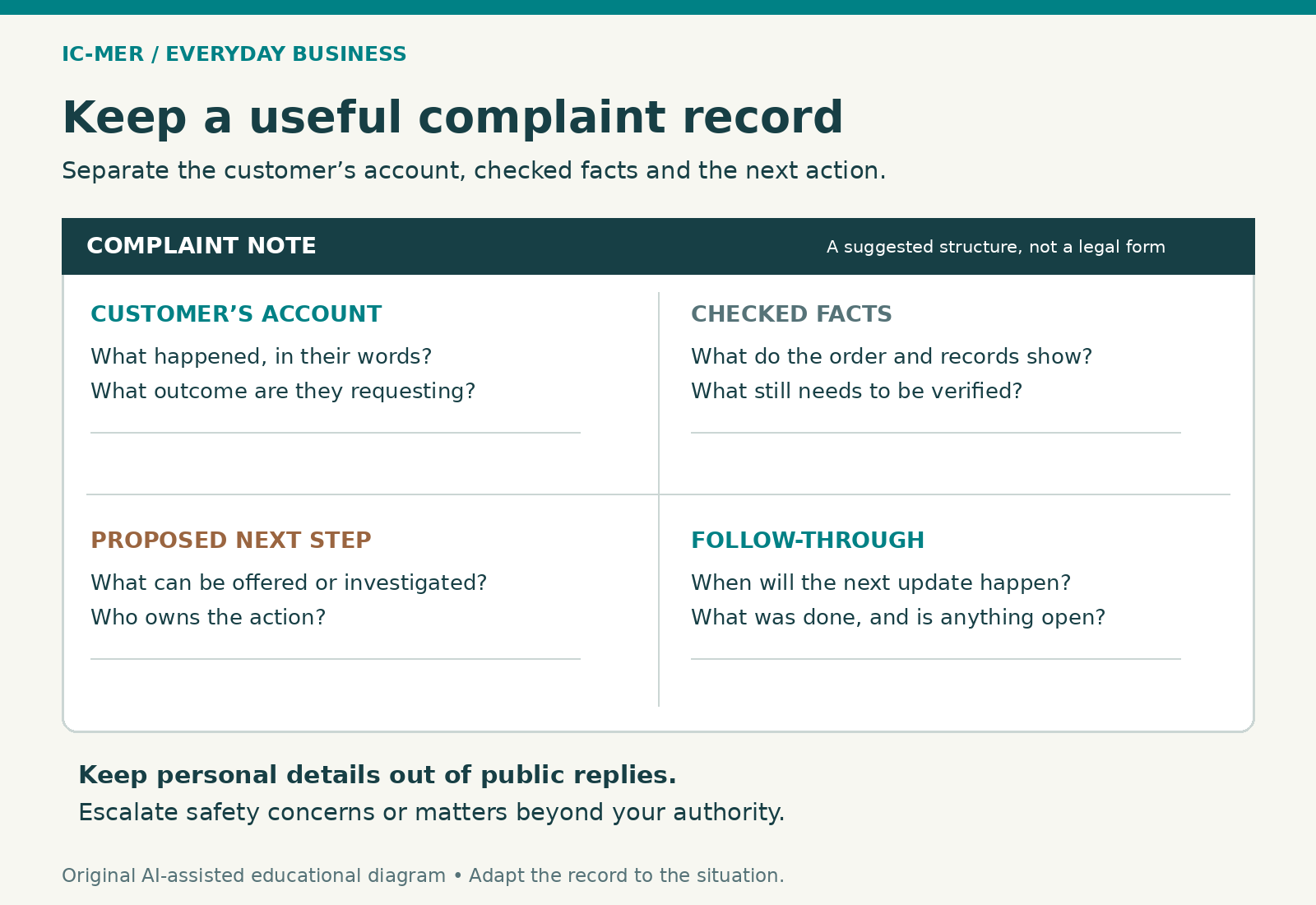
In a simple complaint note, distinguish the customer’s account, your records and unresolved questions. For the invitations, that could mean retaining the order details, the approved artwork and the later message requesting a change. The fact that a file is labeled “final” does not settle whether someone subsequently accepted a revision. Review the sequence before reaching a conclusion.
Request only the information relevant to understanding the problem. A photo may help show a damaged item, while an order reference may identify the purchase. Explain why you need it and offer a practical alternative where possible. Avoid turning a straightforward question into a demand for unrelated personal documents. Use your established secure process if sensitive information is genuinely necessary.
Talk privately with staff who handled the order. Ask them to describe what happened rather than starting with an accusation. If accounts differ, record the difference accurately. A complaint log is not a place for insulting descriptions of customers or employees. Factual notes are more useful to the next person who needs to understand the case.
Sources: [1]
Offer a remedy you can deliver
Once you understand the problem, consider the applicable customer rights, the terms of the transaction and feasible remedies. A repair, replacement, refund or corrected service may be appropriate in different circumstances. Do not assume a store policy overrides legal rights, and do not tell every customer that the law guarantees the same remedy. Seek qualified advice when obligations are unclear.
Return to the invented print-shop case. If the shop confirms that it accepted the correction but used the wrong file, a specific proposal could be to reprint from a newly checked proof and agree on a collection time. Before offering that, confirm the printer, materials and staff are available. A generous-sounding remedy that cannot be delivered creates another unresolved problem.
If the requested outcome is unavailable, explain the limitation and discuss realistic alternatives rather than simply repeating “policy.” Make clear which decision you can make and which needs approval. Business Queensland recommends giving the person managing a complaint authority to arrange solutions within agreed limits. In a sole-owner business, that still means knowing what you can responsibly promise.
Sources: [2]
Write down the agreement and complete it
Summarize the agreed action in a short message: what will happen, who will do it, the expected timing and what the customer needs to do, if anything. For example: “We will send the corrected proof this afternoon. After you confirm the date, we will agree on a collection time.” This proposed wording intentionally avoids promising a finished job before a necessary approval.
Keep a distinction between an acknowledgment, a decision and completion. Receiving the complaint does not mean it is resolved. Offering a replacement does not mean it has arrived. A useful internal record might have three plain-language entries: waiting for information, action agreed, and action completed. Adapt those labels to your business rather than treating them as a required system.
If a commitment becomes impossible, contact the customer before the promised update is missed when you can. Explain the change and give a revised next step. At the end, check whether the agreed action occurred and whether anything remains unresolved. A customer may still disagree with the outcome; record that honestly instead of marking the person satisfied without asking.
Sources: [1]
Respond to public reviews without turning them into a public case file
A public complaint can feel more urgent because other people can read it. Keep the public response brief and professional, then offer an established private contact channel for order-specific discussion. Do not post an address, payment information or private correspondence to prove your side of the story. The aim is to make help available, not to invite an audience into the customer’s records.
An illustrative reply might be: “We would like to check what happened with this order. Please contact our usual customer-service address with your order reference so we can look into it.” Use a channel you actually monitor. Do not claim publicly that you have fixed the problem if you have only sent an invitation to discuss it.
In the United States, the FTC explains that the Consumer Review Fairness Act prohibits certain standardized consumer-contract terms that restrict or penalize honest reviews. An opinion you dislike is not automatically clearly false. Do not use a threat of a review penalty as a complaint-handling tactic. If a review contains threats, private information or apparently fabricated claims, use the platform’s reporting process and obtain qualified advice where needed; this is different from suppressing honest criticism.
Sources: [3]
Know when the issue needs a different response
An ordinary service complaint and a report of immediate danger require different priorities. If someone reports an injury, a potentially unsafe product, a suspected data breach or a serious threat, involve the responsible manager and appropriate qualified help promptly. Follow applicable emergency, incident and reporting procedures. Do not let an informal customer-service conversation substitute for those processes.
Staff can be courteous while maintaining boundaries. If a conversation becomes threatening, prioritize safety and use an established escalation route. A calm written follow-up may be appropriate for some disputes, while an immediate danger calls for emergency assistance. Do not send a junior employee into an unsafe situation merely because that person originally handled the sale.
Regulated services, including health care and financial services, can have specific complaint and confidentiality requirements. This general business guide does not cover those requirements or decide liability. A demand letter, regulatory notice or dispute with significant legal consequences deserves timely professional advice rather than an improvised response copied from an online example.
Use the complaint to improve one process
After the immediate issue is addressed, ask what would help prevent the same confusion. For the print shop, the answer might be a visible record of which artwork version was approved, who accepted changes and when printing began. That is more actionable than telling everyone to “be more careful.” Test whether the new step is easy enough to use during a busy day.
Business Queensland recommends reviewing complaint records for recurring problems. Look for repeated misunderstandings about delivery dates, product descriptions or who is supposed to call back. A quiet complaints inbox alone does not establish excellent service; customers may be using a different channel or deciding not to contact you. Treat the record as one source of information, not a complete measure of customer experience.
Start small: choose one place to record open complaints, name the person responsible for checking it, and make the next promised update easy to find. The process should help a customer understand what happens next and help your business carry out what it agreed to do. Consistent follow-through is a practical goal even when agreement on every point is impossible.
Sources: [2]
Sources & further reading
- Australian Government: Handle customer complaintsChecked 2026-10-26
- Business Queensland: Managing customer complaintsChecked 2026-10-26
- FTC: Consumer Review Fairness Act—What Businesses Need to KnowChecked 2026-10-26
About this article
Prepared with AI assistance and an AI fact-checking pass against the sources listed above. No human clinical review is claimed. Evidence may change; consult appropriate qualified professionals for decisions about your circumstances.
Spotted a problem? Suggest a correction.