Business · 10 min read
Knowing your customers without overcomplicating your business
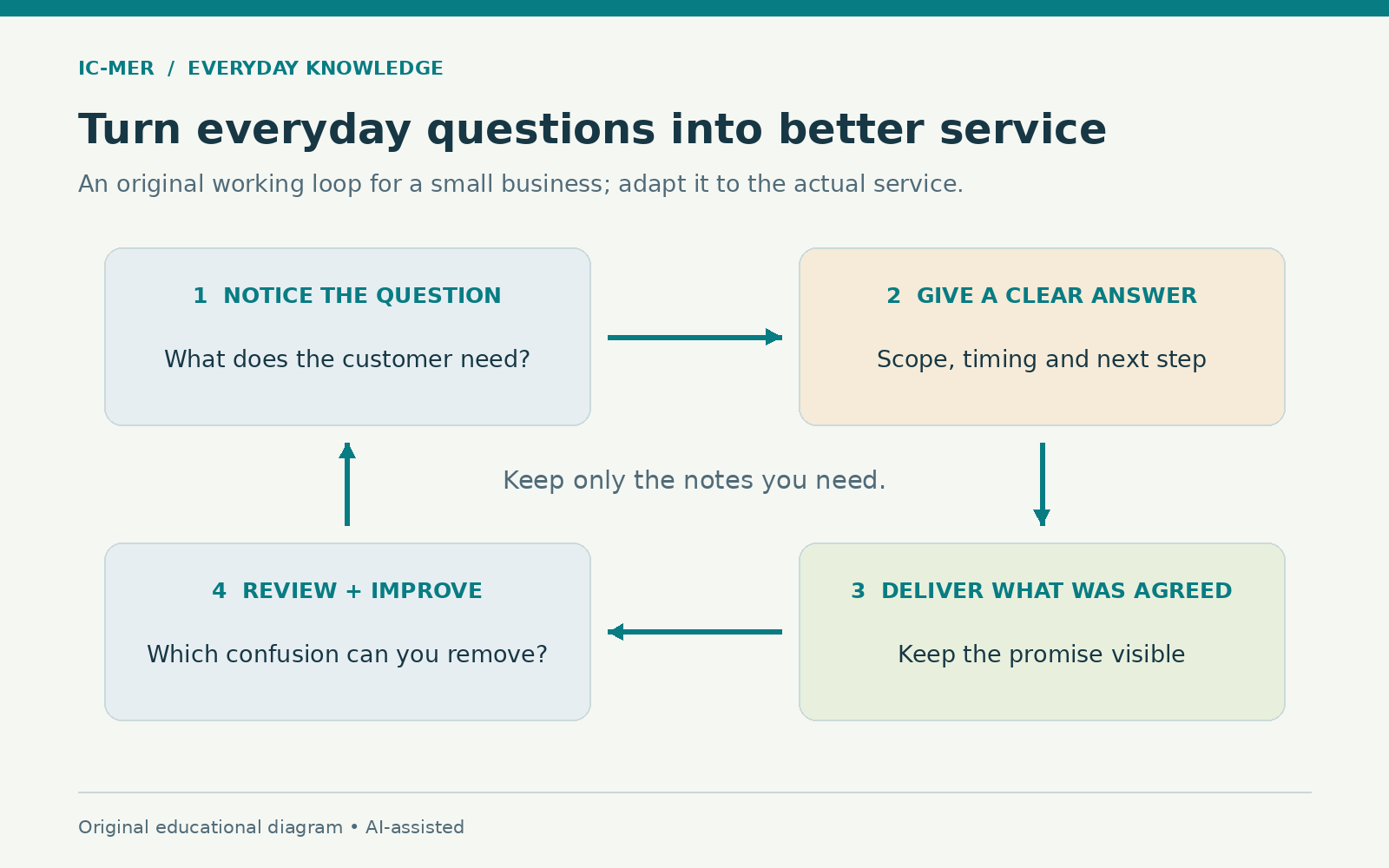
Knowing customers can start with doing ordinary work clearly: explain the offer, agree on the next step, deliver it, and resolve problems.
General small-business education, prepared with AI assistance and independently checked by an AI reviewer. Examples are fictional, and suggested routines do not establish legal compliance or guarantee sales. Obtain qualified advice for contracts, privacy and regulated services.
Information may contain errors, omissions or outdated guidance. This article is general education, not individual medical or other professional advice. Verify important information before acting and consult an appropriately qualified professional. Never disregard medical advice, delay care or change treatment because of this article. See our accuracy disclaimer and terms.
Begin with the work customers are trying to get done
A small business owner does not need to build a complicated customer-management system before making service more useful. Often the next improvement is visible in ordinary work: the same question arrives repeatedly, a quote leaves something unclear, or a customer does not know what happens after paying. Understanding those moments can help you make the business easier to use.
The U.S. Small Business Administration asks business planners to be clear about the customer problem they solve and how sales happen. Those questions can be applied to daily service, not only a business plan. What is the person contacting you trying to accomplish? What information do they need before deciding? What must your business do next to deliver the promised work?
This article focuses on the practical journey from an enquiry to a completed job. It does not require a survey program or detailed profiles of individual customers. The examples use a fictional repair service, but the same questions may help a tutor, cleaner, local shop or other small operation. Adapt them to the kind of work you actually do and any professional obligations that apply.
Sources: [1]
Make the offer understandable before the conversation starts
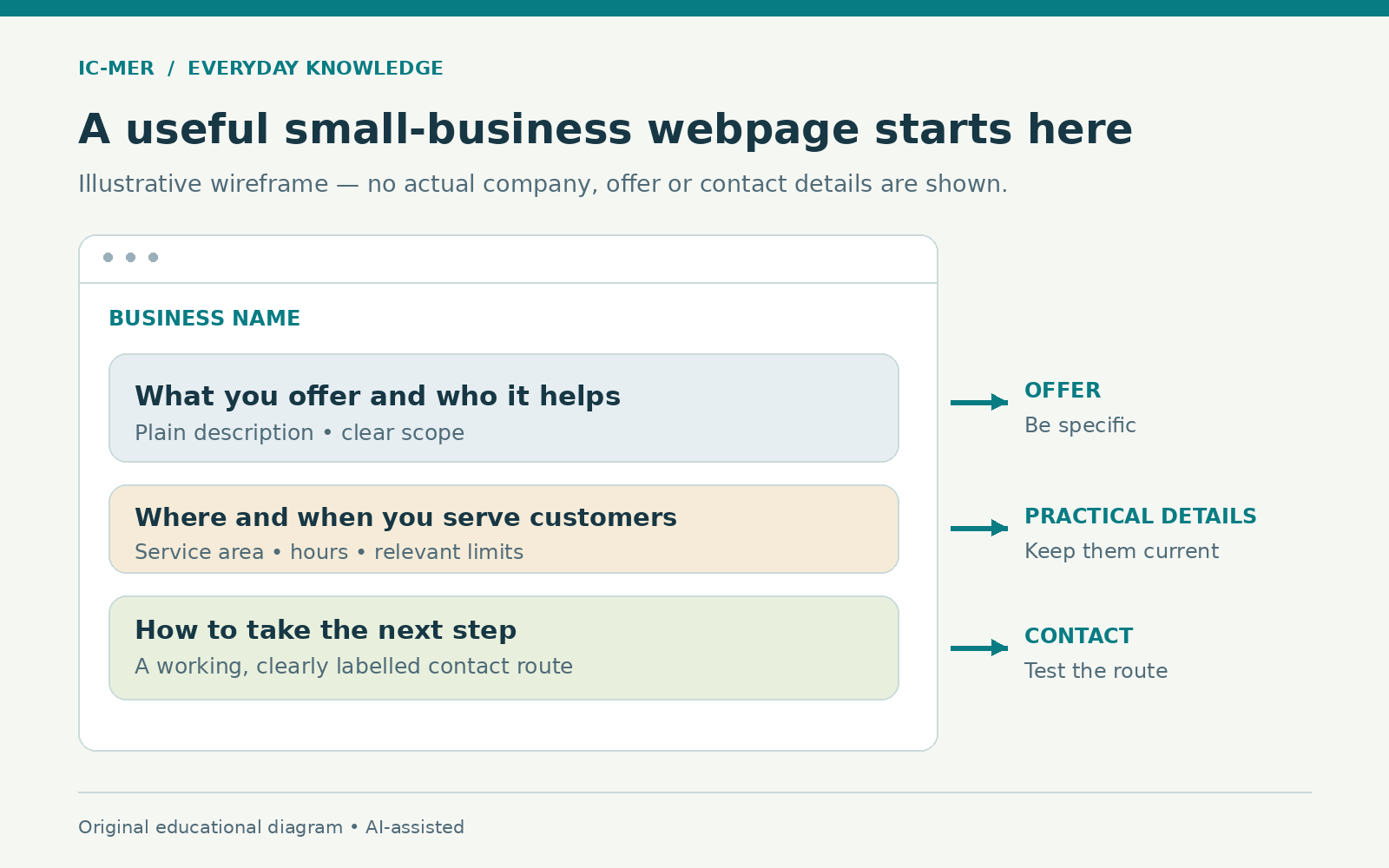
Imagine a fictional repair business whose homepage says only that it offers exceptional solutions. A person with a broken kitchen appliance still needs to know which appliances it handles, where it works and how to request an assessment. A clearer description would give those basic details in ordinary words. It would also state important exclusions, such as products the business does not service.
The FTC says advertising claims must be truthful, not deceptive or unfair, and supported by evidence. Keep that principle close when describing your own offer. Do not promise same-day repairs if you can only promise a same-day reply, or describe an estimate as a final price when the work has not been assessed. Use credentials, guarantees and results claims only when they are accurate and supportable.
Try reading your offer as someone who has never used the service. Replace vague praise with the information needed to make a decision. A short explanation of the actual service area and booking process may answer more questions than several paragraphs about dedication. This is a suggested communication exercise, not a claim that a particular wording will increase sales by a measurable amount.
Sources: [2]
Give an enquiry a clear next step
When someone contacts the fictional repair service, the first reply could acknowledge the request, explain what information is needed and describe the next step. For example: tell us the appliance type and the problem you have noticed, and we will explain whether we can assess it. The business should avoid requesting information unrelated to that decision or implying that a diagnosis has already been made.
A small team can agree on a basic reply structure without making every response sound automated. Start with the person's question, answer what can be answered now, identify what remains unknown, and say who will follow up. If you cannot provide an answer immediately, give a realistic expectation for the reply rather than a deadline nobody has agreed to meet.
Make responsibility visible internally. An enquiry that appears in an inbox is not necessarily assigned to anyone. A simple record of the next action and the person responsible can prevent uncertainty about who is responding. Choose a method your team can maintain, and do not treat the purchase of new software as evidence that the handoff itself has improved.
Put the important parts of a quote in one place
A customer should be able to distinguish the work you have agreed to do from possible additional work. In the fictional repair example, an assessment fee, a later repair estimate and any approval needed before proceeding should be explained according to the business's actual terms. Do not invent a universal fee structure or assume an informal message is sufficient for every contract.
As a practical drafting check, read the quote for scope, price basis, timing, exclusions and the next decision. If the price depends on an unknown condition, say what is unknown and how it will be resolved. If the customer must supply an item or allow access at a particular time, include that expectation where it will be seen before the appointment.
Have a qualified adviser review terms where the stakes or applicable rules require it. The operational aim is straightforward: avoid leaving important assumptions in the owner's head. A customer may understand a phrase differently from a technician who uses it every day. Explaining it before work starts is often easier than arguing about its meaning after an invoice arrives.
Respect different ways of using the service
Some people prefer a phone call, others a written reply they can revisit. A customer may be at work when you call, may need accessible information, or may simply want a clear message instead of a lengthy conversation. Ask about useful communication preferences when relevant, without turning an ordinary booking into an unnecessary personal questionnaire.
Choose the channels your small business can actually monitor. Publishing five contact methods is unhelpful if four are rarely checked. If you offer one main enquiry channel and a separate route for existing customers, explain their purposes. Give realistic response expectations and make it clear when an online request is only a request rather than a confirmed booking.
Avoid assuming that someone's age, accent, neighborhood or appearance tells you what they can afford or how they want to communicate. Work from the question and the service requirements. If a request is outside your capacity, explain the limitation consistently. Knowing customers should help you serve them clearly, not encourage unsupported assumptions about individual people.
Make the handoff from booking to delivery explicit
Once a job is agreed, identify the information the person doing it needs. In the fictional repair service, that might include the agreed appointment, appliance type, reported problem and approved scope. Keep the note factual. The technician should not have to reconstruct an important promise from several scattered messages, and the customer should not have to repeat the whole enquiry simply because a different employee arrives.
Use a short confirmation where appropriate: here is the appointment, here is what we are doing, and here is how to reach us if something changes. Check that the confirmation matches the actual booking. A neatly formatted message with the wrong date is worse than a plain message with the right information. Templates need a final read before they are sent.
Plan for a change as well as the normal case. Who contacts the customer if the appointment must move? Who can authorize work outside the original scope? Where is the customer's decision recorded? These questions are especially useful when the owner cannot personally supervise every interaction. The answers can be simple, but they should not depend on everyone guessing the same thing.
Explain completion and what comes afterward
At the end of a job, tell the customer what was completed and what remains outstanding. If an invoice, care instruction or follow-up decision is part of the service, provide it through the agreed channel. Avoid implying a problem is fully resolved when the business has only completed an initial assessment or a limited piece of work.
For the fictional repair service, a completion note might describe the work carried out and identify any next step the customer has agreed to consider. It should not promise that an appliance will never fail again. Keep technical language understandable, and distinguish a documented result from an assumption about future performance. If you cannot explain a claim clearly, check it before using it.
Make the route for a problem visible. A customer should know how to raise a concern without guessing which employee to contact. State the business's actual process and applicable terms accurately; do not manufacture a guarantee to make the experience sound reassuring. Clear expectations help both sides understand what the next conversation is meant to resolve.
Handle a complaint without turning it into a contest
When a complaint arrives, first establish what happened and what the customer wants resolved. Listen to the account, check the relevant job details, and avoid defending a version of events you have not yet verified. Acknowledging that the person had a frustrating experience does not require inventing an admission about facts you do not know.
Explain what you can do next, who will look into the issue and when an update is realistically possible. If there are several possible remedies, make sure the person offering them has authority to do so. Record the agreed action rather than relying on memory. Where there is a safety issue, a formal dispute or a regulated service, follow the appropriate specialist process instead of improvising from a general article.
After resolving the immediate concern, consider whether an ordinary step needs changing. Perhaps a booking message omitted an access requirement, or a quote did not distinguish an inspection from a repair. Fixing that wording may be more useful than adding another apology template. Do not assume every complaint proves a broad pattern, but do not ignore a clearly correctable problem because only one person raised it.
Keep useful notes without building an unnecessary dossier
The FTC advises businesses to collect and retain sensitive personal information only when there is a legitimate need, protect what they keep and dispose of it appropriately. Apply that principle to customer-service notes. Keep the details needed to fulfill the work and handle the relationship, rather than recording personal observations that have no operational purpose.
Limit access to people who need the information for their jobs. A customer issue should not be copied casually into personal chat threads or left on an open desk. Decide how necessary records will be retained and securely disposed of, taking applicable obligations into account. Contact information supplied for a job should not be treated as blanket permission for every future use.
For a simple internal improvement note, a description such as appointment instructions unclear may be enough; it may not need the customer's name at all. Separate that general lesson from the transaction record that must be handled appropriately. This article does not determine which privacy or retention laws apply to your business, and a short checklist is not a compliance assessment.
Sources: [3]
Improve one repeated difficulty at a time
Choose a problem that you can describe in an ordinary sentence: people cannot tell whether we serve their area, customers are unsure whether an appointment is confirmed, or the invoice does not explain an additional charge. Assign one practical change and someone to maintain it. The goal is to make a specific interaction clearer, not to create an impressive collection of charts.
In the fictional repair service, the owner might first clarify the service area on the website. Next, the team could use a consistent booking confirmation. Later, it might improve the completion note. Those are separate pieces of work. Changing everything at once can make it harder for a small team to learn the new routine or notice which explanation is still missing.
Check whether the change fits the business's capacity. A promise to reply immediately is not useful if the owner is usually on a job. A modest response window that is honestly maintained may be a better operational choice. Likewise, a new service option should be costed and staffed before it is advertised. Customer care and a sustainable business need to fit together.
A short routine you can keep using
At a regular team check-in, walk through one recent job from enquiry to completion. Was the offer clear? Was the next step assigned? Did the customer receive the agreed information? Is any unresolved action still owned by someone? Use the answers to improve the service, not to blame a colleague for every awkward interaction.
Keep the process proportionate. A solo business might need a short booking checklist and a reliable place for necessary records. A growing team may need more explicit responsibilities and appropriate systems. Neither size guarantees good service. The useful test is whether a customer can understand the offer and whether the business can consistently carry out what it has agreed to do.
Knowing your customers is partly a habit of paying attention to these ordinary moments. You can begin with the next enquiry, a clearer quote or a more useful completion message. Maintain truthful claims, respect personal information, and make commitments that match your capacity. Those are concrete improvements you can work on without pretending to know everything about the people you serve.
Sources & further reading
- Plan your businessChecked 2026-10-22
- Advertising and Marketing BasicsChecked 2026-10-22
- Protecting Personal Information: A Guide for BusinessChecked 2026-10-22
About this article
Prepared with AI assistance and an AI fact-checking pass against the sources listed above. No human clinical review is claimed. Evidence may change; consult appropriate qualified professionals for decisions about your circumstances.
Spotted a problem? Suggest a correction.