Medicine · 7 min read
Quitting smoking: finding support that fits your life
You do not have to turn quitting into a test of willpower. Start with support that fits your routines and the next difficult moment.
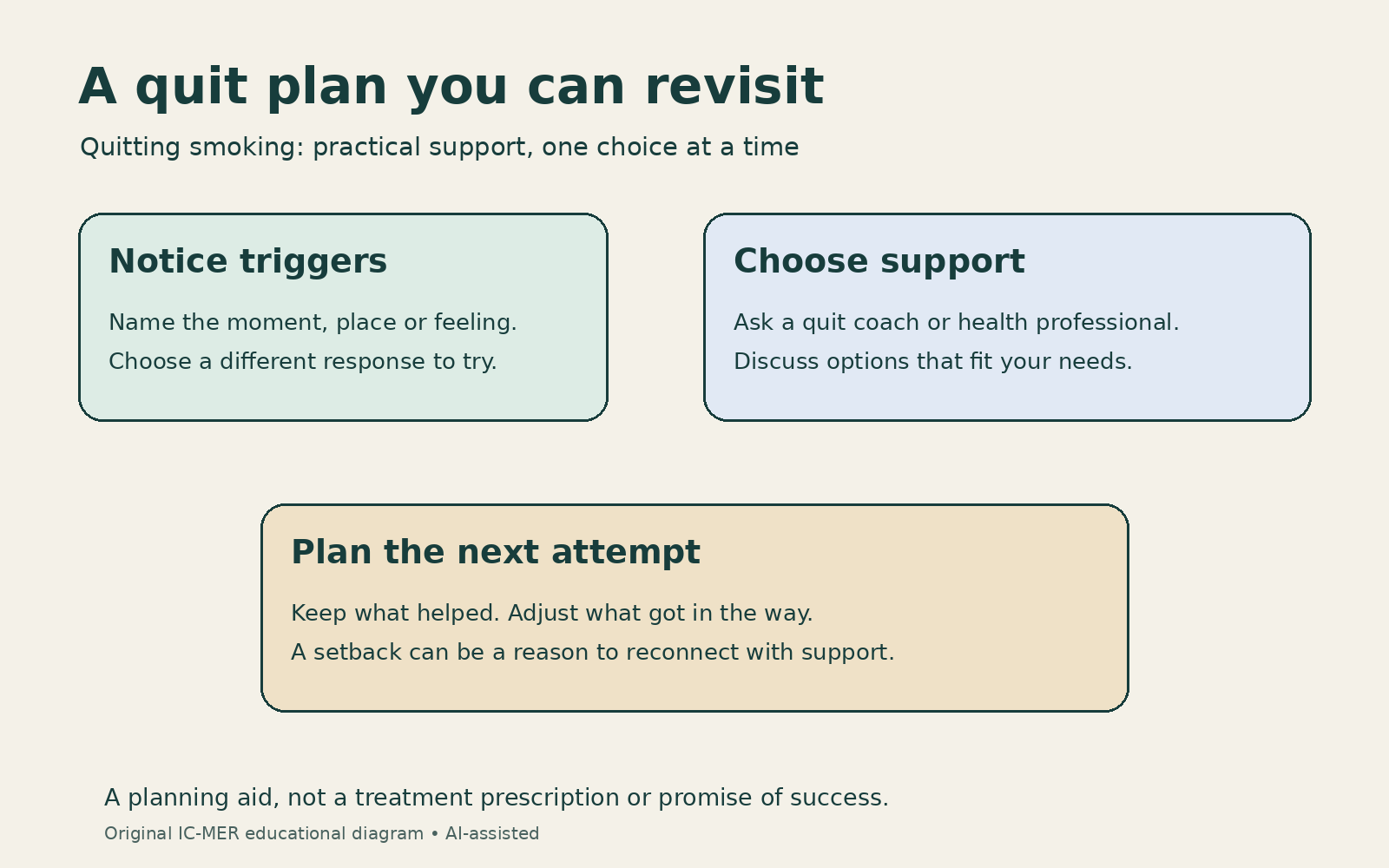
AI-assisted general education, not personalized medical advice or human clinical review. Discuss quitting treatments and medicine safety with a qualified healthcare professional, especially during pregnancy or breastfeeding. Follow product instructions and urgent safety advice.
Information may contain errors, omissions or outdated guidance. This article is general education, not individual medical or other professional advice. Verify important information before acting and consult an appropriately qualified professional. Never disregard medical advice, delay care or change treatment because of this article. See our accuracy disclaimer and terms.
Start with support, not a test of character
Quitting smoking can mean changing a familiar part of the day as well as managing nicotine dependence. A cigarette may be linked to the drive to work, the end of a meal or a conversation with a friend. Finding those connections gives you something practical to plan for. Difficulty quitting is not proof that you do not care about your health.
CDC recommends counseling and medication together as the approach that gives people who smoke the best chance of quitting. A healthcare professional can help you decide which treatment fits your situation. Support does not have to look the same for everyone: a private telephone conversation may be easier to arrange than a group meeting.
Start by writing a reason that matters to you in ordinary language. Perhaps you want fewer interruptions to family time or to stop arranging breaks around cigarettes. This personal note is not a medical outcome measure. It is something you can return to when the next step feels inconvenient or an earlier attempt makes you doubt yourself.
Sources: [1]
Look at the moments when you usually smoke
A trigger is a situation, feeling or cue associated with smoking. Nicotine withdrawal can also bring cravings. The National Cancer Institute explains that urges can recur even well after quitting; there is no single timetable that describes everyone's experience. Understanding that possibility can keep an unexpected craving from becoming a judgment about your progress.
An original planning exercise is to note a few smoking occasions without trying to create a perfect diary: where you were, what happened immediately beforehand and what you needed at that moment. Keep the note somewhere private if you prefer. You are looking for a manageable problem, not producing a score for someone else.
For example, a person who smokes during a work break might discover that the break also provides company and a chance to step away from a noisy room. Simply removing the break leaves those needs unanswered. A different place to sit or an agreed walk with a colleague could be part of a practical replacement. This is a hypothetical example, not a tested program.
Sources: [5]
Make your first support conversation useful
In the United States, 1-800-QUIT-NOW connects people with free, confidential quitline coaching. CDC also points to Smokefree.gov for online help. Ask what the service offers and how follow-up works. Do not assume that every program includes free medicines or that your insurance covers every option; confirm the details that apply to you.
Before a clinician or pharmacist conversation, collect your medication list and describe previous attempts honestly. What helped? What was unpleasant? Was a product difficult to use at work, or did you run out? Mention pregnancy or breastfeeding, existing health conditions and previous mood symptoms. FDA advises discussing medicine benefits, risks and possible effects on other medicines.
A short question list can make the appointment more useful: What are my options? How do I use the chosen product? What side effects need attention? Who should I contact if it is not working for me? Write down the answer in your own words and ask for clarification rather than leaving with instructions you cannot confidently follow.
Understand what medicines can and cannot do
Nicotine replacement options include patches, gum and lozenges. Prescription medicines such as varenicline or bupropion are other options to discuss with a clinician. These treatments can help with withdrawal and cravings; they do not remove the need to plan for situations in which you usually smoke. This article does not choose a product or dose for you.
FDA advises reading the product label and, for prescription products, the Medication Guide. Different products have different instructions. Ask a pharmacist to explain the actual item you will use, including how to store it and what to do about side effects. Pregnancy and breastfeeding require individualized advice rather than copying another person's quit plan.
Do not borrow someone else's prescription or change other prescribed medicines yourself. Tell your healthcare team when you quit so they can consider whether your existing treatment needs review. Seek prompt professional advice about new or worsening mood or behavior changes, and follow the product's urgent safety instructions. These concerns deserve attention rather than being dismissed as something you must simply endure.
Prepare a response for a difficult craving
Smokefree suggests having several responses available, such as contacting a supportive person, changing activity, taking a walk or using slow breathing. An urge can feel demanding without requiring you to act on it. The point of a prepared response is to give yourself an alternative in that moment, not to promise that one technique works every time.
Choose an option you can actually use where the craving happens. A walk outdoors may be impractical during a shift, while a brief change of task or a message during an allowed break may fit. If a proposed replacement would be unsafe or conflict with work duties, choose something else with your counselor. A plan should reflect your life.
Try writing a simple sentence: When I finish lunch, I will move to the smoke-free sitting area and contact my support person if needed. This is an example of planning, not a treatment prescription. Keep the supplies or contact details easy to reach. An elaborate plan hidden in a drawer may be less useful than one clear action you remember.
Sources: [3]
Ask other people for a specific kind of help
Counseling can help with stress and urges, while friends or family can provide day-to-day encouragement. Those are different roles. You do not need a relative to become your clinician, and a well-meaning friend should not decide which medicine you take. Explain what would help without making another person responsible for whether you quit.
Consider a direct request: Please do not offer me cigarettes, or please join me for a different break. If reminders feel like criticism, say what tone you would find more helpful. Another person may not understand why a familiar social routine is difficult to change until you explain the particular situation.
Decide how much you want to share. You might tell one trusted person before making a wider announcement. If people around you smoke, discuss how to avoid being offered cigarettes and where you can spend time together without smoking. These are practical conversation suggestions; they are not a claim that social support alone replaces professional treatment.
Use a setback to revise the plan
Smoking after a quit attempt does not erase what you learned. Smokefree encourages people to identify what led to the setback, use what worked before and return to the goal of not smoking. Repeated attempts are common. A lapse is a reason to reconnect with support, not a reason to conclude that treatment cannot help you.
Review the event with curiosity: Was the usual support person unavailable? Did an unexpected situation catch you without a plan? Were medicine instructions unclear? Pick the specific problem you can address next. Avoid turning the review into a list of personal faults or assuming that every difficulty has the same cause.
A fictional example is someone who stayed smoke-free at home but struggled at a gathering. For the next gathering, they could arrange a supportive companion, choose a smoke-free meeting place or discuss the situation with a counselor beforehand. The revised plan is a proposal, not a guarantee. If you have returned to regular smoking, seek help with another attempt promptly.
Sources: [4]
Choose one useful next step today
You do not need to solve every future craving before asking for help. Choose a concrete next step: save the quitline number, arrange a healthcare conversation or write down the situation you most want help managing. Then decide when you will do it. A specific appointment or reminder can make the intention easier to act on.
Keep room for ordinary needs while you prepare. If sleep, stress or withdrawal symptoms are becoming difficult to manage, bring them to your healthcare professional instead of assuming that suffering silently is required. NCI describes variation in withdrawal symptoms and their duration. Your experience deserves attention even if it differs from someone else's.
At the end of the week, ask what support you used and what you need next, rather than grading yourself against an invented perfect journey. Keep helpful contacts accessible and revisit unclear instructions. The aim is a workable route toward stopping smoking, with qualified help where needed and permission to improve the plan as you learn.
Sources & further reading
- CDC: How to Quit SmokingChecked 2026-10-25
- FDA: Smoking—Medicines To Help You QuitChecked 2026-10-25
- Smokefree: How to Manage CravingsChecked 2026-10-25
- Smokefree: Get Back on Track After a SetbackChecked 2026-10-25
- NCI: Tips for Coping with Nicotine Withdrawal and TriggersChecked 2026-10-25
About this article
Prepared with AI assistance and an AI fact-checking pass against the sources listed above. No human clinical review is claimed. Evidence may change; consult appropriate qualified professionals for decisions about your circumstances.
Spotted a problem? Suggest a correction.