Medicine · 4 min read
Surrogate endpoints versus outcomes that matter to patients
An improved marker can be useful evidence without yet proving the benefit a patient wants.
Educational research-literacy information, prepared with AI assistance, not individual medical advice or a recommendation to start or stop treatment. Hypothetical examples are not clinical findings.
Information may contain errors, omissions or outdated guidance. This article is general education, not individual medical or other professional advice. Verify important information before acting and consult an appropriately qualified professional. Never disregard medical advice, delay care or change treatment because of this article. See our accuracy disclaimer and terms.
Identify the outcome before judging the headline
A trial can report an encouraging change without yet showing the benefit a patient most wants. Start by asking exactly what was measured, in whom, and after how long. An endpoint turns a research question into a specified measurement. A laboratory result, a symptom score and time alive answer different questions, even when a headline describes each as a treatment “working.”
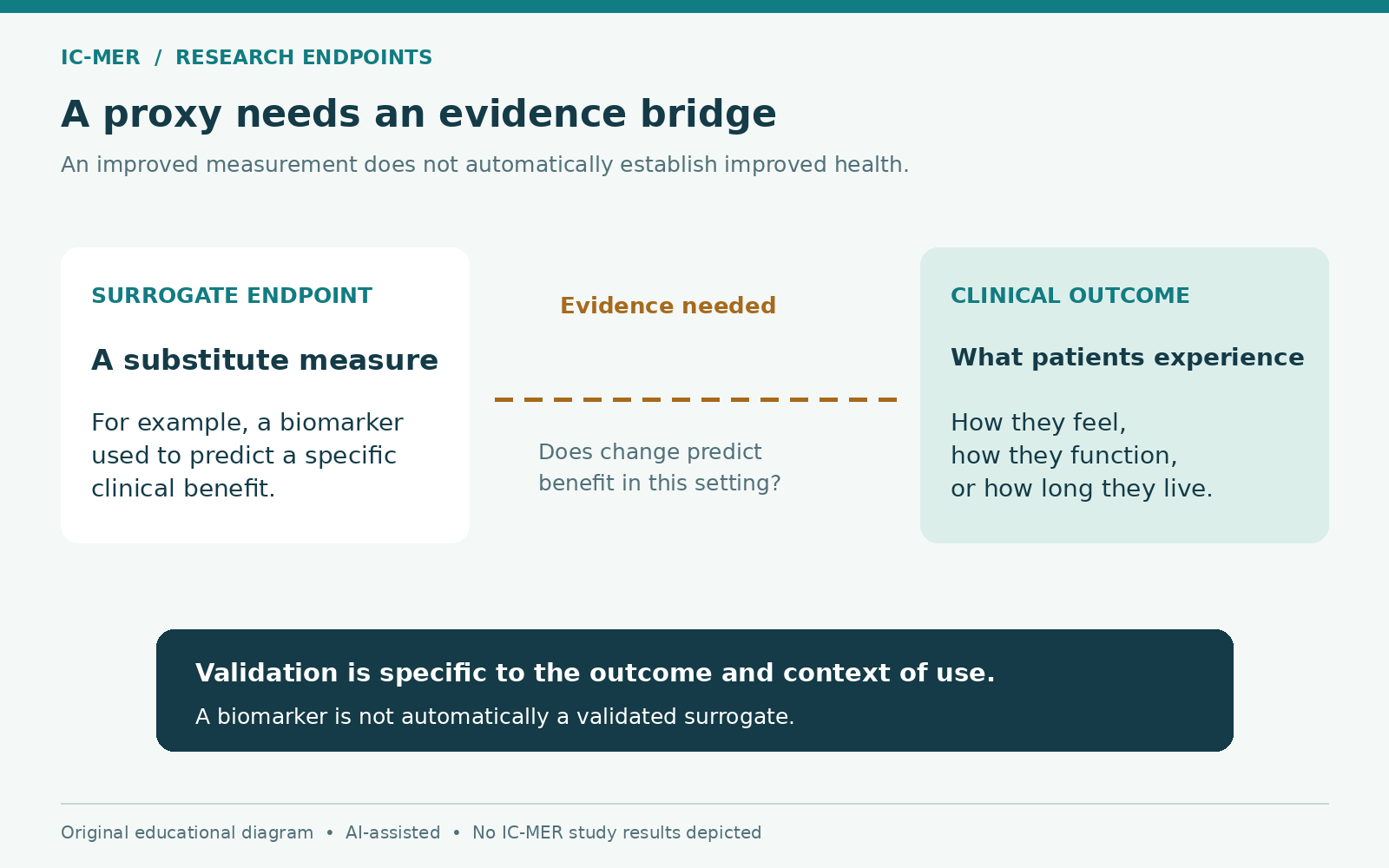
FDA distinguishes surrogate endpoints from direct measures of clinical benefit. A surrogate stands in for an outcome of interest because investigators expect it to predict that outcome. It is evidence about a proposed route to benefit, rather than automatically being the benefit itself. This distinction is useful when reading an abstract or discussing a trial with its research team.
Sources: [1]
A marker and a patient experience are different evidence
Clinical outcome assessments can draw on patients’ reports, clinicians’ assessments, observers’ reports or performance of a task. FDA describes these measures in relation to patients’ symptoms, functioning and survival. A patient report is therefore not inherently less relevant than a laboratory number: its usefulness depends on what is being measured and whether the instrument is suitable for its purpose.
Imagine a fictional trial in which a blood marker improves after eight weeks. The practical question might be whether people can walk to the shops more comfortably. Record those as separate entries: “marker improved” and “daily function not yet established.” That simple two-column note prevents a change in one measurement from silently becoming a claim about another. These are illustrative outcomes, not findings about a particular drug.
Sources: [2]
Ask how well the proxy has been established
FDA distinguishes candidate, reasonably likely and validated surrogate endpoints. A candidate is still being evaluated. A validated surrogate has mechanistic and clinical evidence supporting its ability to predict a specified benefit. A reasonably likely surrogate has a supporting rationale but less clinical confirmation. These labels describe different levels of support; they should not be treated as interchangeable.
Acceptance also depends on context. FDA’s surrogate table specifically cautions against transferring a surrogate from one development program to another without considering the disease, population, treatment mechanism and available therapies. Finding a familiar marker in the table is a starting point for investigation, not permission to assume that any treatment changing that marker helps any patient.
Why earlier answers can still be valuable
Waiting for a clinical outcome can take time. A useful earlier measurement can help researchers investigate promising treatments and, in defined circumstances, support earlier regulatory approval. The tradeoff is that an earlier answer may leave a more consequential question unresolved. Readers should look for that uncertainty to be stated openly.
Under FDA’s Accelerated Approval Program, drugs for serious conditions addressing an unmet need may be approved on a surrogate endpoint. Confirmatory studies are still required to establish the anticipated clinical benefit. Failure to confirm benefit can lead to regulatory action, including withdrawal. Approval based on a surrogate should therefore prompt a question about confirmatory evidence and its current status, rather than an assumption that every clinical question is settled.
Sources: [4]
Keep a favorable result in proportion
FDA’s table notes that a surrogate previously used for accelerated approval is no longer accepted for that use when subsequent confirmatory trials fail to show the expected clinical benefit. The lesson is specific: the evidence supporting a proxy can change. Do not convert a favorable marker result into a blanket promise about longer life or better health.
In the fictional example, an accurate summary would be: “The study found improvement in the blood marker over eight weeks; this summary does not establish improved walking ability.” If symptoms or adverse effects were also measured, report those separately. Combining the results into one word such as “success” makes it harder to see what the study actually resolved.
Sources: [3]
Questions to take to the original report
Use this reading worksheet: name the primary endpoint; describe what a change means in everyday terms; identify whether it is direct or surrogate; note the exact population and follow-up; and find the evidence connecting a surrogate change to the claimed benefit. Then list the clinical outcomes that remain unanswered.
For a treatment discussion, add two questions for the clinician or research team: what benefits and burdens matter in this situation, and which of them were actually assessed? Keep the original article, study registration and any follow-up report together. A carefully limited conclusion is more useful than a confident headline that answers a different question.
Sources & further reading
- Surrogate Endpoint Resources for Drug and Biologic DevelopmentChecked 2026-10-21
- Clinical Outcome Assessment (COA): Frequently Asked QuestionsChecked 2026-10-21
- Table of Surrogate Endpoints That Were the Basis of Drug Approval or LicensureChecked 2026-10-21
- Accelerated Approval ProgramChecked 2026-10-21
About this article
Prepared with AI assistance and an AI fact-checking pass against the sources listed above. No human clinical review is claimed. Evidence may change; consult appropriate qualified professionals for decisions about your circumstances.
Spotted a problem? Suggest a correction.