Environment · 10 min read
Using household cleaning products safely
A cleaner home does not require a stronger mixture. Start with the task, use the right instructions, and finish with safe storage.
Prepared with AI assistance for general household education, not individualized medical advice or human clinical review. Follow the exact product label and local disposal requirements. For a serious exposure emergency call 911 in the United States; for poison guidance call 1-800-222-1222. Use local services elsewhere.
Information may contain errors, omissions or outdated guidance. This article is general education, not individual medical or other professional advice. Verify important information before acting and consult an appropriately qualified professional. Never disregard medical advice, delay care or change treatment because of this article. See our accuracy disclaimer and terms.
Start with the job, not the strongest bottle
A crowded cleaning cupboard can make a simple job unnecessarily confusing. One bottle promises shine, another removes scale, and a third advertises disinfection. Before choosing anything, name the task: removing food residue, cleaning a bathroom surface, washing a floor, or responding to illness. Those jobs do not automatically need the same product.
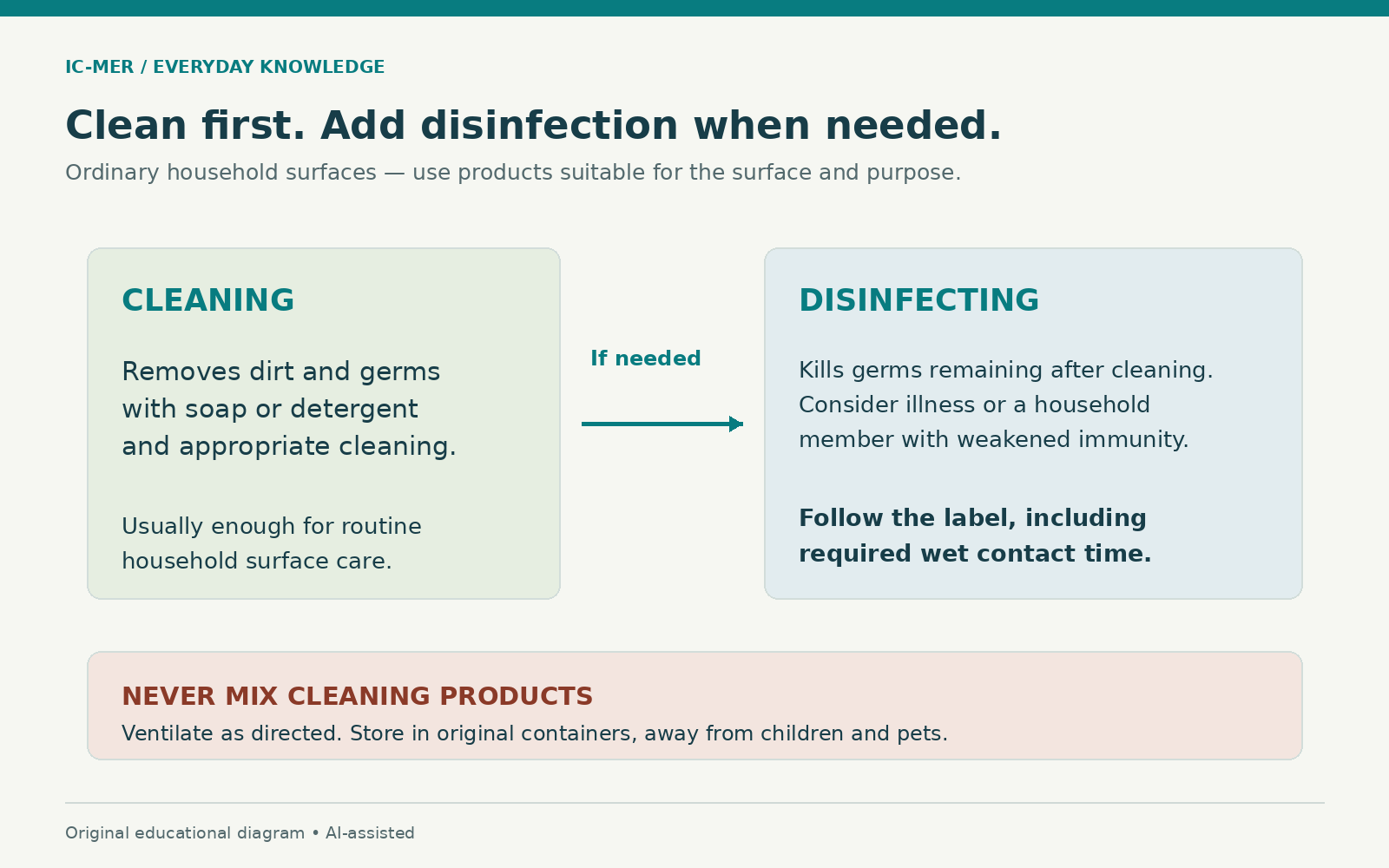
For ordinary household messes, cleaning with an appropriate soap or detergent is often enough. CDC distinguishes this routine from disinfection, which may be needed when someone is sick or has a weakened immune system. A household member with particular infection risks may need advice from their healthcare team about a suitable routine.
Make the first decision small. Choose one surface, check what it is made of, and find the product instructions for that use. An organized approach is easier to repeat than a collection of extra sprays added because a surface does not yet smell sufficiently clean.
Sources: [1]
Know what the product is meant to do
Cleaning removes dirt and organic material. A surface sanitizer and a disinfectant make different germ-control claims; the words are not interchangeable. EPA explains that surface sanitizers target bacteria, while disinfectants can target bacteria and viruses. A single product may have more than one use, with different directions for each.
Read the section that matches your intended task rather than applying whichever instructions appear first. An all-purpose cleaner is not automatically a disinfectant. Likewise, a disinfectant label does not mean that the bottle is suitable for every material, every germ, or every object in your home.
This matters when sharing chores. If one person says “clean the counter,” explain whether ordinary cleaning is sufficient or whether there is a specific reason to sanitize or disinfect. A clear task prevents someone from reaching for a stronger product simply because the instructions were vague.
Sources: [6]
Read the working instructions before opening
Set the bottle where you can read the whole label in good light. Locate the intended surfaces, any preparation or dilution directions, required protective equipment, and warnings. For bleach, CDC specifically advises following the bottle directions and checking whether gloves or eye protection are needed. Different products should not be treated as interchangeable recipes.
A useful household habit is to read the label before buying a replacement, even when the brand looks familiar. Check that the container actually fits your planned task and that you can follow the instructions with the equipment and space you have. A large economical container is not helpful if it creates a preparation task you cannot manage safely.
If the directions are unreadable or unclear, pause. Use the manufacturer’s contact information to clarify the intended use, or choose an appropriate product with instructions you can understand. Guessing from another bottle or an online cleaning trick defeats the purpose of the label.
Sources: [2]
Never combine cleaning products
Do not mix household cleaners. Poison Control warns that combinations can release poisonous fumes and cause serious breathing problems. Bleach combined with an acid-containing cleaner can produce irritating chlorine fumes; bleach and ammonia can produce chloramine gas. You do not need to identify every possible reaction to follow the safer rule: do not combine products.
This includes improvising with vinegar, adding a second cleaner to a bucket, or pouring another product into a drain because the first did not work. An apparently simple household ingredient is still a substance that can react with another product. “Natural” is not permission to mix.
Tell anyone sharing the work which product is already in use. If you do not know what someone has applied, stop before adding anything. Keep the original container available so that a family member, cleaner, plumber, or poison specialist can identify the product when necessary.
Sources: [3]
Prepare the room before the chore
Poison Control advises ventilation during cleaning, particularly in small spaces such as bathrooms. It also recommends keeping children and pets out of the area where cleaners are being used when possible. Plan those arrangements before you have an open container or a wet floor to supervise.
For example, choose a time when another adult can keep a young child occupied elsewhere, clear the path to the room, and gather the cleaning tools first. If a task repeatedly gets interrupted, break it into smaller jobs that can be finished and put away separately. These are practical planning options, not a prescribed cleaning schedule.
Avoid setting aerosol containers near heat sources. A stove or sunny windowsill is not a convenient temporary storage spot. Choose a stable place for the product while working, and put it back promptly when the task is done rather than leaving it ready for an uncertain later round.
Sources: [3]
Use the amount and method specified
More product is not a substitute for following directions. When a product must be diluted, use the instructions for that exact product and intended use. A ready-to-use product and a concentrate create different tasks. This guide intentionally gives no universal bleach or disinfectant dilution recipe.
Before preparing a solution, decide whether you have a suitable container, a clear label, and a way to measure the instructed amounts. Do not work from memory while answering the phone or supervising another task. If you are interrupted and no longer know what you added, do not try to correct the mixture by guessing.
CDC notes that diluted bleach loses effectiveness over time and calls for a fresh solution daily. That does not establish a storage rule for every other cleaner: follow each product’s directions. Preparing only what the task requires can make the end-of-job cleanup and storage decisions simpler.
Sources: [2]
Give disinfection its required time
When disinfection is appropriate, the application instructions matter as much as the product name. EPA emphasizes contact time: the period for which the surface must remain wet. Spraying and immediately wiping dry may not achieve the disinfecting action described on the label. Clean the surface first, then disinfect if needed, following the product label.
Plan the task around that interval. A timer can help you avoid confusing “I sprayed it” with “I completed the directions.” Keep people from using the area while you finish the required process, and follow any instructions about rinsing or allowing it to dry afterward. Do not invent a contact time that applies to every bottle.
If the needed wet period is impractical for a particular material or household routine, choose another appropriate method or product with directions you can follow. The answer is not to shorten the label time or add an extra chemical in the hope of making it work faster.
Give kitchens and personal items special attention
Check that a product is suitable for the particular object, including food-contact surfaces. Cleaning a floor and cleaning a cutting board are different uses. Follow any product requirements for rinsing and the item manufacturer’s instructions. Do not assume a bathroom spray is appropriate for dishes, infant feeding items, or toys.
CDC advises cleaning and then sanitizing surfaces contaminated by raw meat, poultry, or their juices. That specific food-safety situation is different from automatically disinfecting every kitchen surface throughout the day. For electronics, follow the equipment manufacturer’s recommendations rather than borrowing a method intended for a countertop.
Keep household surface disinfectants away from bodies: they are not for swallowing, applying to skin, or bathing pets. If you are trying to solve a skin problem or clean an animal, use advice and products intended for that purpose. A surface-cleaning claim does not establish safe personal use.
Sources: [1]
Consider who shares the home
Some cleaning and disinfecting products can trigger asthma. Someone who develops symptoms around a particular chore should not simply push through it to finish. Discuss recurring problems with a healthcare professional and review the products and methods involved. Breathing difficulty after an exposure needs prompt attention, as described below.
For everyday planning, ask household members what makes cleaning difficult: a small bathroom, a poorly timed chore, or products left where a child can reach them. Write down the practical obstacle rather than assuming everyone will remember an informal warning. Visitors and temporary caregivers also need to know where products belong.
If the household includes someone with special infection-control needs, ask their care team for instructions that fit that person’s circumstances. Avoid using a general article to either dismiss those needs or create a demanding routine for everyone. The useful plan is specific enough to follow and clear enough to share.
Sources: [1]
Make storage part of finishing
Keep hazardous household products in their original containers with labels intact; never put them in food or drink containers. EPA also warns that even empty containers can retain hazardous residues. An attractive unmarked dispenser can remove the very information needed to prevent or respond to an exposure.
Choose storage that matches the label and prevents access by children and pets. Check that caps are properly closed before returning containers. Treat the last few minutes of a chore as part of the job: put products away, clean up the working area, and account for any solution you prepared.
A practical cupboard review can start without opening bottles. Identify duplicates, products with damaged labels, and items you no longer need. Do not consolidate leftovers into one container to create space. If a container is corroding or unsafe to handle, seek local hazardous-materials guidance rather than transferring its contents on your own.
Sources: [7]
Shop for a useful routine, not a bigger collection
EPA’s Safer Choice program helps shoppers identify products that meet its criteria for safer ingredients and performance. It can be a useful starting point when comparing cleaning products. It is not a reason to ignore directions, treat a product as edible, or assume that any mixture containing it is safe.
Before adding a new bottle, ask what current task it will perform. Is it replacing a product, filling a real gap, or simply repeating a claim already covered by something you own? Compare the usable amount, storage space, and preparation required rather than focusing only on container size or fragrance.
Keep a short shopping note with the product type and intended surface. That can help another household member buy a suitable replacement without copying the color of a package. If you change products, review the new directions together instead of silently carrying over an old method.
Sources: [5]
Dispose of leftovers deliberately
Some leftover cleaners qualify as household hazardous waste because they can be toxic, corrosive, flammable, or reactive. Follow label disposal directions and consult the local solid-waste, environmental, or health agency about accepted materials and collection options. Do not assume that a drain, storm sewer, the ground, or ordinary trash is suitable.
Keep unwanted products separate. Combining leftovers can create a reaction and can also make the resulting waste harder to manage. If a collection program requires an appointment or has particular packaging instructions, check those before transporting anything. This article does not establish the current rules for a specific Florida collection site.
Put disposal on an actual household task list rather than leaving an unidentified box for the next person to solve. Record the agency’s instructions and the product names. Buying only what you can reasonably use can also reduce the number of partially used containers waiting for disposal.
Sources: [7]
Respond promptly to an exposure
In the United States, call 911 immediately if someone collapses, has a seizure, has trouble breathing, or cannot be awakened. For other suspected poison exposures, contact Poison Control at 1-800-222-1222 for situation-specific help. Outside the United States, use local emergency and poison-information services.
For inhaled fumes, move to fresh air and stay away from the contaminated area; do not re-enter a dangerous space to retrieve a bottle. For an eye splash, begin rinsing immediately with plenty of room-temperature water for at least 15–20 minutes and remove contact lenses. For skin exposure, remove contaminated clothing and rinse with running water for at least 15 minutes.
Do not induce vomiting after swallowing a product. Obtain expert guidance promptly, including during or after first aid. Have the product name, exposure route, approximate amount and time available if you can obtain them safely. Do not delay urgent care while searching for those details, and do not try to neutralize a chemical with another household substance.
Sources: [4]
Build a simple routine you can repeat
Try organizing the next cleaning job into three short stages. Before starting, identify the surface and task, read the directions, gather the needed equipment, and arrange the room. During the job, use the selected product as directed without combining it with other cleaners. Afterward, finish the label steps and return everything to its proper place.
A shared note can be more useful than a complicated chart: “This is the product for this surface; these are the instructions; this is where it belongs.” Keep the actual label available. The note should help someone locate the directions, not replace them with an abbreviated homemade formula.
Review the arrangement after a real chore. If the bottle is hard to read, the cupboard is too crowded, or interruptions make preparation confusing, solve that practical problem before the next cleaning day. A safer household routine depends on clear choices and manageable steps, not on having the most products or making every surface smell strongly of cleaner.
Sources: [3]
Sources & further reading
- CDC: When and How to Clean and Disinfect Your HomeChecked 2026-10-25
- CDC: Cleaning and Disinfecting with BleachChecked 2026-10-25
- National Capital Poison Center: Top tips for a safe spring cleaningChecked 2026-10-25
- National Capital Poison Center: First aid guidelinesChecked 2026-10-25
- EPA: Safer ChoiceChecked 2026-10-25
- EPA: Difference between disinfecting, sanitizing and cleaning surfacesChecked 2026-10-25
- EPA: Household Hazardous WasteChecked 2026-10-25
About this article
Prepared with AI assistance and an AI fact-checking pass against the sources listed above. No human clinical review is claimed. Evidence may change; consult appropriate qualified professionals for decisions about your circumstances.
Spotted a problem? Suggest a correction.