Environment · 7 min read
Saving water at home without expensive upgrades
Start with the water you can avoid wasting: an unnoticed leak, a running tap or an outdoor watering routine that no longer fits the weather.
AI-assisted educational content, checked against the listed official sources on 24 October 2026. Numerical examples are hypothetical. Follow current local water advisories and restrictions, appliance instructions and property requirements. Obtain qualified help for repairs beyond your knowledge or authority.
Information may contain errors, omissions or outdated guidance. This article is general education, not individual medical or other professional advice. Verify important information before acting and consult an appropriately qualified professional. Never disregard medical advice, delay care or change treatment because of this article. See our accuracy disclaimer and terms.
Start with a small household investigation
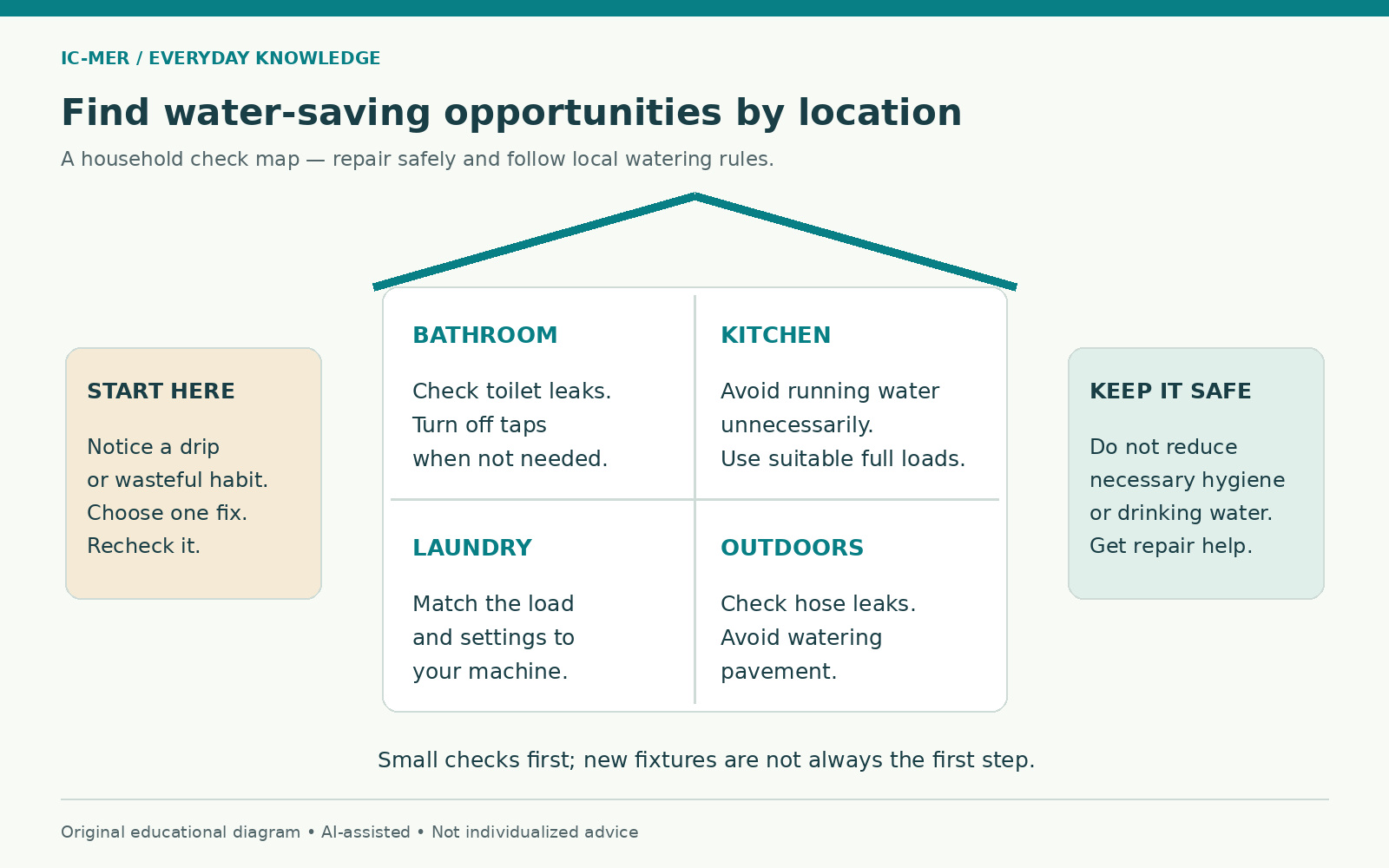
Saving water does not have to begin with replacing a toilet, buying appliances or redesigning a garden. Start by finding where water is being used without doing a useful job. That might be a toilet that runs between flushes, a tap left flowing while you walk away, or a sprinkler wetting the pavement instead of a plant.
Choose one week to observe your household routines. Note a few things you can change, one possible maintenance issue and any question for the water utility or landlord. You are gathering useful clues, not measuring every sip or making household members compete.
Keep essential hygiene, safe food preparation and drinking needs intact. This article focuses on avoidable waste and practical maintenance. It does not recommend reducing necessary handwashing, restricting drinking water or improvising water treatment. If there is a boil-water notice or other local advisory, follow the responsible authority’s instructions; conservation habits do not replace safety guidance.
Read the water-use figure before judging the bill
Find the amount of water used and the number of days in the billing period. Confirm the units rather than assuming every utility bills in gallons. Compare periods with similar weather and household occupancy when possible. A bill with extra days or visiting family is not a fair comparison with a shorter, quieter month.
For a fictional example, 3,000 gallons over 30 days equals 100 gallons per day for the entire household. A later 3,360-gallon bill covering 28 days equals 120 gallons per day. The second total is only part of the story: the daily average rose by 20 gallons. These are illustrative numbers, not household targets or measured results.
EPA explains that many bills combine fixed charges with charges based on water volume. Saving water therefore does not mean the entire bill falls by the same percentage. Read your own rate information and look for unexplained changes in use. A consumption trend is a better starting point for investigating waste than the total dollar amount alone.
Sources: [4]
Look for leaks that are easy to overlook
Check places you can safely see: beneath sinks, around accessible fixtures and near outdoor taps. Listen for a toilet refilling when nobody has flushed it. A recurring wet patch or unexplained rise in use deserves attention even if you cannot locate the cause. Report it to the property manager, utility or a qualified plumber as appropriate.
EPA suggests comparing water-meter readings over a two-hour period when no water is being used. Account for automatic irrigation and appliances before interpreting a change. Follow the utility’s instructions for reading your meter; do not force covers or operate unfamiliar valves. A moving reading can indicate a leak, but it is a clue to investigate rather than a diagnosis of its location.
For a conventional toilet tank, EPA describes adding a few drops of food coloring and checking the bowl after ten minutes. Color appearing in the bowl suggests a leak. Flush promptly afterward to avoid staining. Follow fixture instructions and ask for help if you are unsure; there is no need to dismantle unfamiliar equipment to begin investigating.
Sources: [2]
Make kitchen habits easier to repeat
EPA recommends running the dishwasher when full, scraping plates instead of pre-rinsing them, and using a basin rather than a constantly running tap for handwashing dishes. Follow the appliance instructions for loading and cleaning performance. A full load should still allow the machine to do its job; tightly packing items that need washing again defeats the purpose.
Keep a covered pitcher of drinking water in the refrigerator if you currently run the tap just to obtain a cold drink. Plan frozen food ahead so it can thaw in the refrigerator instead of using running hot water. These are simple routine changes, not reasons to take shortcuts with cleaning or food safety.
Choose the habit that fits your kitchen. If washing by hand is your only option, set up the space so utensils and dishes can be washed efficiently. If somebody needs a different routine because of a disability or other practical need, adapt the plan around that. The useful question is where water can be saved without making an ordinary task harder to complete safely.
Sources: [1]
Find a bathroom change that is comfortable and realistic
Turning off the tap while brushing teeth or shaving avoids running water during moments when you are not using it. EPA also advises keeping showers brief. Rather than treating a particular shower length as a universal rule, notice whether water runs while you fetch towels, choose products or do another task.
A simple household experiment is to gather what you need before turning on the shower and then notice whether the routine becomes shorter. You do not need a new device or a competitive stopwatch. Consider the needs of children, older adults and anyone who requires assistance; an efficient routine should still be comfortable and safe.
If the shower or tap drips after being turned off normally, add it to the maintenance list. Avoid repeatedly forcing the handle tighter. Keep leak repair and ordinary conservation habits as separate actions: a shorter shower will not repair a faulty fitting. In a rental, describe the location and pattern of the problem clearly so the person responsible can arrange appropriate work.
Sources: [1]
Let outdoor watering respond to actual conditions
A timer can keep repeating an old routine after the weather or season changes. Review what is being watered and whether the water reaches it. EPA recommends checking local guidance because plant needs, climate and watering rules vary. There is no single schedule in this article that fits every Florida yard or every household.
Watch an irrigation cycle if you can do so safely. Note water spraying a sidewalk, pooling or running off before it soaks in. Check settings after rain and when seasons change. Follow local restrictions and seek advice from your utility or extension service about suitable timing and plant needs rather than automatically adding more minutes.
For small areas, think about whether you can target the plants that actually need water. Sweep hard surfaces when that can accomplish the cleaning task instead of reaching for a hose. If you rent or live in a managed community, report broken or misdirected irrigation to the responsible person. Do not alter shared equipment without authorization.
Make a repair list before a shopping list
You may discover a problem that does require a part or professional work. Record the symptom, when it happens and any relevant meter or bill information. Distinguish an urgent leak from a future efficiency improvement. A visible active leak or water threatening electrical equipment calls for prompt appropriate help, not a month-long conservation experiment.
For a nonurgent improvement, check whether the utility offers advice, repair guidance or a relevant assistance program. Availability and eligibility vary, so verify the actual local terms. Do not assume a rebate exists or buy a product first expecting reimbursement. A renter can ask the landlord about approved repairs and responsibility for costs.
There is no need to replace every working fixture at once to begin. Review what the observation week revealed and prioritize the issue with the clearest evidence of waste. If you later choose an upgrade, compare suitable products and installation requirements separately. An expensive purchase should answer an identified need rather than substitute for finding the source of unusually high use.
Check whether the changes helped
Keep a short note of what you changed and when: reported a running toilet, stopped unnecessary pre-rinsing, adjusted outdoor watering after local guidance. On the next bill, compare water use per billing day and consider weather, travel and visitors. One lower bill cannot prove which individual habit caused the difference.
If use remains unexpectedly high, revisit the leak question and ask the utility how the meter reading and billing period were determined. If use falls, keep the manageable changes rather than adding a complicated new set of rules. A household may save water without seeing a dramatic change in the total bill because some charges do not depend on volume.
Choose a small next step that you can complete today: read the consumption line on the bill, listen for a running toilet or agree on one kitchen habit. Repeat the check when seasons or household circumstances change. Useful conservation starts with noticing avoidable waste and making the response easy enough to continue.
Sources: [4]
Sources & further reading
- U.S. Environmental Protection Agency: Start SavingChecked 2026-10-24
- U.S. Environmental Protection Agency: Fix a Leak WeekChecked 2026-10-24
- U.S. Environmental Protection Agency: Watering TipsChecked 2026-10-24
- U.S. Environmental Protection Agency: Understanding Your Water BillChecked 2026-10-24
About this article
Prepared with AI assistance and an AI fact-checking pass against the sources listed above. No human clinical review is claimed. Evidence may change; consult appropriate qualified professionals for decisions about your circumstances.
Spotted a problem? Suggest a correction.